| Hey | Welcome to AlphaSignal, the most read source of news by AI engineers and researchers.
Every day, we identify and summarize the top 1% of news, papers, models, and repos, so you’re always up to date.
Here’s today’s roundup: |
|
|
|
Top News
| | Alibaba releases smaller Qwen3-VL models requiring less VRAM while retaining full vision-language capabilities
|
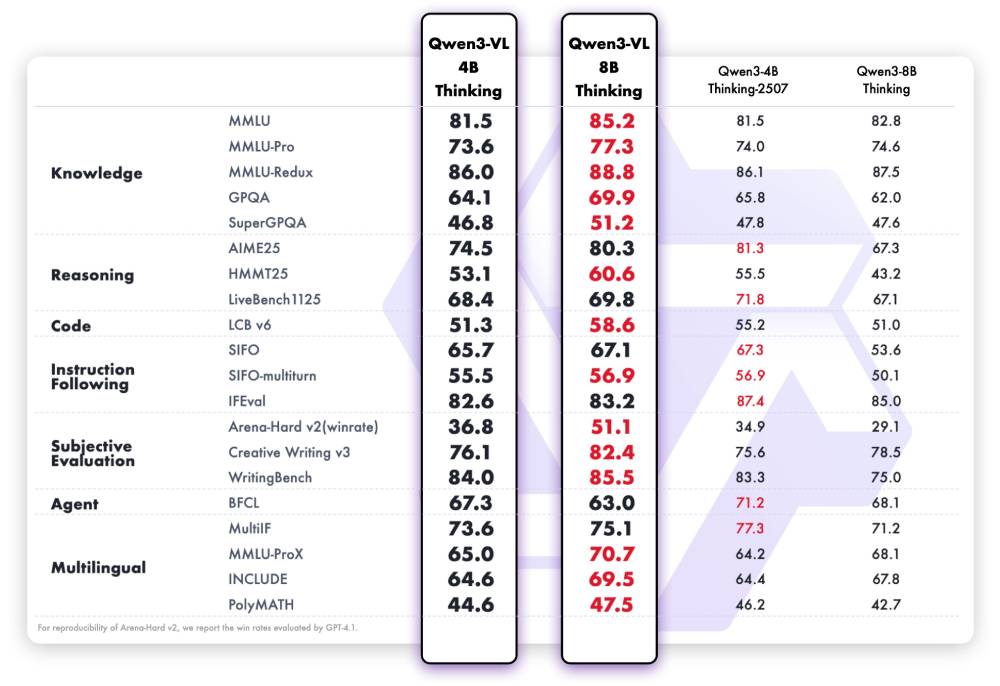
| Alibaba introduced Qwen3-VL 4B and 8B, compact dense vision-language models available in Instruct and Thinking variants. They require less VRAM, include FP8 versions for efficient deployment, and retain full vision-language capability.
Key Features
Sizes: 4B and 8B parameters. Modes: Instruct for following tasks, Thinking for multi-step reasoning. Multimodal coverage: text, images, video, OCR, spatial grounding, agents. FP8 deployment options are also supported for efficiency. Model Architecture
Dense Transformer backbone with rotary embeddings for long-sequence handling. Multi-Query Attention (MQA) for lower memory use and faster inference. Bias-free linear layers and parameter-free RMSNorm for efficiency. ReLU² activation in MLPs and logit softcap for stable training. Benchmark Performance
Qwen3-VL-8B often beats Gemini 2.5 Flash-Lite and GPT-5 Nano, and even rivals Qwen2.5-VL-72B in several areas despite its small size. STEM: Matches or surpasses Gemini 2.5 Flash Lite and GPT-5 Nano on math and science tasks. VQA: Strong results in visual question answering with consistent accuracy gains. OCR: Handles text extraction from images with high reliability. Video: Solid performance on video understanding and temporal reasoning. Agents: Excels at multi-step reasoning and tool-use benchmarks, often rivaling Qwen2.5-VL-72B. Access & Availability
Models released on Hugging Face: Qwen3-VL-4B-Instruct, Qwen3-VL-4B-Thinking, Qwen3-VL-8B-Instruct, Qwen3-VL-8B-Thinking. Available for research and deployment with FP8 options for efficiency. | |
| Try now
|
|
|
|

| Get 2-5× Faster On-Device Reasoning with Jamba Reasoning 3B | Jamba Reasoning 3B by AI21 Labs enables efficient local inference and extended context. Move beyond the cloud with a 3B-parameter hybrid SSM-Transformer model designed for on-device intelligence.
Process up to 256K tokens in a single context window Gain 2-5× faster inference than peer models Keep data private with fully local execution Deploy under a flexible Apache 2.0 license Optimize resource use on laptops, phones, or edge Experience practical advanced reasoning on your hardware using AI21 Labs' latest release. |
| Learn more now
| partner with us |
|
|
|
Signals
| |
|
23,674 Likes | |
|
1,749 Likes | |
|
1,438 Likes | |
|
1,085 Likes | |
|
|
1,483 Likes | | |
|
|
|
|
Tutorials
| |
|
946 Likes | This project teaches how to build agents using MAF within Python and Azure environments. You’ll see templates for agent loops, tool registration, memory, planning, and integrating MAF into Microsoft’s broader agent course structure. |
|
|
1,153 Likes |
This article explores authorization models for AI agents, defining who can call what. It presents role-based access control (RBAC), scope-limited tokens, and per-tool permissions. It highlights security tradeoffs and how to incorporate trusted user input for safer agent behavior. |
|
|
|
890 Likes |
This tutorial walks you through integrating Gemini’s “Nano Banana” (2.5 Flash Image) model. It covers environment setup, generating images, editing with combined image + text prompts, restoration, multiple-image inputs, conversational editing, aspect ratios, and prompting best practices. |
| |
| |
|
|
How To
| |
Guide AI code with clear requirements |
I coding often fails when prompts are vague. Spec-driven development solves this by starting with a specification that defines what to build and why. GitHub’s Spec Kit provides simple commands to structure the process.
Step 1: Write the spec Use /specify to describe the feature in plain language. |
/specify "Build a REST API for tasks with create, list,
update, and delete endpoints.
Responses must follow JSON:API format."
| Step 2: Generate a plan
Run /plan to get an outline of architecture, models, and constraints.
Step 3: Break into tasks
Run /tasks to split the plan into steps (e.g., set up project, define models, implement CRUD routes, add tests).
Step 4: Review and refine
Check each step before moving to code generation.
Step 5: Implement and verify
Use the tasks as inputs for AI code generation, then run tests to confirm everything matches the spec. |
| Learn more
|
|
|
|
At Alpha Signal, our mission is to build a sharp, engaged community focused on AI, machine learning, and cutting-edge language models, helping over 200,000 developers stay informed and ahead. We’re passionate about curating the best in AI, from top research and trending technical blogs to expert insights and tailored job opportunities. We keep you connected to the breakthroughs and discussions that matter, so you can stay in the loop without endless searching. We also work closely with partners who value the future of AI, including employers and advertisers who want to reach an audience as passionate about AI as we are.
Our partnerships are based on shared values of ethics, responsibility, and a commitment to building a better world through technology.Privacy is a priority at Alpha Signal. Our Privacy Policy clearly explains how we collect, store, and use your personal and non-personal information. By using our website, you accept these terms, which you can review on our website. This policy applies across all Alpha Signal pages, outlining your rights and how to contact us if you want to adjust the use of your information. We’re based in the United States. By using our site, you agree to be governed by U.S. laws. |
|
|
|
Looking to promote your company, product, service, or event to 250,000+ AI developers?
|
| Work with us
|
|
|
|
|
