| Hey, | Welcome to AlphaSignal – the most read newsletter by AI developers.
We bring you the top 1% of news, papers, models, and repos, all summarized to keep you updated on the latest in AI. |
|
|
|
IN TODAY'S SIGNAL
| Read time: 5 min 32 sec | 🎖️ Top News
📌 Galileo
⚡️ Trending Signals
📌 Basetin
⚙️ Top Tutorials
🧠 How-To |
|
|
|
If you're enjoying AlphaSignal please forward this email to a colleague.
It helps us keep this content free. |
|
|
|
TOP NEWS
| Image Generation Model | Stability AI Launches Stable Diffusion 3.5: An 8B Parameter open-source Image Generation Model. |
⇧ 2,373 Likes |
 |
What's New |
Stability AI released Stable Diffusion 3.5, marking a significant architectural advancement in open-source image generation. This release addresses the limitations of June's SD3 Medium version through fundamental changes in transformer block design and training methodology.
The new update introduces three model variants, each designed to cater to different user needs.
Key Highlights:
Large variant (8B parameters) operates at 1 megapixel resolution with superior prompt adherence.
Large Turbo, is a distilled version of Stable Diffusion 3.5 Large and achieves comparable quality.
Medium variant (2.5B parameters) supports 0.25 to 2 megapixel range.
Query-Key Normalization enables enhanced fine-tuning capabilities.
Free commercial use for sub-$1M revenue entities.
Architecture The core technical innovation centers on Query-Key Normalization in transformer blocks, which stabilizes the training process and simplifies downstream fine-tuning.
This architecture produces higher output variation with identical prompts and seeds, maintaining a broader knowledge base and style diversity.
The trade-off enables more flexible customization but requires more specific prompting for consistent results.
Performance metrics Performance metrics show the Large variant leading in prompt adherence benchmarks against comparable models.
The Large Turbo variant achieves inference speeds significantly faster than non-distilled models while maintaining competitive quality metrics.
Deployment
Deployment options include self-hosting through Hugging Face, direct API access, or integration with platforms like Replicate and ComfyUI.
The architecture supports batch processing and multi-resolution generation, with specific optimizations in the Medium variant for resolution flexibility.
The Medium variant's MMDiT-X architecture incorporates specialized training methods for improved coherence across different resolutions.
Hardware requirements vary by model size: Large variants need enterprise-grade GPUs, while Medium runs on consumer hardware with standard VRAM configurations.
Implementation tooling includes standard fine-tuning pipelines, with enhanced stability from the Query-Key Normalization allowing for more aggressive learning rates during customization. | |
|
Read more
|
|
|
|

| One more day until NVIDIA, Databricks, HP, and more share GenAI tips | Tomorrow --- Learn how NVIDIA, Databricks, Twilio, HP, and ServiceNow get their GenAI apps into production!
Don't miss GenAI Productionize 2.0 for GenAI best practices, including:
How to design an enterprise-scale GenAI stack
Techniques for AI governance, evaluation, and observability
Proven strategies for getting GenAI apps into production |
|
Free registration - last day
| partner with us |
|
|
|
TRENDING SIGNALS
| Grok 2 |
|
⇧ 39,170 Likes | |
LLM |
|
⇧ 1,429 Likes | |
LLM |
|
⇧ 38,800 Likes | |
Microsoft |
|
⇧ 5,700 Likes | |
Anthropic |
|
⇧ 1,900 Likes | | |
|
|
|
|
Slow models? Get optimized performance + distributed infrastructure with Baseten
| Descript, Bland AI, and Rime engineers achieve millisecond-level model inference latency with Baseten's infrastructure.
The platform just released performance updates for open-source, fine-tuned, and custom models.
Alpha Signal readers receive $30 in credits. |
Deploy your first model |
|
|
|
|
TOP TUTORIALS
| AI Agent |
| ⇧ 382 Likes |
Learn to build intelligent agents with LangGraph and Graphiti for persistent conversational memory. This tutorial shows how to create a product recommendation system using graph databases. You'll implement conversation history tracking, custom search tools, and state management in Neo4j. The system maintains context across user interactions through graph-based memory while serving personalized product suggestions from a database. |
| Llama-index |
|
⇧ 102 Likes |
Learn to build an automated research paper report generator using LlamaIndex and OpenAI. This hands-on tutorial shows you how to fetch arXiv papers, extract metadata using Pydantic, and create structured reports through RAG workflows. You'll implement a complete system that downloads papers, parses PDFs, generates intelligent queries, and produces formatted research summaries using LLM agents. |
| GPU |
|
⇧ 1,400 Likes |
Learn how to calculate exact GPU memory needed for serving LLMs in production. This guide gives you the core formula. You'll understand parameter count impact, precision choices (16-bit vs 32-bit), and memory overhead calculations. Know exactly how many GPUs you need for models like LLaMA-70B, avoiding deployment bottlenecks. |
| |
|
|
|
|
|
DEEP DIVE
| Speech-to-speech |
Deploy speech-to-speech models on HuggingFace for production use |
⇧ 893 Likes |
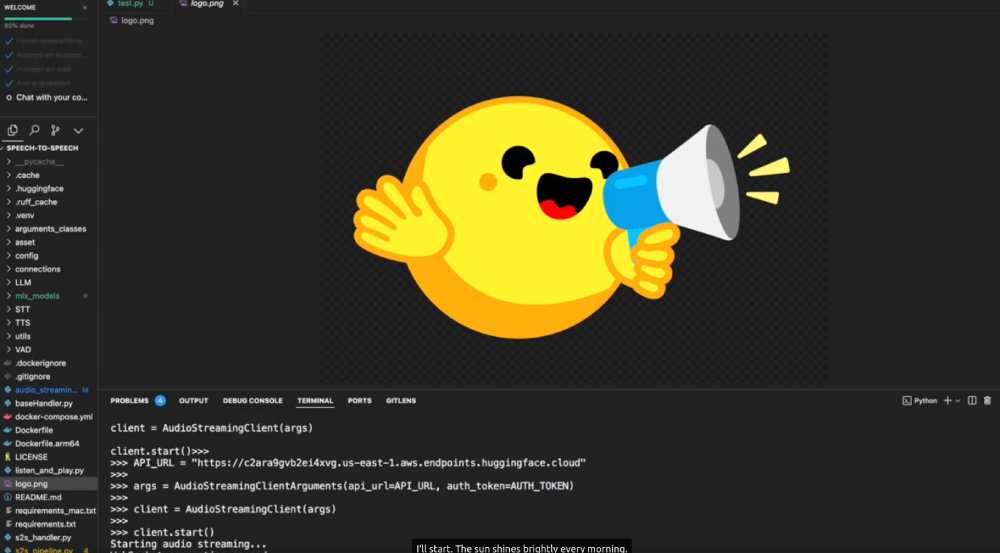 |
Speech-to-Speech (S2S) on Hugging Face is a pipeline that combines Voice Activity Detection, Speech-to-Text, Language Model, and Text-to-Speech components for real-time voice interactions.
The system supports English, French, Spanish, Chinese, Japanese, and Korean, with automatic language detection capabilities.
In this guide, you'll learn
Building custom Docker images for S2S deployment
Setting up Hugging Face Inference Endpoints with GPU acceleration
Implementing websocket-based client-server architecture for low latency
Managing model dependencies and data preprocessing
Configuring container settings for optimal performance
Handling audio streaming and playback
Integrating with the Hugging Face hub
Implementation Steps Clone the Hugging Face inference toolkit
Add S2S codebase as submodules
Modify Dockerfile for dependency management
Build and push custom Docker image
Configure Inference Endpoint with L4 GPU
Set up websocket handlers for audio streaming
Implement audio recording and playback client |
|
Read more
|
|
|
|
|
At Alpha Signal, our mission is to build a sharp, engaged community focused on AI, machine learning, and cutting-edge language models, helping over 200,000 developers stay informed and ahead. We’re passionate about curating the best in AI, from top research and trending technical blogs to expert insights and tailored job opportunities. We keep you connected to the breakthroughs and discussions that matter, so you can stay in the loop without endless searching. We also work closely with partners who value the future of AI, including employers and advertisers who want to reach an audience as passionate about AI as we are.
Our partnerships are based on shared values of ethics, responsibility, and a commitment to building a better world through technology.Privacy is a priority at Alpha Signal. Our Privacy Policy clearly explains how we collect, store, and use your personal and non-personal information. By using our website, you accept these terms, which you can review on our website. This policy applies across all Alpha Signal pages, outlining your rights and how to contact us if you want to adjust the use of your information. We’re based in the United States. By using our site, you agree to be governed by U.S. laws. |
|
|
|
Looking to promote your company, product, service, or event to 200,000+ AI developers? Let's work together.
|
|
Work with us
|
|
|
|
|
