|
Hey,
Your daily briefing is ready. You can finally take a break from the AI firehose.
Our algos spent the night splitting signal from noise and pulled the top news, models, papers, and repos.
Here’s the must-read:
|
|
Together with:
|

|
|

|
Today's Author
Lior Alexander. Founder of AlphaSignal and former ML Engineer.
Previously built ML systems at Iguazio, Guesty, Enphase, Mila.
|
|
Top News
|
|
|
|
Meta increases video throughput and reduces compute overhead with multiplexed object tracking in SAM 3.1
|
|
2,474 Likes
|
|
Meta releases SAM 3.1 as an update to its Segment Anything Model for image and video segmentation. It focuses on tracking objects across video frames using prompts like text, points, or masks.
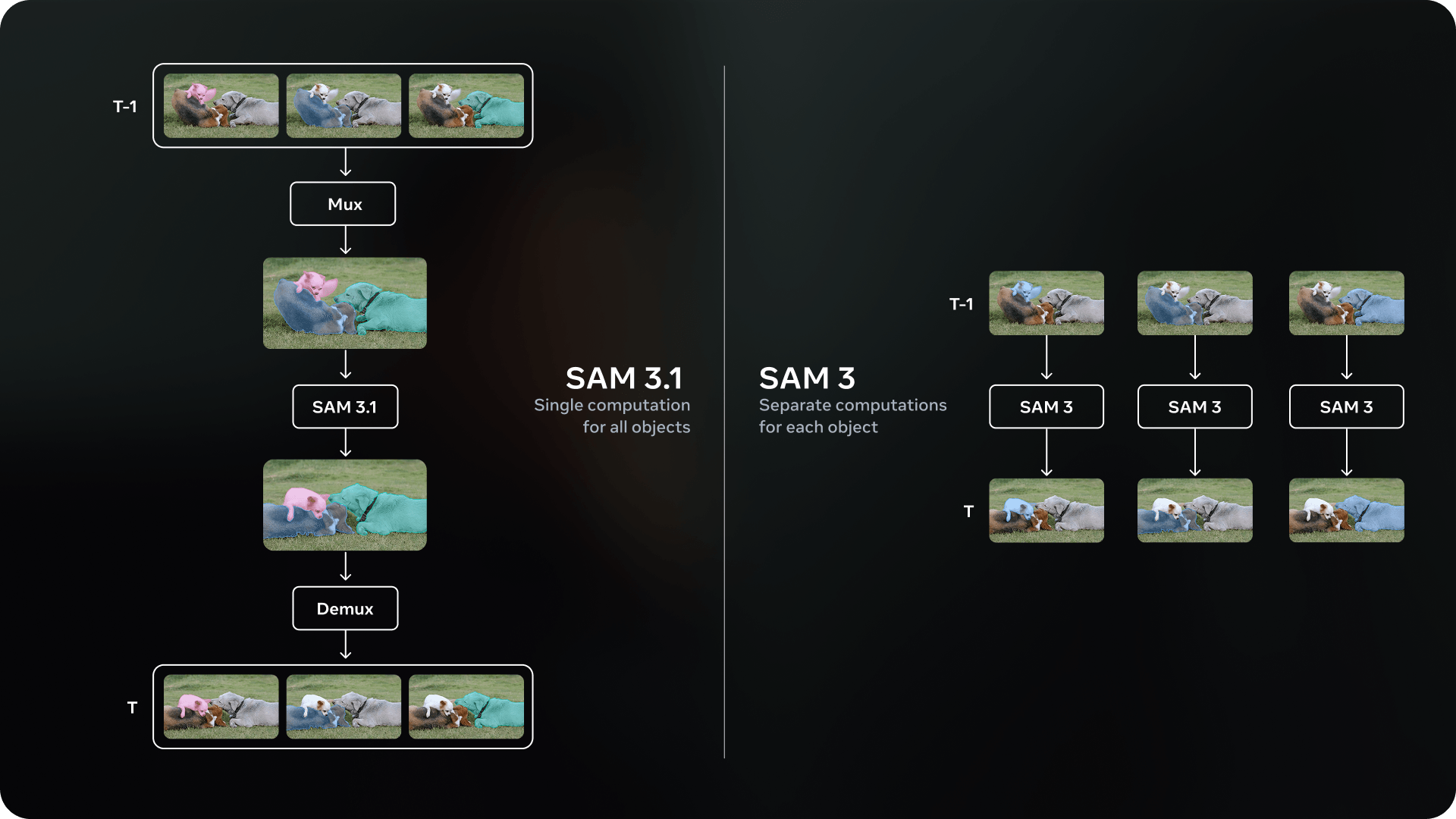
The key change is object multiplexing, which lets the model process multiple objects together instead of separately.
Video tracking usually runs one pass per object, which increases compute cost as objects increase. SAM 3.1 removes this by grouping objects into a single pass. This reduces repeated work and simplifies multi-object tracking pipelines.
Key features
-
Tracks up to 16 objects in one pass using shared computation across frames
-
Increases throughput from 16 to 32 FPS on a single H100 GPU
-
Removes redundant per-object passes that previously repeated feature extraction
-
Maintains segmentation and tracking accuracy with the new computation structure
Performance Changes
Improves video processing speed and reduces compute overhead in multi-object scenes.
- Increases throughput from 16 to 32 frames per second on one H100 GPU
- Reduces memory bottlenecks caused by repeated per-object inference pipelines
- Maintains accuracy while changing the computation structure for object tracking
- Enables real-time processing in videos containing a medium number of objects
|
|
|
|
Presented by Augment Code
|
|
Stop babysitting your agents. Write a spec.
|
|
You’ve got Claude Code, OpenCode, and Codex and you’re still the one making sure they don’t conflict. That’s not leverage. That’s a second job.
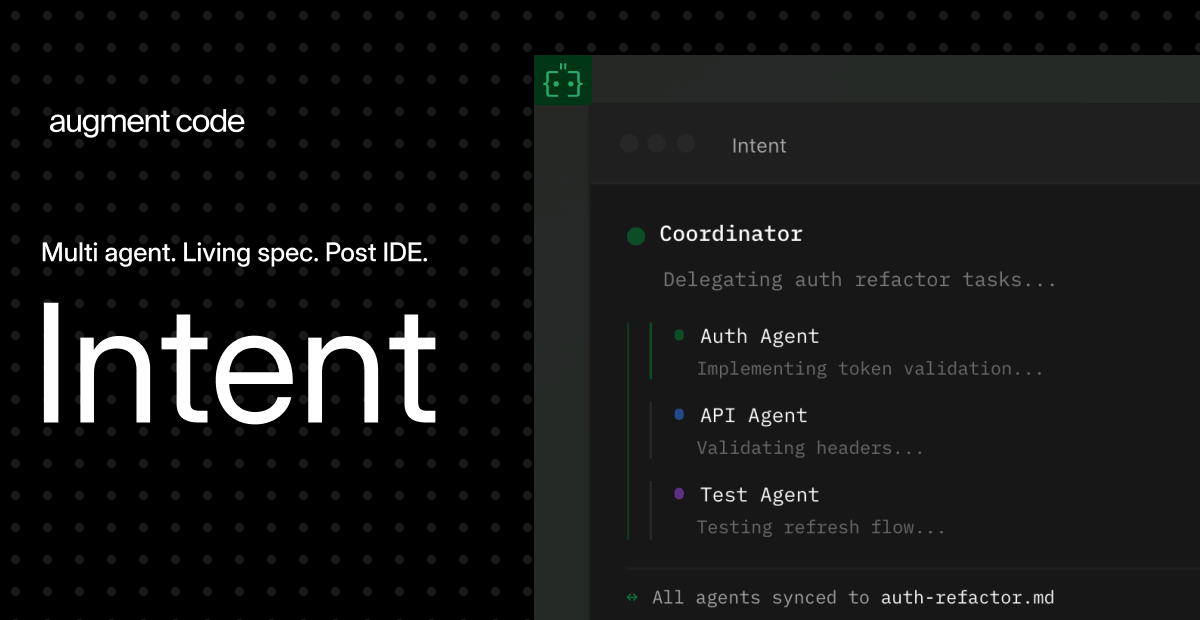
Intent turns one spec into parallel agent execution:
-
Define the work, the boundaries, and the success criteria
-
Agents read the same plan and build in their own lane
-
Ship without stepping on each other - no merge conflicts
-
One spec, full coordination, zero babysitting
Free with Claude Code, OpenCode, and Codex.
|
|
|
|
partner with us
|
|
Top Repo
|
|
|
|
Supermemory replaces vector databases with a structured memory graph for consistent context across AI conversations
|
|
20,427 Stars
|
|
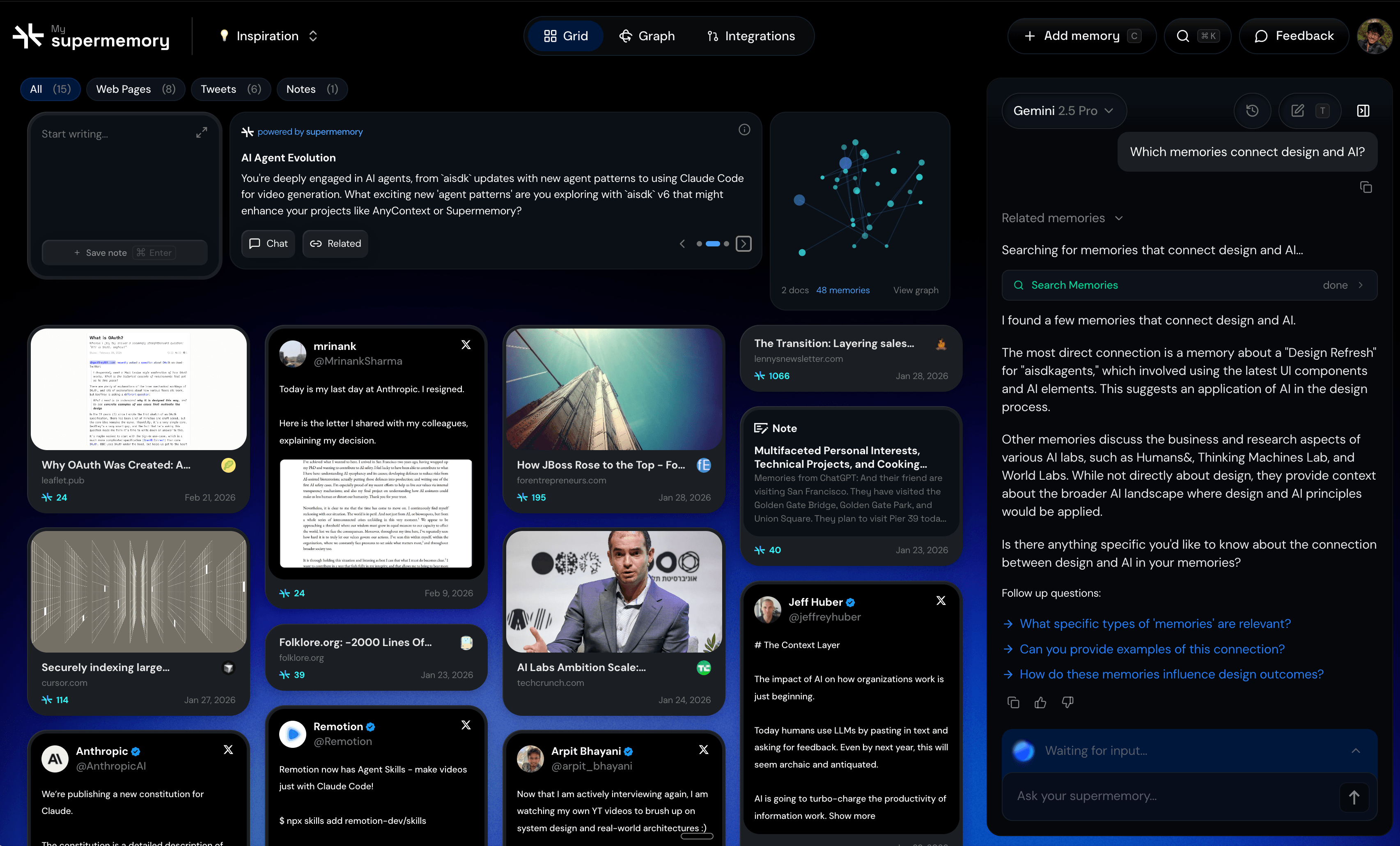
Supermemory is an open-source memory layer for AI systems that replaces vector databases and embedding pipelines with a structured memory graph.
It solves a common issue: AI systems forget past interactions or return inconsistent context across sessions.
The system reports 81.6% on LongMemEval and ranks first on LoCoMo and ConvoMem, which measure long-term recall, reasoning over time, and personalization.
Key Features and Results
Supermemory stores and retrieves context as structured facts instead of text chunks.
- Extracts facts from conversations and organizes them into entities, relationships, and timestamps
- Updates or replaces outdated or conflicting information using recency and contextual rules
- Combines memory and document retrieval in one query instead of separate RAG pipelines
- Returns user profile context in ~50ms without scanning full conversation history
- Uses multi-agent retrieval (ASMR) to read, verify, and reconstruct context across sessions
How to Use It
You add memory to agents through a single API or MCP server integration. Install via npm or pip and store context with simple API calls
|
|
|
|
Presented by Brave
|
|
The search API your agent actually needs
|

|
40B pages. Independent index. $5/1K calls.
Brave Search API gives your chatbots and agents real-time web data - no Google scraping, no middlemen.
|
|
|
|
partner with us
|
|
Top Paper
|
|
|
|
Princeton finds reasoning models consume 79× more energy per query due to longer compute chains
|
|
1,727 Likes
|
|
Princeton University researchers analyze how modern AI systems scale in energy, cost, and reasoning. They estimate a next-gen model training run uses 11 billion kWh, while a single reasoning query uses 33 Wh vs 0.42 Wh, a 79× jump.
The paper argues current large models rely on pattern matching outside math and code, which limits real reasoning.
Key findings
The paper quantifies where current systems break and what works instead.
- Energy shifts from training to inference due to repeated query execution at scale
- Reasoning models increase compute through longer token chains and multi-step generation
- Performance stays strong in structured domains but drops in unstructured real-world tasks
- A 14B domain-trained model beats a larger general model in clinical reasoning benchmarks
- Local specialist models achieve ~10,000× lower energy per query than cloud reasoning systems
How to use this approach
The paper explains how you can build systems like this today.
- Train small models (1B–15B parameters) on focused datasets from one domain
- Build knowledge graphs, which store facts and relationships in a structured format
- Add a router that sends each query to the right specialist model
- Run models locally with optimized runtimes instead of relying on cloud GPUs
|
|
|
At Alpha Signal, our mission is to build a sharp, engaged community focused on AI, machine learning, and cutting-edge language models, helping over 200,000 developers stay informed and ahead. We’re passionate about curating the best in AI, from top research and trending technical blogs to expert insights and tailored job opportunities. We keep you connected to the breakthroughs and discussions that matter, so you can stay in the loop without endless searching. We also work closely with partners who value the future of AI, including employers and advertisers who want to reach an audience as passionate about AI as we are.
Our partnerships are based on shared values of ethics, responsibility, and a commitment to building a better world through technology.Privacy is a priority at Alpha Signal. Our Privacy Policy clearly explains how we collect, store, and use your personal and non-personal information. By using our website, you accept these terms, which you can review on our website. This policy applies across all Alpha Signal pages, outlining your rights and how to contact us if you want to adjust the use of your information. We’re based in the United States. By using our site, you agree to be governed by U.S. laws.
|
|
|
Looking to promote your company, product, service, or event to 250,000+ AI developers?
|
|
|
|
|
