Hey, | Welcome to today's edition of AlphaSignal.
Whether you are a researcher, engineer, developer, or data scientist, our summaries are there to keep you up-to-date with the latest breakthroughs in AI.
Let's get into it!
Lior | |
|
|
IN TODAY'S SIGNAL
|
Top Repo: MIT OpenVoice V2 Top Papers: Fully use context, OpenAI safety, hidden computations Top Signals: ChatGPT memory, 8x video upscaling, LeCun's predictions Top Tutorial: How to Run LLaMa 3 and Phi-3 locally
| Read Time: 4 min 58 sec |
|
|
|
Enjoying this newsletter?
Please forward it to a friend or colleague. It helps us keep this content free.
|
|
|
|
TOP REPO
| Voice & Audio | OpenVoice: Multilingual Voice Cloning and Powerful text-to-speech Model |
⇧ 27,593 |
 |
What's New | OpenVoice V2 is an open source text-to-speech model released by MIT CSAIL and MyShell.ai researchers. It enables instantly cloning a person's voice from a short audio sample and generating highly realistic speech in that cloned voice.
Core Features
- Accurate voice cloning reproducing speaker's tone color
- Control over stylistic attributes: emotion, accent, rhythm, intonation
- Zero-shot cross-lingual voice cloning for unseen languages
- Native multi-lingual support: English, Spanish, French, Chinese, Japanese, Korean
Enhanced Audio Quality A new training approach in V2 delivers significantly improved audio fidelity and more natural-sounding synthesized speech compared to V1.
Zero-Shot Cross-Lingual Cloning The standout feature of OpenVoice V2 is its zero-shot cross-lingual voice cloning capability, which allows it to produce speech in languages not present in the training data. This functionality is crucial for applications requiring broad linguistic versatility, utilizing just a short audio sample to accurately replicate a speaker's voice in multiple languages.
Open Source The model's technical report and full source code are available on arXiv. As of April 2024, both V1 and V2 are released under the MIT License for free commercial and research use.
System Requirements The model runs locally on any computer, without the need for specialized hardware. |
|
Check the repo
|
|
|
|
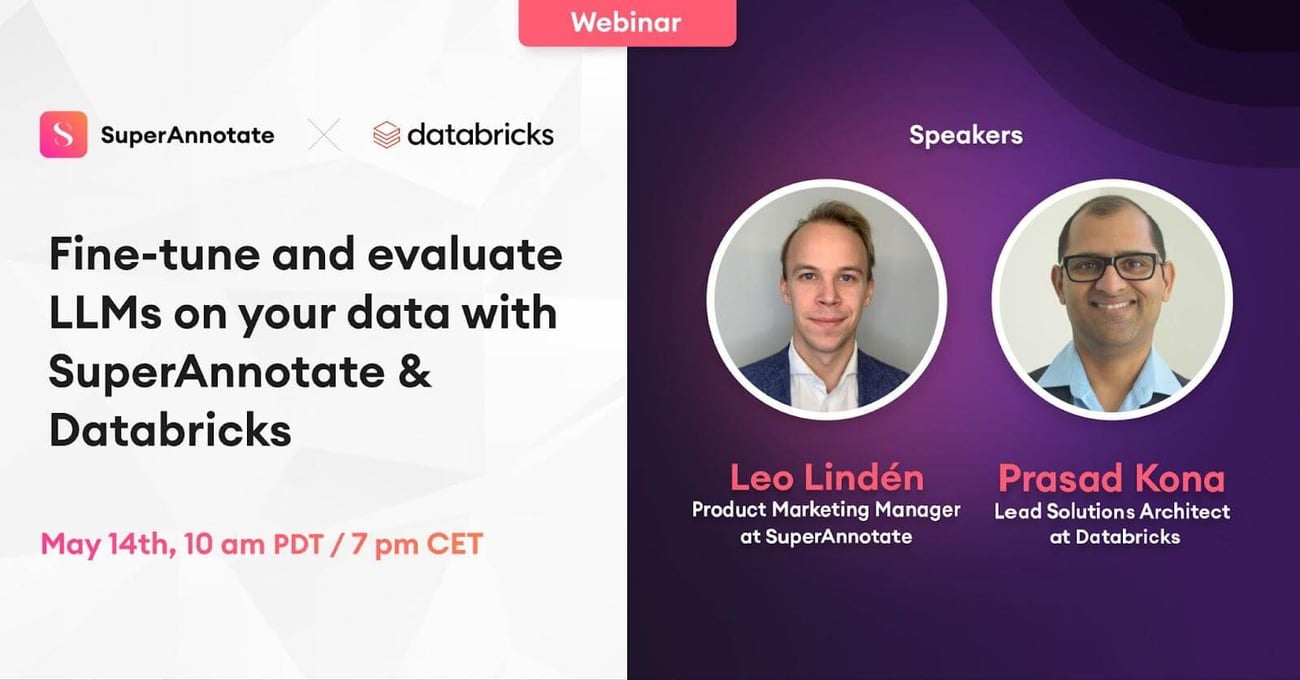
| Free Webinar: Fine-tune and evaluate LLMs on your data with SuperAnnotate and Databricks | Date: May 14th, 10 am PST / 7 pm CET
While most companies have large amounts of data, they are often unprepared for LLM fine-tuning. During fine-tuning, LLMs learn to mimic the style and content of the data used, and it is therefore important that this data represents the intended model behavior exactly.
During this webinar, we will explore how you can leverage SuperAnnotate with Databricks to refine your data, fine-tune large language models, and thoroughly evaluate the results to make well-informed deployment decisions. |
|
Register now
| partner with us → |
|
|
|
TOP PAPERS
| In-Context Learning |
| ⇧ 1031 |
Problem: LLMs often struggle to effectively utilize information from the middle of long contexts (4K-32K tokens), a phenomenon termed the "lost-in-the-middle" challenge. This issue results from insufficient explicit supervision during long-context training, leading to a bias toward information at the beginning and end.
Solution: To address this, Microsoft researchers developed the FILM-7B model using an "INformation-INtensive" (IN2) training approach on a synthetic dataset, emphasizing fine-grained information awareness and multi-hop reasoning from various segments within long contexts.
Results: FILM-7B demonstrated improved performance across a 32K context window, achieving a 26.9 F1 score on NarrativeQA and maintaining a 59.2 accuracy on MMLU. It outperformed the baseline model and showed better robustness on long-context tasks, confirming the effectiveness of IN2 training in overcoming the "lost-in-the-middle" issue. |
| AI Safety |
|
⇧ 2342 |
Problem: Large Language Models face vulnerabilities from attacks like prompt injections, where malicious prompts override system instructions. This issue arises because LLMs often treat system prompts and user inputs with equal priority.
Solution: The paper proposes an instruction hierarchy to prioritize system messages over user or third-party inputs. It introduces automated data generation techniques that train LLMs to selectively ignore or refuse lower-priority instructions. These techniques include context synthesis for aligned instructions and context ignorance for misaligned ones.
Results: The enhanced models show increased robustness across multiple attack types, improving defense against system prompt extraction by 63% and jailbreak robustness by over 30%. The models demonstrate significant generalization to new, unseen attacks while maintaining their standard capabilities with minimal over-refusals. |
| Tranformers |
|
⇧ 451 | |
Problem: Transformers use filler tokens, like '......', to solve complex tasks beyond their typical scope, which in this case, involve problems defined by quantifier depth greater than two, such as 3SUM. Standard methods fail without these intermediate tokens.
Solution: Researchers introduced datasets like 3SUM and 2SUM-Transform, where transformers enhanced with filler tokens can solve these algorithmically challenging tasks. Filler tokens increase the model’s computation capacity across tokens, rather than adding informative content.
Results: Filler tokens enabled a Llama 34M model to achieve 100% accuracy on 3SUM problems, significantly outperforming the immediate-answer setup, which only reached 66% accuracy at similar complexity levels. | | |
| |
|
|
Automate Multimodal Tasks Using GenAI at Scale with V7 Go
| V7 Go connects your work to a powerful reasoning engine, but at its core is simple to use like a spreadsheet or database, with each cell being powered by an LLM.
V7 Go was featured last week alongside Mark Zuckerberg on Dwarkesh's podcast.
Use code ALPHASIGNAL20 for 20% a Pro subscription for V7 Go. |
Try it now ↗️ |
|
|
|
TRENDING SIGNALS
| ChatGPT |
| ⇧ 1089 |
| Future of AI |
| ⇧ 4372 |
| Features |
| ⇧ 720 |
| Video Generation |
|
⇧ 2015 | |
Image Generation |
| ⇧ 3391 |
| |
| |
|
|
TUTORIAL
| Local LLMs | How to Run LLaMa 3 and Phi-3 Locally |
⇧ 1469 |
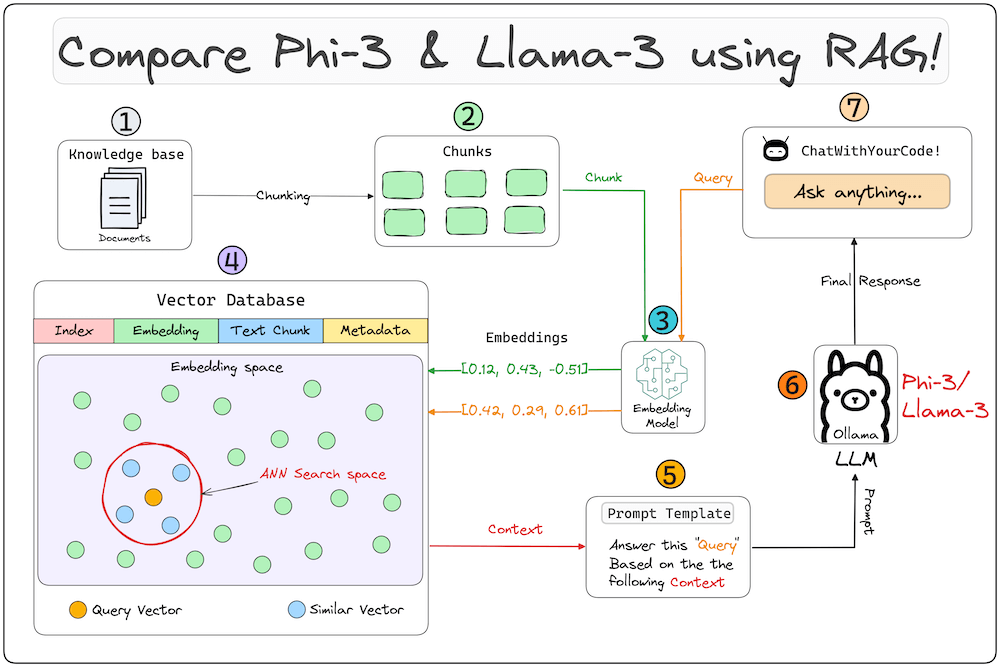 |
What's New | This tutorial details how to compare the capabilities of Meta AI's Llama-3 and Microsoft's Phi-3 models using a Retrieval Augmented Generation (RAG) approach, served locally via Ollama.
The tutorial focuses on loading the knowledge base, creating an embedding model, indexing & storing data, creating a prompt template, and setting up a query engine, before comparing the two models.
You'll learn how to set up the environment, manage GPU processes to ensure smooth operation, and interact with your documents through a user-friendly Streamlit-based interface |
|
Read more
|
|
|
|
Ghita is an editor at AlphaSignal and AI Engineer at Clear Ventures. Experienced in Computer Vision and Language models, she holds 2 masters in Applied Mathematics.
|
|
|
|
Want to promote your company, product, job, or event to 180,000+ AI researchers and engineers?
|
|
Sponsor
|
|
|
|
|
