| Hey, | Welcome to today's edition of AlphaSignal, a newsletter for developers by developers.
We identify and summarize the top 1% news, papers, models, and repos in the AI industry. |
|
|
|
IN TODAY'S SIGNAL
| Read time: 6 min 2 sec | 🎖️ Top News
📌 Galileo
⚡️ Trending Signals
📌 Speechmatics
📦 Top HF Models
🧠 Pytorch Tip
|
|
|
|
If you're enjoying AlphaSignal please forward this email to a colleague.
It helps us keep this content free. |
|
|
|
TOP NEWS
| LLM | Meta AI Releases Opensource Multimodal AI Models Llama 3.2 |
⇧ 6,682 Likes |
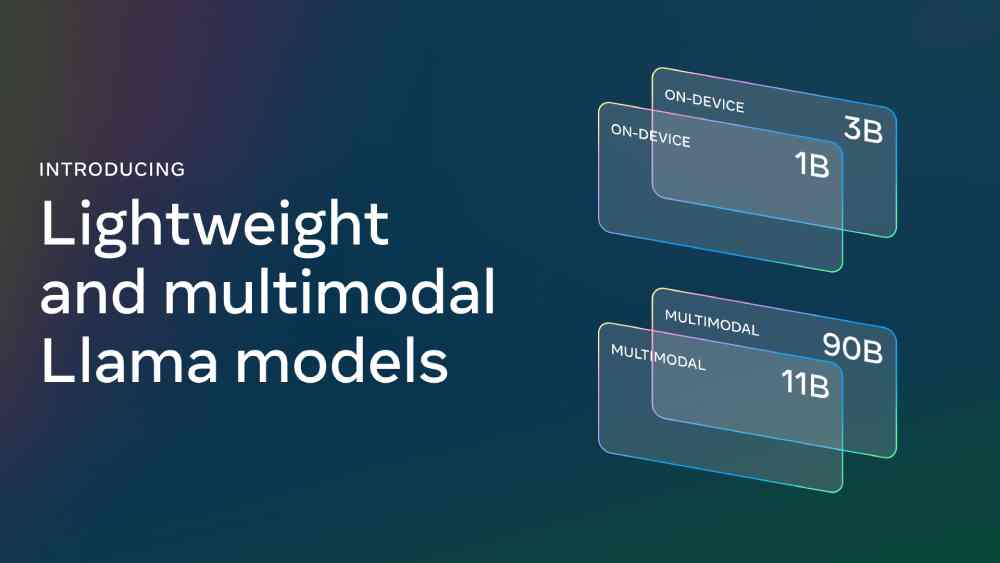 |
What's New | Meta has expanded its open-source Llama model family with Llama 3.2, introducing multimodal capabilities and lightweight versions for edge devices.
This release includes vision-enabled models (11B and 90B parameters) and compact text-only models (1B and 3B parameters) designed for mobile and edge computing.
Key highlights Multimodal models support image reasoning tasks Lightweight models optimized for on-device use with 128K token context Llama Stack API introduced for simplified AI application development Models available for immediate use on various cloud and on-device platforms The multimodal models integrate vision capabilities through adapter weights, allowing image processing without altering text performance. This architecture enables them to function as drop-in replacements for previous text-only versions. Performance
11B vision model outperforms Claude 3 Haiku across multimodal benchmarks 90B model competes with GPT-4o mini 3B text model surpasses Gemma 2 2.6B and Phi 3.5-mini in tasks like summarization and instruction following Training and Architecture
Lightweight models were created using pruning and knowledge distillation techniques, with larger Llama models serving as teachers. hese models support a 128K token context window, enhancing their capabilities for longer text processing. Llama Stack provides a standardized interface for customizing Llama models and deploying them across various environments.
The models are optimized for mobile hardware through partnerships with key chip manufacturers. Meta is actively exploring quantized variants for improved efficiency, though current releases use BFloat16 numerics.
Model Access
Developers can access these models through multiple channels: Direct download from llama.com and Hugging Face Cloud platforms like AWS, Google Cloud, and Microsoft Azure On-device deployment via PyTorch ExecuTorch Single-node distribution through Ollama It offers APIs for inference, tool use, and retrieval-augmented generation (RAG), simplifying the development of AI applications. |
|
|
Read more
|
|
|
|

| Unlock the Secrets of RAG Systems with Galileo's Free eBook: Mastering RAG | Galileo just released a new FREE eBook: Mastering RAG - A Developer's Guide to Enterprise-Grade RAG Systems
Download now to access 200 pages of technical content covering
Chunking strategies Embedding and reranking model selection Vector database comparisons RAG architecture best practices Testing and evaluation methods Key topics include
Mitigating hallucinations Optimizing chunking techniques Choosing the right vector database Overcoming common RAG implementation challenges Preparing your system for production Boosting performance |
|
Get yours today
| partner with us |
|
|
|
TRENDING SIGNALS
| Multimodal AI models |
|
⇧ 2,100 Likes | |
LLM Inference |
| ⇧750 Likes |
| Google |
|
⇧ 902 Likes | |
LLM |
|
⇧ 1,400 Likes | |
OpenAI |
|
⇧ 9,200 Likes | | |
|
|
|
|
|
Power your Conversational AI with this Real-Time Speech API
| Speechmatics just released an updated speech-to-text API for Conversational AI. It offers: The API enables responsive voice interactions in real-time. |
Try it today [Free]👉 |
|
|
|
|
TOP MODELS
| OCR | |
⇧133,528 Downloads | Helps you extract text from PDFs and images with high accuracy and flexibility.
You can
Get plain text, formatted output, or fine-grained OCR with bounding boxes and color info Process multiple cropped regions in a single image Handle various document types and complex layouts Built on Hugging Face Transformers, it runs efficiently on NVIDIA GPUs. The model improves on its predecessor, addressing key issues and enhancing capabilities.
|
| LLM |
|
⇧ 496 Downloads | Helps you build efficient, high-quality language applications. It's a 51B parameter model derived from Llama-3.1-70B, optimized for single H100-80GB GPU use.
Key features
Neural Architecture Search for memory efficiency 80.2% on MMLU (5-shot), 91.43% on GSM8K (5-shot) 8192 token context length Supports English, coding, and other languages Licensed for commercial use Trained on 40B tokens, data cutoff 2023 Available through Hugging Face Transformers | |
LLM |
|
⇧ 4,753 Downloads | Helps you build powerful AI applications with less computational resources.
This 22-billion parameter model supports: It's designed for instruction-following and handles various NLP tasks efficiently. You can access it freely on Hugging Face Hub for non-commercial use.
The model balances performance and scalability, positioning between Mistral NeMo 12B and Mistral Large 123B. Its compact size makes it suitable for resource-constrained environments while maintaining high-quality output. | | |
| |
|
|
PYTHON TIP
| Custom data structures using Python's collections.abc for efficient handling of high-dimensional tensors |
Python's collections.abc module lets you create tailored classes that behave like built-in containers. This approach optimizes memory usage and computation speed for specific tensor operations.
This class supports indexing and custom methods like sum_along_axis. It's useful for tasks involving 3D data, such as video processing or 3D image analysis. The benefits include intuitive access patterns and specialized operations while maintaining compatibility with Python's sequence protocols.
Here's a simple example of a custom 3D tensor class:
|
from collections.abc import Sequence
import numpy as np

class Tensor3D(Sequence):
    def __init__(self, data):
        self._data = np.array(data)

    def __getitem__(self, index):
        return self._data[index]

    def __len__(self):
        return len(self._data)

    def sum_along_axis(self, axis):
        return np.sum(self._data, axis=axis)

# Usage
t = Tensor3D([[[1, 2], [3, 4]], [[5, 6], [7, 8]]])
print(t[0])  # Access first 2D slice
print(t.sum_along_axis(0))  # Sum along first axis
|
In above, the collections.abc module helps by providing the Sequence abstract base class.
This
Enforces a consistent interface (getitem and len) Adds extra functionality automatically (contains, iter, reversed) Allows custom methods (sum_along_axis) alongside standard operations Improves interoperability with other Python code This creates a tailored 3D tensor structure that's efficient and compatible with Python's sequence protocols. |
|
Get the google colab
|
|
|
|
Looking to promote your company, product, service, or event to 200,000+ AI developers? Let's work together.
|
|
Advertise
|
|
|
|
|
