Moonshot AI recently released the weights for its flagship Kimi K3 model, making it the largest open-weights LLM to date, rivaling Opus 4.8 and GPT-5.6.
While the weights for Kimi K3 are open, running the model presents a massive engineering hurdle. You cannot spin up a model of this scale efficiently without innovations at different levels.
There is a lot to learn from the engineering the Moonshot team implemented to ensure this behemoth can be deployed efficiently. These choices give us direct insight into how modern mega-models are run in production.
Kimi K3 recap: By the numbers and where it shines
Kimi K3 is a multimodal Mixture-of-Experts (MoE) architecture with 2.8 trillion total parameters. Through extreme sparsity, only about 104 billion parameters are active for each token (roughly 16 out of 896 experts). It natively supports a massive 1 million token context window.
K3 is currently the third strongest model on the Artificial Analysis index. The model dominates in agentic knowledge work. On the Artificial Analysis AA-Briefcase benchmark, Kimi K3 scores second overall, trailing only Claude Fable 5. It decisively beats GPT-5.6 Sol (max) and Opus 4.8 in this category.
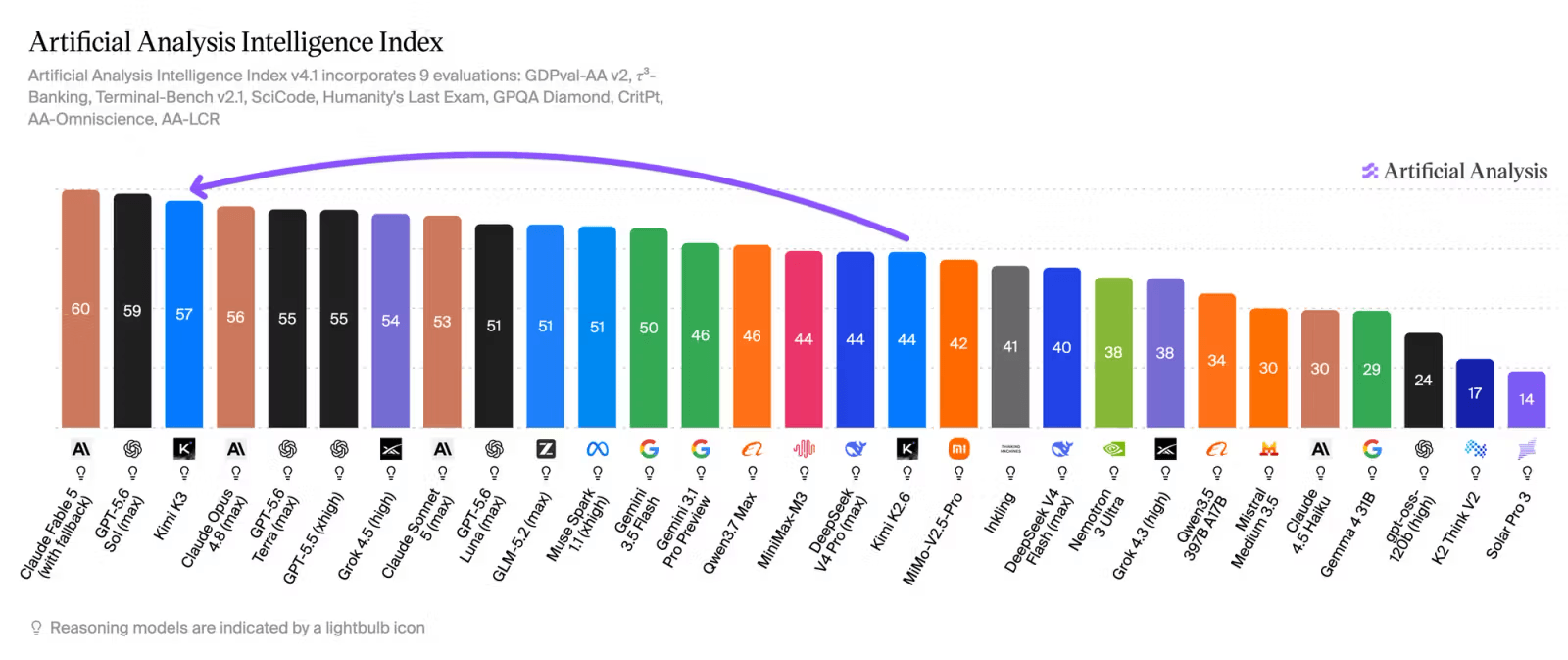
It also demonstrates top-tier analytical and multimodal strengths. The model ranks in the 97th percentile for coding and visual workflows like reading charts and document screenshots.
These frontier-level capabilities and massive context windows are impressive. Yet they are practically usable because of architectural decisions that tame the underlying compute and memory requirements.
LatentMoE: Taming expert routing
The Mixture-of-Experts (MoE) architecture solves a fundamental scaling problem by conditionally activating only a small subset of parameters per token. This avoids the computational cost of running the entire network for every single calculation.
However, traditional MoE setups introduce a new bottleneck. The communication overhead and data movement across massive linear expert layers consume huge amounts of memory bandwidth.
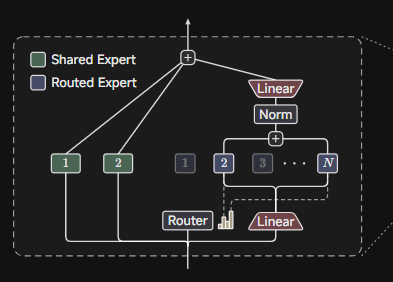
Stable LatentMoE addresses this by compressing the input tokens into a much smaller latent space before routing them to experts. In Kimi K3, the hidden size is down-projected to 3,584 dimensions, slashing activation memory and cross-node communication traffic.
These bandwidth and memory efficiencies become exponentially more pronounced as models scale. For architectures crossing the 1 trillion parameter threshold, LatentMoE is practically mandatory.
This approach builds on the foundation laid by Nvidia's Nemotron 3 and shows open research compounds.
Hybrid attention: Smashing the KV cache wall
Standard Multi-Head Attention (MHA) scales quadratically. If Kimi K3 used standard attention for its 1 million token context window, caching every Key and Value vector across all layers would create a memory wall requiring hundreds of gigabytes of VRAM.
Kimi Delta Attention (KDA), used in Kimi K3, replaces standard attention with a linear mechanism that keeps a fixed-size state that updates per token. This brings the computational complexity down and stops the KV cache from growing with sequence length.
K3 mixes KDA with Multi-Head Latent Attention (MLA), pioneered by DeepSeek, to preserve important information across long contexts. MLA compresses the KV cache into a single latent vector. This vector is decompressed during inference, shrinking memory overhead while preserving exact context retrieval.
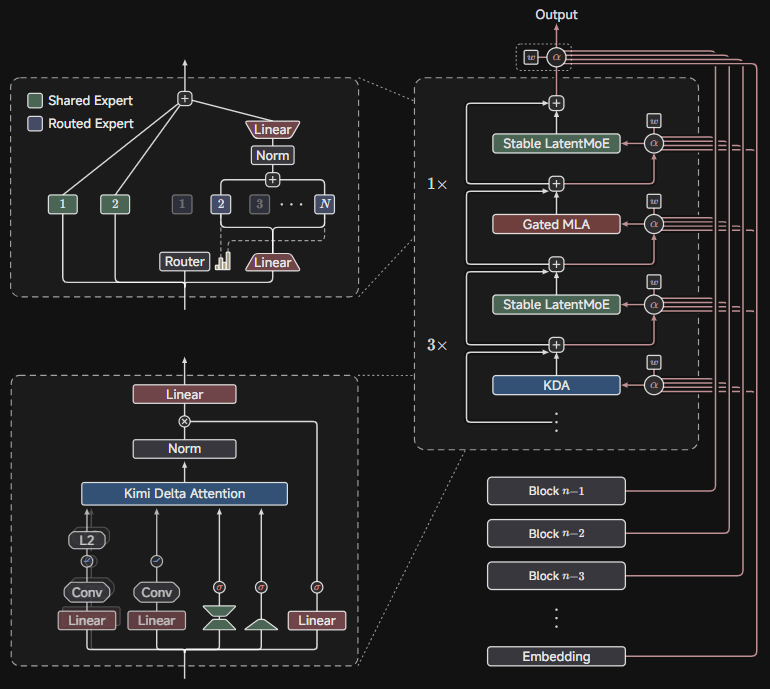
Kimi K3 combines these two innovations in a 3:1 ratio. It stacks three layers of KDA for speed and constant memory state, followed by one layer of Gated MLA to restore full, accurate context retrieval. This hybrid synergy makes a 1 million token context window practically deployable.
Quantization: Shrinking the footprint via QAT
Quantization maps high-precision model weights, like 16-bit BF16, to lower-bit representations, such as 4-bit formats. This drastically reduces the memory footprint and bandwidth requirements needed to serve the model.
Holding 2.8 trillion parameters in standard BF16 precision would take over 5 terabytes of memory. Even with LatentMoE and hybrid attention, the raw weight of the model remains a significant hurdle.
Kimi K3 leans heavily on advanced quantization, shipping with mixed precision format (4-bit floating point for weights, 8-bit for activations. The crucial detail is Quantization-Aware Training (QAT). The Moonshot team ran the post-training pipeline natively in FP4. This allowed the model to adapt to low-precision numerics, preventing the accuracy loss usually associated with extreme quantization.
While Kimi K3 has more than double the parameter count of the previous Kimi K2 model, its deployed memory footprint grew at a much smaller ratio. QAT successfully offsets the traditional scaling tax where larger models demand exponentially larger hardware setups.
Unsloth recently demonstrated the resilience of this native QAT. They successfully quantized K3 down to 1-bit and 2-bit Dynamic GGUF formats. This compression shrinks the model from 1.56 terabytes down to roughly 594 gigabytes while maintaining approximately 79% top-1 accuracy.
Honorable mentions: The accuracy preservers
High sparsity and low-bit quantization usually degrade reasoning quality. To compensate, Moonshot introduced two clever architectural tweaks designed to preserve accuracy.
In standard Transformers, classic residual connections simply add the output of a layer to its input. This fixed addition prevents information loss through the layers of the model (aka vanishing gradient problem).
Kimi K3 replaces this fixed accumulation with Attention Residuals (AttnRes). Instead of a simple addition, Attention Residuals use a learned attention score to selectively aggregate outputs from preceding layers. This connects residuals across layers dynamically to improve information flow and prevent signal dilution.
Also important is the removal of Rotary Position Embeddings (RoPE). Most frontier models use RoPE to inject positional information into the tokens by rotating their vector representations based on their sequence position.
Kimi K3 opted for a NoPE (No Positional Embeddings) architecture. Thanks to K3's other architectural tweaks, the model accumulates an implicit sequence index on its own. This helps extend context to 1 million tokens without degradation seen in other architectures.
The ecosystem and the future
Kimi K3 proves that frontier AI progress relies as much on clever systems engineering and routing mechanisms as it does on raw compute scaling. Model deployment is now an architectural challenge from day one.
Moonshot successfully stitched together concepts from multiple studies to achieve this efficiency. The open-source community is acting as a massive, decentralized R&D lab where research compounds rapidly.
The enterprise ecosystem is already prepared for these architectural shifts. Frameworks like vLLM offer day-zero support via dedicated containers, complete with multi-node Tensor Parallelism over NVLink for deploying on massive GB300 clusters. We have reached a point where engineering innovations allow open-source AI to rival proprietary giants efficiently.