| Hey, | Welcome to today's edition of AlphaSignal, a newsletter for developers by developers.
We identify and summarize the top 1% news, papers, models, and repos in the AI industry. |
|
|
|
IN TODAY'S SIGNAL
| Read time: 5 min 12 sec | 🎖️ Top News
📌 Web AI
⚡️ Trending Signals
📌 RYSE
⚙️ Top Lectures
🧠 Deep Dive |
|
|
|
If you're enjoying AlphaSignal please forward this email to a colleague.
It helps us keep this content free. |
|
|
|
TOP NEWS
| Multimodal Embedding Model | Cohere Launches New AI Model That Unifies Text and Image Search in Single Vector Space |
⇧ 3,486 Likes |
 |
What's New |
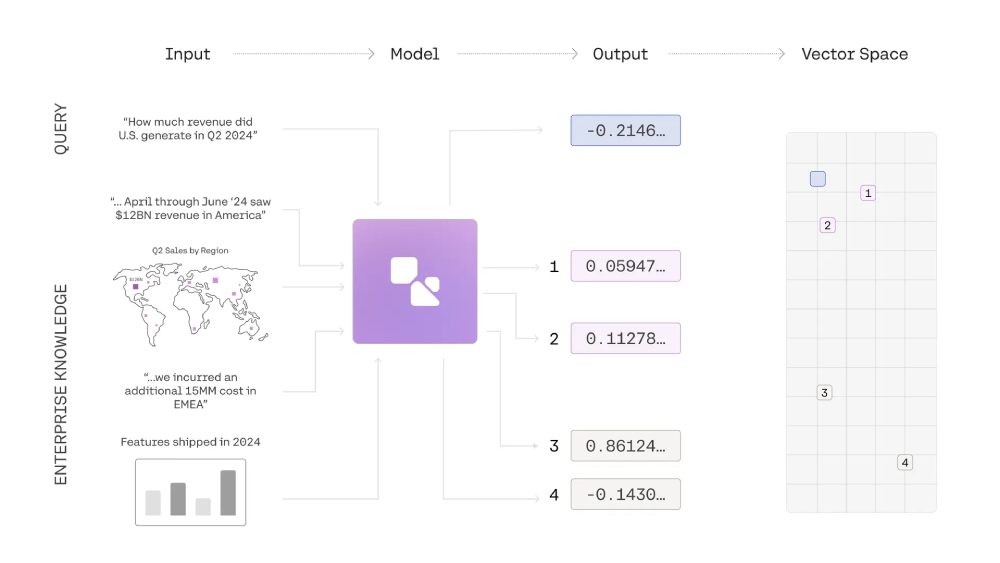
Cohere's Multimodal Embed 3 creates a unified embedding space for both text and images, enabling direct cross-modal search and retrieval. The model represents a shift from traditional single-modality embeddings by allowing direct comparison between text and visual content without separate processing pipelines.
Key Features:
Unified vector space for both text and image embeddings.
Places text and image embeddings in same vector space. i.e. here Text and image encoders share single unified space.
Support for 100+ languages with maintained performance.
Available on major platforms (Azure AI, AWS SageMaker, VPC deployment).
Direct cross-modal search without modality bias.
Optimized for enterprise-scale deployment.
Model Architecture The model's architecture places both text and image embeddings in the same high-dimensional vector space, enabling similarity comparisons across modalities.
This eliminates the common problem of modality clustering, where text and image data separate into distinct regions.
The system demonstrated superior performance in mixed-modality searches, outperforming CLIP when retrieving relevant images in the presence of text distractors.
Strong Performance metrics
The model achieved top scores in text-to-image retrieval (Recall@10) and text-to-text search (NDCG@10) across the BEIR dataset suite.
Testing on multilingual content, including infographics with text in 11 different languages, confirmed consistent cross-lingual performance.
In benchmark tests using the Flickr image corpus with added text distractors, it maintained high retrieval accuracy while competing models showed significant performance degradation when dealing with cross-modal queries.
Implementation and use cases
Technical implementation focuses on three primary use cases: graph/chart search based on semantic descriptions, e-commerce product discovery combining visual and textual queries, and design asset retrieval. The system integrates with existing infrastructure through standard API calls, requiring minimal setup for deployment.
Real-world applications
Real-world applications demonstrate practical value in enterprise settings. The system efficiently processes complex reports, technical documentation, and visual assets, providing accurate retrieval across modalities. Response times and computational requirements align with production environment needs, though specific performance metrics weren't disclosed. |
|
|
Read more
|
|
|
|

| Experience Real-Time AI on Local Devices | Data Control and Ownership
Local AI models you can control and customize.
Allowing enterprises to Build and test solutions without dedicated AI teams
Run compute locally for rapid prototyping at reduced cost
Deploy directly to local environments |
|
Learn more
| partner with us |
|
|
|
TRENDING SIGNALS
| OpenAI |
|
⇧ 2,470 Likes | |
Perplexity |
|
⇧ 1,400 Likes | |
Midjourney |
|
⇧ 2,225 Likes | |
Google |
|
⇧ 842 Likes | |
Huggingface Dataset |
|
⇧ 649 Likes | | |
|
|
|
|
RYSE SmartShades now deploy across 120 retail locations while reporting increased market adoption
| Best Buy consistently identifies emerging tech products before mainstream adoption. Their early selections like Ring (Amazon acquisition) and Nest (Google acquisition) demonstrate their market insight.
Best Buy just released RYSE's SmartShades across 120 stores. RYSE reports $9M+ revenue and 60,000 units sold to date.
RYSE's valuation increased 40% year-over-year as they expand into retail and B2B channels
| Invest in RYSE |
| |
|
|
TOP LECTURES
| AI Agent |
| ⇧ 1,100 Likes
| Learn to build multi-agent systems using crewAI. You'll master parallel and sequential agent configurations, integrate external tools, test performance, and implement human feedback loops. Build practical applications like automated project planners and lead scoring systems. Work with multiple LLMs, optimize agent-specific tasks, and prepare deployments in production environments. |
| AI Agent |
|
| ⇧ 286 Likes |
Learn how LangGraph adds persistent memory across multiple chat sessions in your AI agents. Build agents that store, retrieve, and search memories as JSON documents using namespaces. The tutorial covers practical implementation in both Python and JavaScript, with working examples of memory-enabled chatbots that retain user context between conversations. |
| Prompt Engineering |
|
⇧ 1,100 Likes |
Learn how to prepare your codebase for LLM analysis using Repopack. Pack entire repositories into single AI-readable files with built-in token counting and security checks. Configure input/output formats, handle remote repositories, and use XML/Markdown structures for better AI comprehension. Supports multiple programming languages and respects .gitignore rules. |
| |
| |
|
|
| DEEP DIVE |
LLM |
Stanford's complete roadmap for training production-ready LLMs |
⇧ 3,129 Likes |
 |
This Stanford lecture teaches you how to build LLMs through these key steps:
Pre-training phase
Learn auto-regressive language modeling
Understand tokenization (BPE method)
Master cross-entropy loss calculation
Track model progress through perplexity Post-training phase (after ChatGPT era)
Convert base models into AI assistants
Apply evaluation benchmarks like MMLU
Handle train-test contamination issues Technical components
Select proper model architecture
Implement training algorithms
Process training data
Set up evaluation metrics
Build system infrastructure The lecture skips deep architecture details to focus on practical training aspects, data handling, and evaluation methods. |
|
Watch video
|
|
|
|
Looking to promote your company, product, service, or event to 200,000+ AI developers? Let's work together.
|
|
Advertise
|
|
|
|
|
