|
Hey
|
Welcome to AlphaSignal, the most read source of news by AI engineers and researchers.
Every day, we identify and summarize the top 1% of news, papers, models, and repos, so you’re always up to date.
Here’s today’s roundup:
|
|
Top News
|
|
|
|
Anthropic publishes open-source evalution method to measure political bias with structured scoring
|
|
1,248 Likes
|
|
|
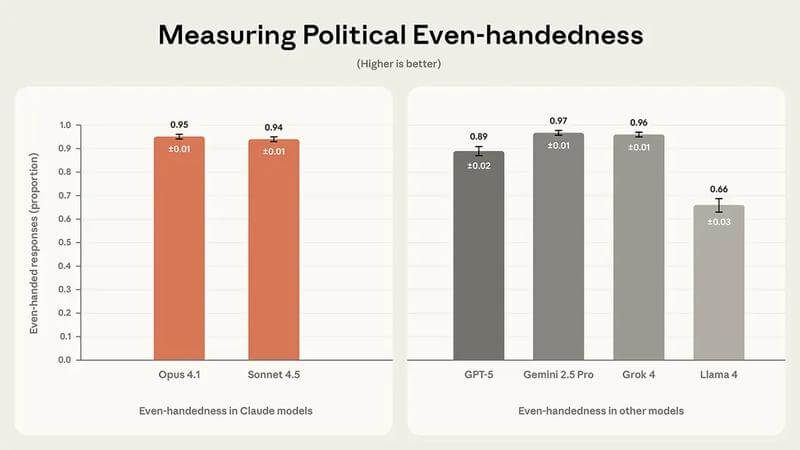
Anthropic introduces a new evaluation that measures political balance with numbers instead of impressions. The test covers 1,350 paired prompts across 150 topics, giving you a wide map of how a model behaves when pushed from opposite ideological angles. The scope makes this one of the most detailed public neutrality evaluations yet.
The Setup: What Anthropic Built
Anthropic designs a test that checks whether a model treats two conflicting prompts with equal depth.
-
Each topic includes one stance and its opposite.
-
The grader inspects clarity, depth, tone, and structure.
-
Scoring rules define “even-handedness,” “opposing perspectives,” and “refusals.”
-
You see how consistently a model handles friction in political framing.
The Problem: Subtle Bias Is Hard to See
Models rarely show bias through obvious statements.
-
Uneven detail reveals preference even when wording stays neutral.
-
Higher refusal rates skew outcomes by cutting off one side.
-
Missing caveats or counterpoints weaken balance.
-
You need a numeric way to inspect these patterns.
The Breakthrough: Everything Is Open Source
Anthropic releases the full pipeline so you can run it end-to-end.
-
The repo includes all prompts, grader rubrics, and scripts.
-
You run your model across the paired prompts to generate outputs.
-
You pass both outputs to the grader to score each metric.
-
The process requires no Anthropic model unless you choose to use one.
The Results: How Models Compare
Anthropic reports clear behavioral differences across the tested models.
-
Claude Opus 4.1 gives both sides of a prompt nearly identical depth and structure.
-
Claude Sonnet 4.5 maintains consistent balance but shows slightly less symmetry than Opus.
-
Gemini 2.5 Pro produces the most evenly matched responses across opposing viewpoints.
-
Grok 4 stays close behind Gemini with stable, symmetrical arguments on both sides.
-
GPT-5 shows uneven depth between viewpoints, with occasional shifts in tone or caution.
-
Llama 4 Maverick diverges the most, with shorter explanations or refusals on one side.
What You Can Do Now
You can test your own models under the same conditions.
|
|
|
|
Stop Rebuilding API Key Infrastructure With WorkOS API Keys
|
|
Sponsored
|
|
|
WorkOS provides infrastructure for authentication, access control, and enterprise features.
The team built WorkOS API Keys to remove the recurring work of secure key generation, rotation, revocation, and scoped permissions that appears as soon as customers ask for API access.
What you’ll get:
-
Production-ready API key infrastructure you ship in minutes
-
Drop-in widget for customer-facing key management
-
API endpoints for programmatic key creation and revocation
-
Keys tied to WorkOS Organizations and Roles for consistent permissions
-
A system that scales without ongoing maintenance overhead
|
|
|
|
partner with us
|
|
Coding Tip
|
|
|
|
Use git worktree to run multiple branches without extra clones
|
Git's worktree feature lets you check out multiple branches at once without extra clones. It helps you test model variants, debug pipelines, or run experiments in parallel without touching your main branch.
How to use it:
Run git worktree add ../exp-new feature-branch
to create a new working directory.Repeat for any other branch you want to isolate.
Why use it?
It keeps experiments separate, avoids stash conflicts, and removes the need for repeated cloning when you switch between branches.
|
|
|
At Alpha Signal, our mission is to build a sharp, engaged community focused on AI, machine learning, and cutting-edge language models, helping over 200,000 developers stay informed and ahead. We’re passionate about curating the best in AI, from top research and trending technical blogs to expert insights and tailored job opportunities. We keep you connected to the breakthroughs and discussions that matter, so you can stay in the loop without endless searching. We also work closely with partners who value the future of AI, including employers and advertisers who want to reach an audience as passionate about AI as we are.
Our partnerships are based on shared values of ethics, responsibility, and a commitment to building a better world through technology.Privacy is a priority at Alpha Signal. Our Privacy Policy clearly explains how we collect, store, and use your personal and non-personal information. By using our website, you accept these terms, which you can review on our website. This policy applies across all Alpha Signal pages, outlining your rights and how to contact us if you want to adjust the use of your information. We’re based in the United States. By using our site, you agree to be governed by U.S. laws.
|
|
|
Looking to promote your company, product, service, or event to 250,000+ AI developers?
|
|
|
|
|
