Hey | Welcome to AlphaSignal, your weekly guide to the latest and most promising developments in the world of AI.
In this edition, we've meticulously scoured GitHub, HuggingFace, and every relevant code repository to identify the most trending and groundbreaking projects.
Let's get into it!
Lior |
|
|
|
IN TODAY'S EMAIL | Repo Highlight: LLM Course Trending Repos: AppAgent, StreamDiffusion, and more Trending Models/Spaces Pytorch Tip: Checkpointing Python Tip: numba
| Reading time: 4 min 37 sec |
|
|
|
HIGHLIGHT REPO | LLM Course | 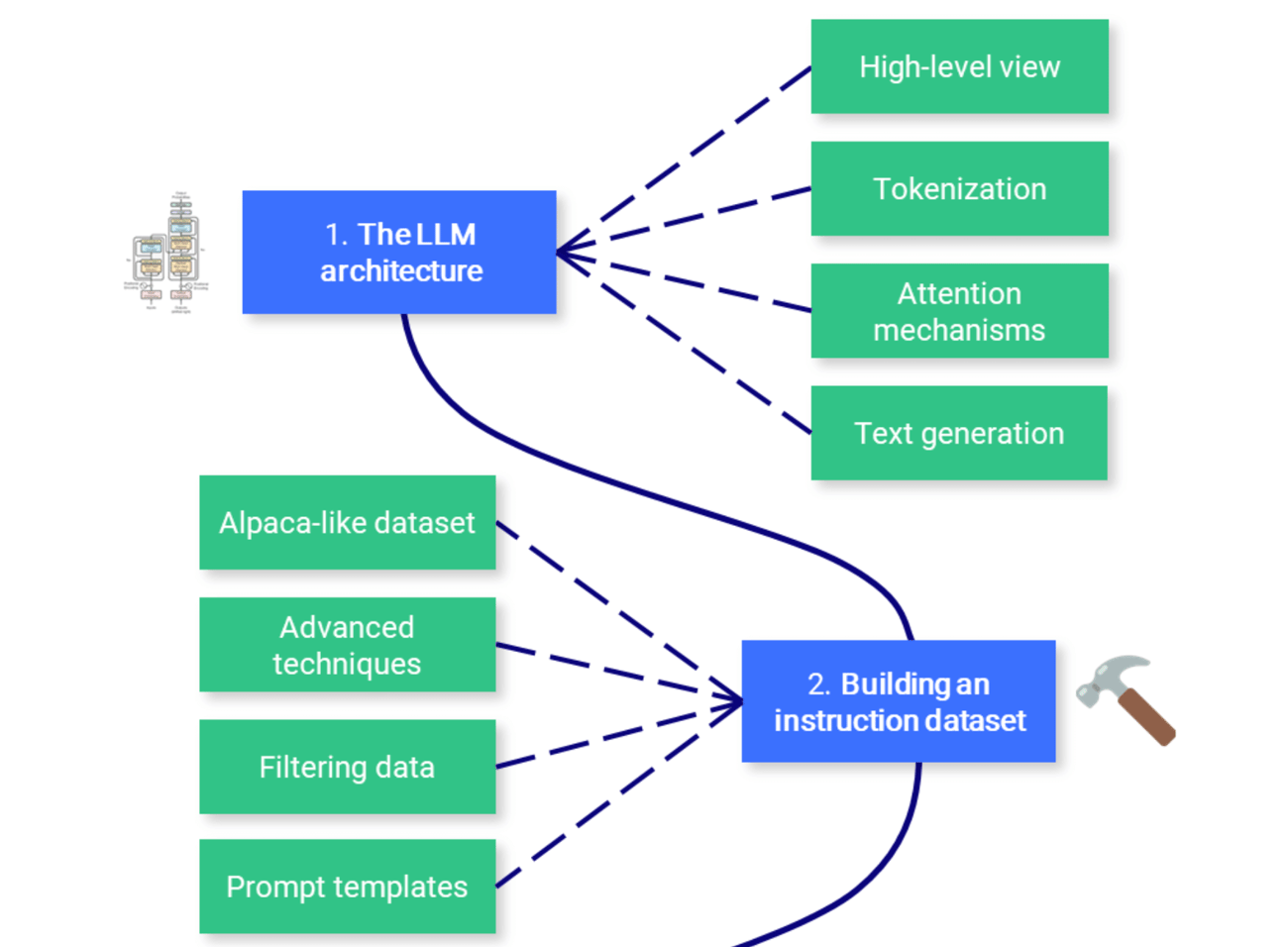 | What's New | The "Large Language Model Course" blew up on Github this week and collected over 9000 stars. It's a course on Large Language Models with detailed roadmaps and Colab notebooks.
It's split into three sections:
The Fundamentals section covers mathematics, Python, and neural networks essential for understanding LLMs.
The Scientist section delves into building LLMs with advanced techniques. It discusses topics like understanding transformer architecture, creating instruction datasets, pre-training models, and reinforcement learning from human feedback.
The Engineer section focuses on practical applications, like creating and deploying LLM-based solutions.
The course includes a collection of notebooks and articles related to LLMs which cover various topics like fine-tuning different models, quantization techniques, merging LLMs, and understanding decoding strategies.
Each topic is supported with step-by-step guides and practical examples in Google Colab.
| Highlights | - The LLM architecture
- Building an instruction dataset
- Pre-training models
- Supervised fine-tuning
- Reinforcement Learning from Human Feedback
- Evaluation
- Quantization
- Inference optimization | | Try the llm course |
|
|
|
 | Accelerate Your AI/ML Development Pipeline with Intel’s New AI Tools
Intel's latest suite of AI/ML tools is a game-changer for data scientists, AI developers, and researchers seeking to accelerate end-to-end data science and analytics pipelines on Intel architecture.
Optimized TensorFlow & PyTorch*: Achieve faster model training and inference with Intel®-specific enhancements in TensorFlow* and PyTorch*.
Python Library Performance: Experience significant speed improvements in data processing with Intel-optimized versions of Modin*, scikit-learn*, and XGBoost.
Cloud Testing: Test and develop AI models directly in the cloud on Intel® CPUs and GPUs, facilitating remote and scalable development.
Customizable Toolkit: Select and configure AI tools efficiently for project-specific needs using the AI Tools Selector.
Modin for Pandas Enhancement: Efficiently scale pandas operations to multi-nodes with minimal code changes, integrating with HDK, Dask, Ray, or HEAVY AI for distributed computing.
| | Get ai tools now | *Other names and brands may be claimed as the property of others. Trademarks | partner with us | |
| |
|
|
TOP OF GITHUB | AppAgent (☆ 2.6k) New framework enabling agents to operate smartphone apps via simplified actions like tapping and swiping. It autonomously learns new app functions or from human demonstrations, creating a knowledge base for complex tasks across various apps. Features include autonomous exploration, learning from demonstrations, and a user-friendly demo and quick start guide. | | mixtral-offloading (☆ 1.3k) Run Mixtral-8x7B models on free Colab or consumer desktops by enhancing model inference through mixed quantization and a unique MoE offloading strategy, fitting models within combined GPU and CPU memory. Includes a demo notebook. | | StreamDiffusion (☆ 6.8k) A real-time interactive generation solution enhancing diffusion-based image generation techniques. Features efficient batch operations, an improved guidance mechanism, advanced GPU filtering, optimized input/output management, and accelerated model processing. | | crewAI (☆ 1.3k) A framework enabling AI agents to role-play and collaboratively tackle complex tasks. It features role-based agent design, autonomous task delegation, and flexible task management, ideal for multi-agent systems in smart platforms or customer services. | | OpenVoice (☆ 3.4k) Instantly clone and control voice styles with high accuracy in multiple languages and accents. Enables zero-shot cross-lingual cloning and flexible style adjustments. Offers advanced customization for enhancing speech naturalness. | |
| |
|
|
PYTORCH TIP | Checkpointing for Memory Efficiency | In PyTorch, torch.utils.checkpoint reduces GPU memory use by segmenting large models during training. It stores only one segment at a time in memory, helping in training larger models or using bigger batches in limited memory. It increases epoch time but saves memory by recalculating activations during the backward pass instead of storing them. | When to Use | Large Model Training: Ideal for scenarios where the model is too large to fit into memory during training.
Memory Constraints: Useful when working with limited GPU memory resources, enabling the training of complex models without upgrading hardware.
Long Training Processes: Applicable in situations involving extensive training periods, as it helps in managing memory usage more efficiently over time
| Benefits | Reduced Memory Footprint: Significantly lowers the GPU memory requirement by storing only part of the model at a time.
Enables Larger Models: Facilitates training of models that would otherwise be too large for the available memory.
|
import torch
from torch import nn
from torch.utils.checkpoint import checkpoint

class LargeModel(nn.Module):
def__init__(self):
super(LargeModel, self).__init__()
# Define your model segments here
 self.part1 = nn.Linear(1000, 1000)
 self.part2 = nn.Linear(1000, 1000)

defforward(self, x):
# Use checkpointing for each part
 x = checkpoint(self.part1, x)
 x = checkpoint(self.part2, x)
return x

model = LargeModel()
input_tensor = torch.randn(10, 1000)
output = model(input_tensor)
|
|
|
|
TOP MODEL/SPACES | TinyLlama-1.1B-Chat-v1.0 A compact 1.1 billion parameter model, pretrained in 90 days on 16 A100-40G GPUs, is compatible with Llama 2, optimized for various applications. It offers enhanced dialogue generation, accessible through Hugging Face Transformers for advanced text generation tasks. | | VCoder VCoder introduces vision encoders enhancing Multimodal Large Language Models' (MLLM) object perception. It uses segmentation and depth maps, training on the COCO Segmentation Text (COST) dataset. This improves MLLMs in tasks like object counting, outperforming existing models like GPT-4V in visual perception. | |
| |
|
|
PYTHON TIP | Numba | Numba, an open-source JIT compiler, accelerates Python code by translating subsets, particularly numerical functions, into optimized machine code using LLVM. With decorators, Python functions, especially those with heavy data operations, see significant speed increases, often by orders of magnitude.
It excels in vectorized computations and loop-heavy tasks, seamlessly integrating with Python's data science tools like NumPy. | When to Use | Heavy Numerical Computations: For functions with complex array operations or math calculations.
Machine Learning Data Processing: To speed up preprocessing and custom algorithms in ML.
Real-Time Data Analysis: For faster processing in time-sensitive data analysis tasks.
| Benefits | - Performance Boost: Numba can significantly speed up the execution of Python functions, often achieving performance close to that of C or Fortran.
- Ease of Use: You can optimize Python functions simply by adding a decorator to your code, requiring minimal modifications.
- Flexibility: It supports both CPU and GPU programming.
|
from numba import jit
import numpy as np

# Numba decorator to optimize the function
@jit(nopython=True)
defcomplex_calculation(data):
# Example: A complex mathematical operation
 result = np.exp(data) * np.log(data)
return result

# Large array of data
large_data = np.random.rand(1000000)

# Function execution
optimized_result = complex_calculation(large_data)
|
|
|
|
| Thank You | | Want to promote your company, product, job, or event to 150,000+ AI researchers and engineers? You can reach out here. |
|
|
|
|
