| Hey | Welcome to AlphaSignal, the most read source of news by AI engineers and researchers.
Every day, we identify and summarize the top 1% of news, papers, models, and repos, so you’re always up to date.
Here’s today’s roundup: |
|
|
|
Top News
| | Cursor releases Composer, its new coding model built for multi-step, parallel coding workflows
|
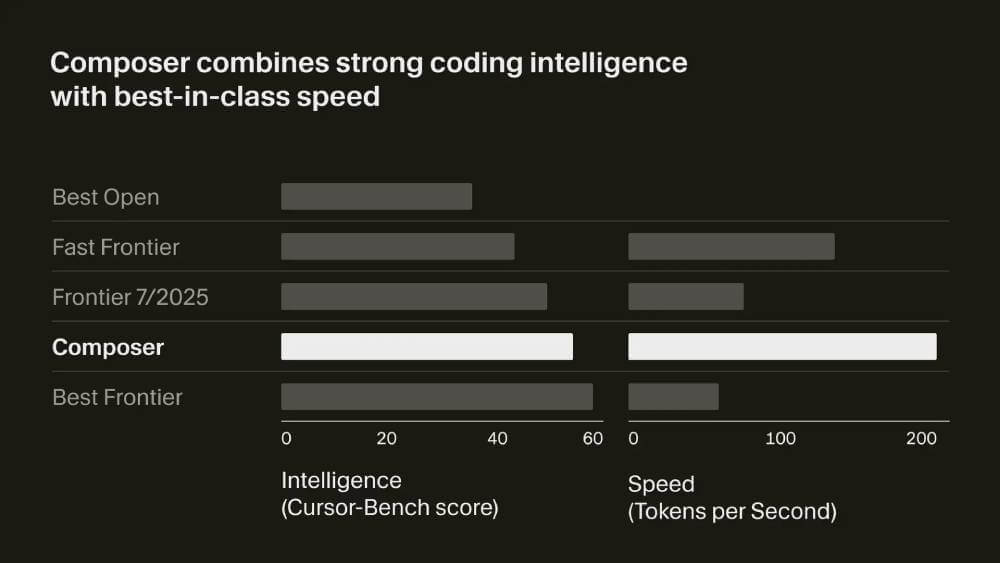
| Cursor just got a major upgrade. Version 2.0 introduces Composer, its first in-house coding model, and a redesigned multi-agent interface that makes the editor feel more like a small development team than a single AI assistant. The headline number is bold: Composer completes most tasks in under 30 seconds and runs four times faster than models in the same intelligence tier.
The Setup
Building with AI assistants used to feel like working with one intern at a time. Each model handled your requests in sequence, often hitting the limits of latency and context. Cursor wanted to fix that by treating coding as a team sport, multiple agents, each with its own workspace, working together.
The Problem Single-agent tools struggle with scale. When a model edits several files or runs commands, tasks start to collide. Reviewing changes becomes tedious, and tests often break silently. Teams using large codebases lose time switching between files or re-running failed builds.
The Insight
Cursor realized agents could work in parallel if each one lived in its own sandbox. Using git worktrees i.e., temporary clones of your repo or remote machines, Cursor 2.0 runs up to eight agents at once. Each agent works independently without touching the same files. The result feels closer to orchestrating teammates than prompting a single chatbot.
The Breakthrough Composer powers this system. It’s a mixture-of-experts model, meaning it routes parts of a task to specialized sub-models for faster, more accurate coding. It also uses semantic search across your codebase to find relevant functions and dependencies before writing anything.
Key features:
Tool-aware training with file edits, terminal commands, and debugging traces. Low-precision MXFP8 kernels for faster inference. Multi-step reasoning for long coding tasks. Reinforcement learning for correctness and structure adherence. The Impact
Cursor’s interface now centers on agents, not files. You can: Spin up agents from a sidebar and assign them tasks. Review multi-file diffs in a single pane. Test results directly inside the editor with the new embedded browser. Run shell commands safely in sandboxed terminals with no internet access. These updates make Cursor less like an IDE plug-in and more like an autonomous workshop for code. |
|
| Try now
|
|
|
|
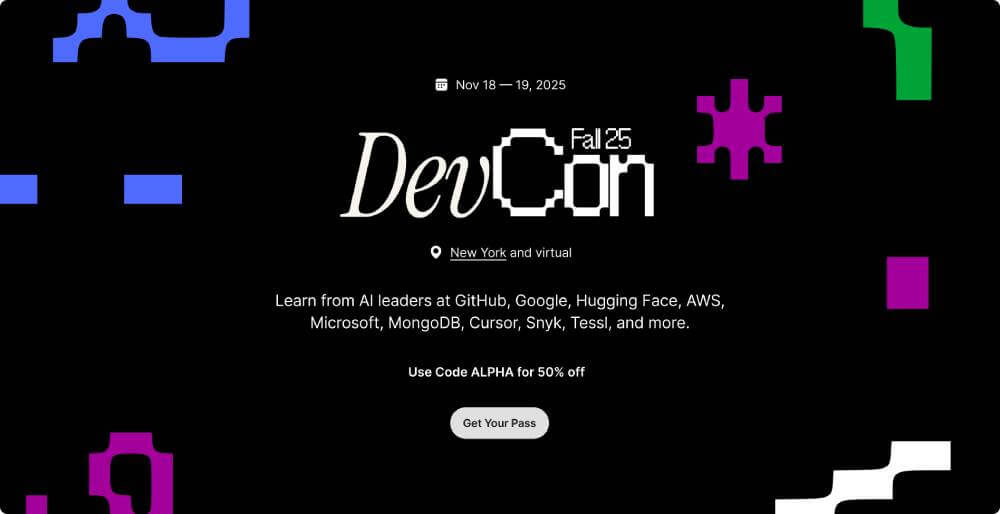
| Last Call: AI Native DevCon Hits NYC + Virtual Nov 18 -19 | Join the AI Native DevCon for two days of sessions, workshops, and talks on building, testing, and shipping with AI and coding agents. Walk away with practical insights you can apply immediately.
See what’s inside:
2 days, 30+ sessions, 3 tracks Deep dives on MCP, agent safety, evals, DX→AX, memory engineering Speakers from GitHub, AWS, Microsoft, Hugging Face, Google, Cursor, and more Community perks: great food, after party, and hallway conversations Free virtual live stream of main stage talks.
Discount expires next week. Get 50% off with code ALPHA. |
| Book your tickets
| partner with us |
|
|
|
Signals
| |
|
1,834 Likes | |
|
2,748 Likes | |
|
2,389 Likes | |
|
1,296 Likes | |
|
|
3,573 Likes | | |
|
|
|
|
Agents in Production - Free Virtual Conference. November 18 - 3:00 PM CET / 9:00 AM ET / 6:00 AM PT
| Join practitioners from Meta, OpenAI, and Google as they share how agentic AI is being deployed in real systems. What’s working, what’s breaking, and what’s next.
With over 25 speakers sharing their hard-earned lessons on deploying agents at scale, expect technical depth, real implementation stories, and a format that keeps your attention between sessions. |
Register free ↗️ |
|
|
|
Reads
| |
|
5,539 Likes |
The method bridges reinforcement learning i.e., on-policy and supervised distillation which is off-policy. It uses reverse-KL per-token loss, training students on what they actually produce, reducing compounding errors and enabling smaller models to perform like larger ones. |
|
|
3,276 Likes | Goose runs locally as an open-source, extensible AI agent that can build projects from scratch, write and execute code, and debug failures. It orchestrates developer workflows using any connected large-language model. |
|
|
| 3,027 Likes |
The article breaks down Transformer architectures from first principles, attention, positional encoding, encoder/decoder stacks. It discusses how they replaced RNNs and how modern LLMs like GPT‑3 build on them. |
| |
| |
|
|
AI Coding Tip
| |
Comment-Driven Refactoring: One Line to Update Every ML Script |
Cursor lets you trigger intelligent multi-file edits using inline comment directives.
Add structured instructions like '# @refactor: convert all dataset paths to pathlib' and hit ⌘+Enter.
Cursor finds every occurrence across your repo, applies consistent changes, and shows a diff before commit. |
# @refactor: replace all os.path.join with pathlib.Path
from pathlib import Path
data_dir = Path("data") / "train"
| Use this when cleaning pipelines, upgrading APIs, or enforcing consistent imports.It removes repetitive edits, preserves context, and works across Python, notebooks, or configs.
Ideal for large ML projects that evolve often but must stay reproducible.
| |
|
|
|
At Alpha Signal, our mission is to build a sharp, engaged community focused on AI, machine learning, and cutting-edge language models, helping over 200,000 developers stay informed and ahead. We’re passionate about curating the best in AI, from top research and trending technical blogs to expert insights and tailored job opportunities. We keep you connected to the breakthroughs and discussions that matter, so you can stay in the loop without endless searching. We also work closely with partners who value the future of AI, including employers and advertisers who want to reach an audience as passionate about AI as we are.
Our partnerships are based on shared values of ethics, responsibility, and a commitment to building a better world through technology.Privacy is a priority at Alpha Signal. Our Privacy Policy clearly explains how we collect, store, and use your personal and non-personal information. By using our website, you accept these terms, which you can review on our website. This policy applies across all Alpha Signal pages, outlining your rights and how to contact us if you want to adjust the use of your information. We’re based in the United States. By using our site, you agree to be governed by U.S. laws. |
|
|
|
Looking to promote your company, product, service, or event to 250,000+ AI developers?
|
| Work with us
|
|
|
|
|
