There is a prevailing assumption in the AI industry that massive frontier models will eventually consume all vertical applications. We routinely see out-of-the-box reasoning capabilities from general models threatening specialized tools, such as AI assistants in the legal sector. The logic dictates that as frontier models advance, specialized tools will lose their moat.
But at least in software engineering, we're seeing a move in the opposite direction, as seen with the recent release of Composer 2.5, Cursor's specialized coding model.
Specialized models compete with frontier models, though their advantage is not raw, generalized intelligence. They win on price, latency, and vertical-specific utility. For high-volume, repetitive tasks like coding, specialized models are rapidly becoming the superior choice for engineering teams.
The case study: Composer 2.5 vs. the frontier
Developers are already shifting their default workloads away from massive foundation models. Power users are actively replacing their default coding agents with Composer 2.5. They prefer the speed and efficiency of specialized agentic loops over waiting on slower models to process every request.
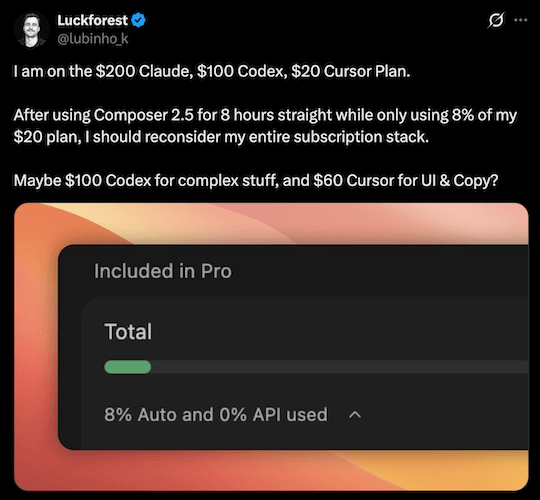
Unit economics explain this shift clearly. Agentic coding requires continuous, long-running loops where the model writes code, reads error logs, and iterates.
Running these autonomous loops exclusively on frontier models quickly becomes a financial burden for companies.
Composer 2.5 standard costs $0.50 per million input tokens and $2.50 per million output tokens. Frontier models like Opus 4.7 and GPT-5.5 sit at roughly $5.00 per million input and $25.00 per million output tokens.
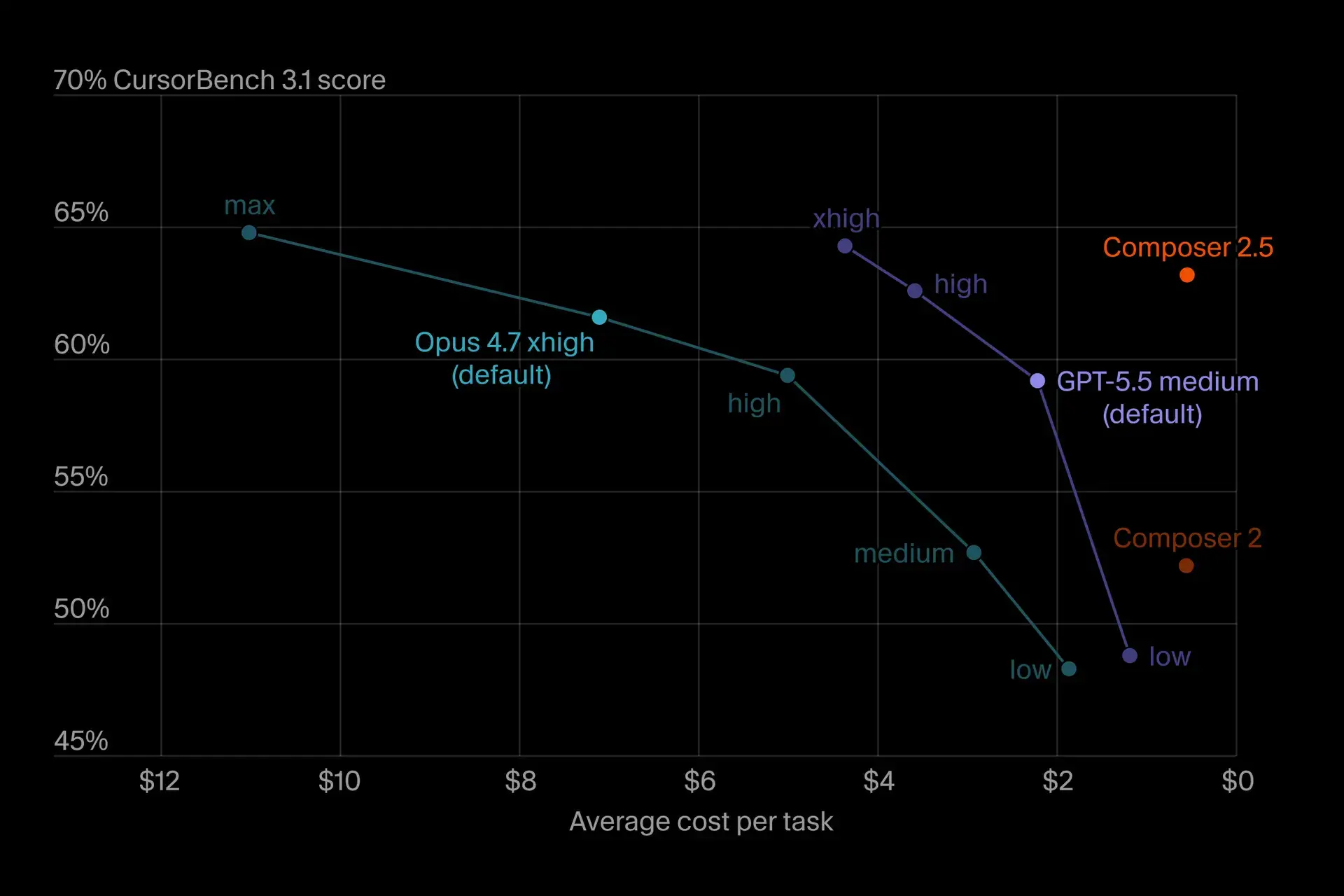
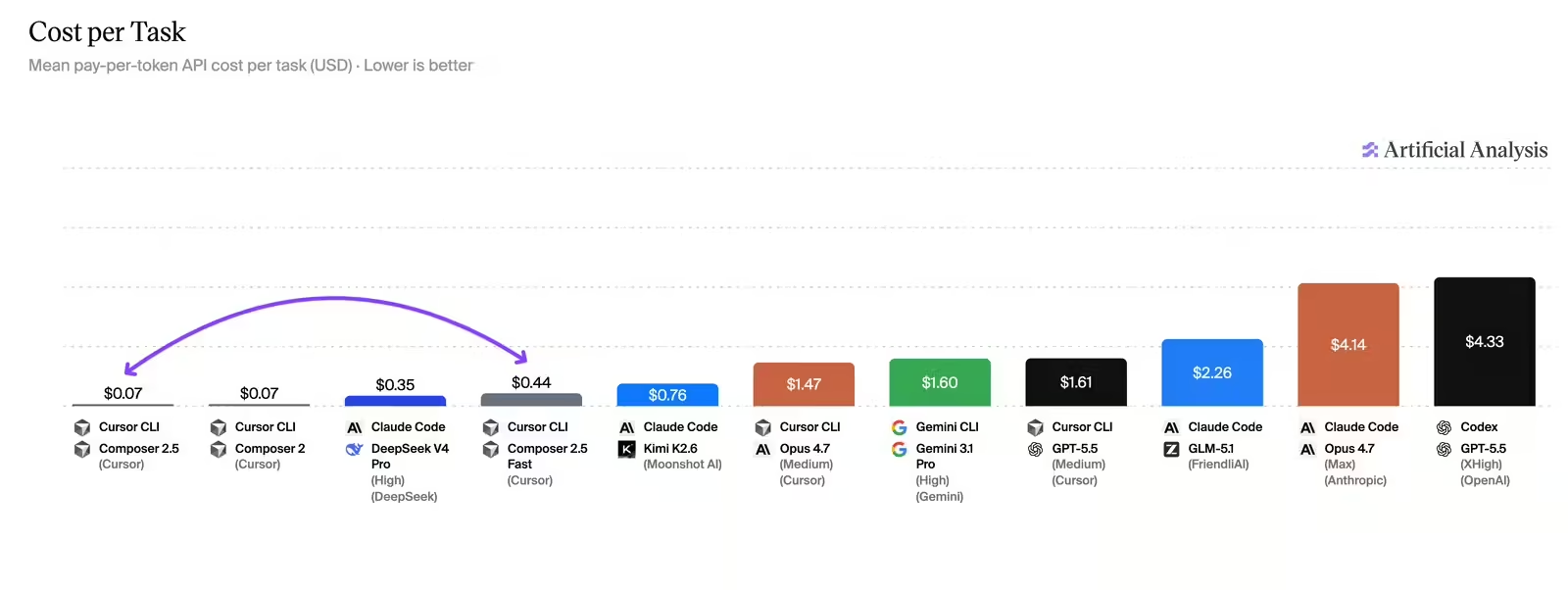
Despite costing a fraction of the price, Composer 2.5 delivers comparable results on complex engineering tasks. It scores a 62 on the Artificial Analysis Coding Agent Index, standing shoulder-to-shoulder with models that cost up to 60 times more per task.
Here is how the unit economics compare:
- Composer 2.5 (Standard): $0.07 average per-task cost (62 benchmark score)
- Claude Opus 4.7: $4.10 average per-task cost (66 benchmark score)
- GPT-5.5 (High Reasoning): $4.82 average per-task cost (65 benchmark score)
Developers get near-frontier performance for specific coding tasks at a fraction of the token spend.
The specialized playbook: Data moats and the flywheel
Cursor achieved this performance without training a foundational model from scratch. They built Composer 2.5 on the open-weight Kimi K2.5.
Cursor dedicated roughly 85 percent of their total compute budget to reinforcement learning (RL) and synthetic data generation. The team trained the new model on 25 times more synthetic coding tasks than its predecessor. This forced the model to practice difficult, multi-step reasoning tasks repeatedly, hardening its ability to follow complex instructions over long contexts.
The real secret to Composer 2.5, however, is product data. Cursor owns the IDE interface, giving them the ability to co-evolve the model and the harness together.
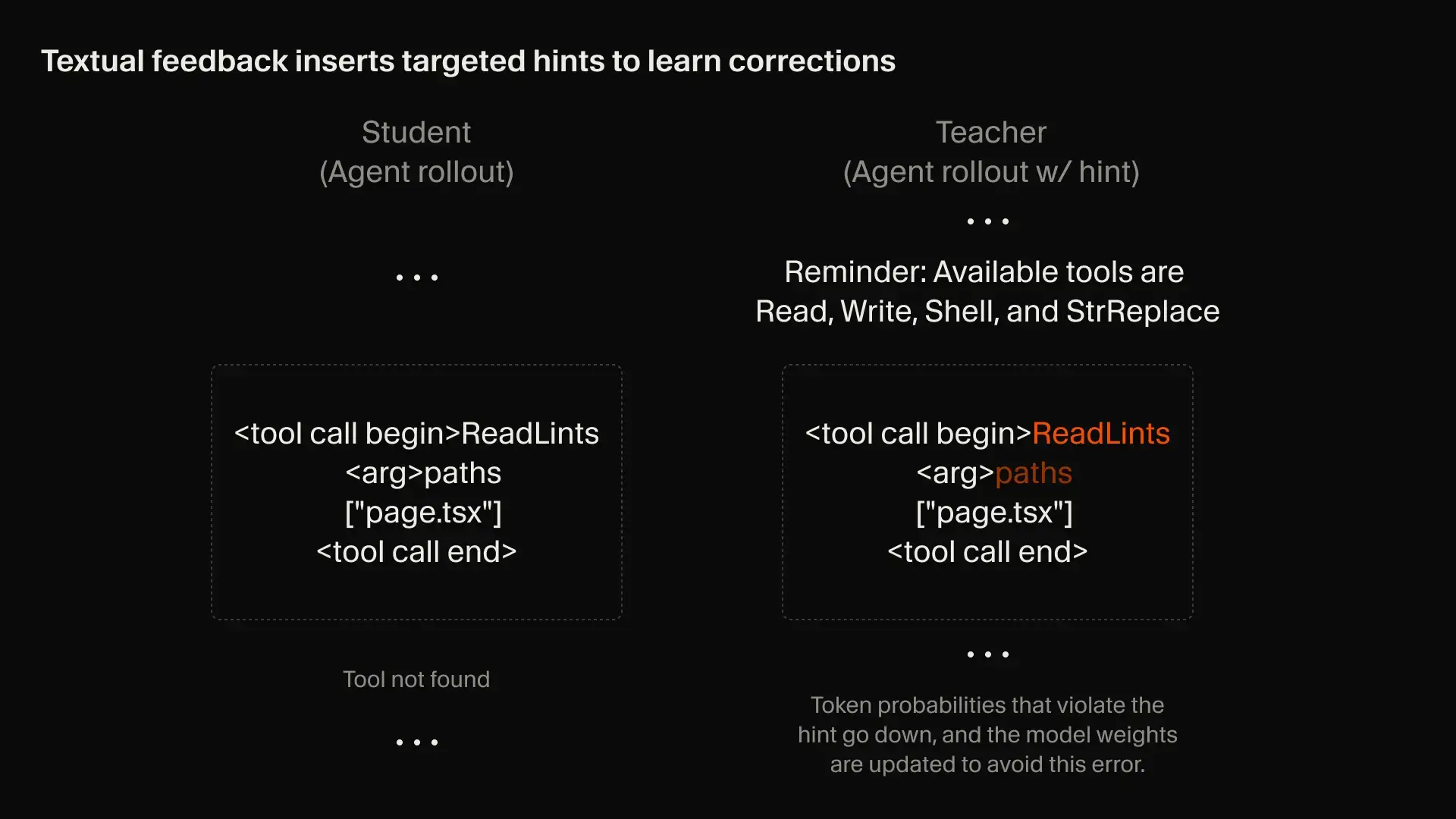
With this, they were able to apply advanced training techniques, including self-distilled fine-tuning (SDFT), to enable the model to improve its behavior without relying on expensive frontier models.
If a model makes a mistake in step four of a 50-step task, a simple pass/fail grade at the end of the rollout is too noisy to be helpful. SDFT inserts a localized textual hint right at the exact moment the model deviates from the correct path. This teaches the model to self-correct efficiently.
If a company owns the user interface and captures specialized interaction data, it possesses the foundation to outcompete a frontier model in its specific domain.
The hybrid architecture and the counterpoints
Modern AI engineering teams are moving away from single-model architectures. They are adopting a hybrid pattern to manage their token spend and maximize return on investment.
With the right adjustments to your workflow, you can route 80 to 90 percent of your coding work to highly efficient models like Composer 2.5. Accordingly, you can reserve the heavy, expensive frontier models for the 10 to 20 percent of deeply complex tasks that involve novel architecture, zero-shot edge cases, or deep research.
However, specialized models have limitations:
- They lag behind frontier models on the hardest, most generalized, or out-of-distribution reasoning tasks (which is why you should still keep frontier models in the mix).
- Integrating a specialized model involves switching friction and setup costs (which can be solved at the harness level).
Not every company has Cursor's massive distribution and usage data advantage. However, organizations with deep proprietary domain data in fields like legal, medical, finance, or internal codebases already have a distinct starting point to build their own targeted models.
The specialization stack
Training a specialized model typically requires managing clusters of GPUs, balancing memory loads, and writing complex distributed training code. It is an infrastructure hurdle that locks many companies out of the market.
But I expect the market to evolve so that more companies can create their specialized AI stack with products that make model fine-tuning cheaper and more accessible. A prime example of this infrastructure maturation is Tinker, a tool launched by Thinking Machines.
Tinker serves as a Python-native API for distributed LLM fine-tuning. It abstracts away the infrastructure requirements. Researchers can define their training loops and reinforcement learning algorithms in standard Python, while the platform handles the hardware orchestration in the background.
Tools like this give standard engineering teams the power to execute the Cursor playbook without needing access to a massive supercomputer cluster.
What are the key takeaways?
For product builders, relying entirely on generic API calls to Anthropic or OpenAI is losing its viability as a defensible margin strategy. Long-term performance and profitability will depend heavily on building or tuning specialized backend models that lower inference costs.
For AI engineers, the required skill set is expanding. Model routing and cost-aware orchestration are now core engineering competencies. Defaulting to the most capable foundation model is no longer an effective architectural choice.
As the underlying infrastructure matures, expect a flourishing market for bespoke models tailored to specific verticals and workflows.