| Hey, | Welcome to today's edition of AlphaSignal, a newsletter for developers by developers.
We identify and summarize the top 1% news, papers, models, and repos in the AI industry. |
|
|
|
IN TODAY'S SIGNAL
| Read time: 4 min 39 sec | 🎖️ Top News
📌 Oxylabs
⚡️ Trending Signals
🛠️ Trending Repos
manim: Python framework for creating mathematical animations.
agents: Build real-time multimodal AI applications.
Python: All Algorithms implemented in Python
🧠 Recommended Lecture
|
|
|
|
If you're enjoying AlphaSignal please forward this email to a colleague.
It helps us keep this content free. |
|
|
|
TOP NEWS
| LLM Research | New Research Vector Post-Training Quantization Achieves 2-Bit Compression for LLMs |
⇧ 986 Likes |
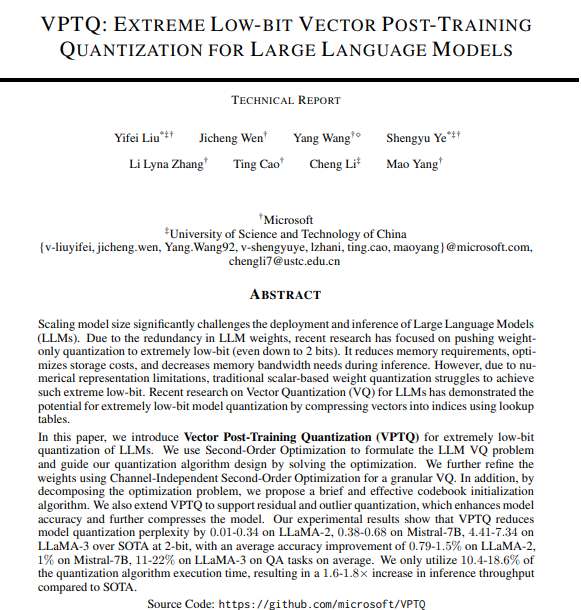 |
What's New | Vector Post-Training Quantization (VPTQ) is a new technique that compresses large language models to extremely low bit-widths without retraining.
It addresses the challenge of deploying massive models on resource-constrained devices by using vector quantization instead of traditional scalar-based weight quantization.
Key highlights Compresses 405B parameter models to 1-2 bits in ~17 hours Enables 70B parameter model inference on a single RTX 4090 GPU Outperforms GPTQ, QuIP#, and AQLM in perplexity and accuracy Maintains high inference throughput with low quantization overhead Supports PyTorch, TensorFlow, and Hugging Face Transformers Experiments demonstrate reduced quantization perplexity and increased accuracy and inference throughput across benchmarks like LLaMA-2, Mistral-7B, and LLaMA-3 compared to state-of-the-art methods.
Core innovation VPTQ's core innovation lies in its use of Second-Order Optimization and Channel-Independent Second-Order Optimization. This approach minimizes quantization errors and allows for more efficient compression. The method compresses weight vectors into indices using lookup tables, achieving better accuracy at 1-2 bits compared to other methods.
Performance metrics Performance metrics demonstrate VPTQ's effectiveness. For the LLaMA-2 70B model quantized to 2.07 bits, VPTQ achieves a perplexity of 3.93 on WikiText-2, an inference speed of 9.7 tokens/second, and memory usage of 19.54 GB. These results indicate minimal loss in model quality while significantly reducing computational requirements.
The scalability of VPTQ is evident in its ability to handle models up to 405B parameters. This suggests potential applicability to even larger models, though specific performance on architectures beyond the LLaMA family remains to be explored. The method's impact on downstream task performance compared to full-precision models is an area for further investigation.
| |
|
|
Read more
|
|
|
|

| First AI copilot for building web scrapers | OxyCopilot, a new AI-powered tool from Oxylabs, helps developers build scalable web scrapers and parsers. It identifies complex website patterns, including nested and listed data, enabling data extraction without coding.
This free tool streamlines the scraping process, allowing developers to focus on results.
With the help of OxyCopilot, you can: Parse raw HTML into structured data Adapt to web layout changes in seconds Free up your time and focus on results |
|
Test for free
| partner with us |
|
|
|
TRENDING SIGNALS
| Andrej Karpathy |
|
⇧ 6,200 Likes | |
Diffusion Model |
|
⇧ 1,025 Likes | |
Computer Vision |
|
⇧ 1,400 Likes | |
Prompt Engineering |
| ⇧ 1,401 Likes |
| Computer Vision |
|
⇧ 1,000 Likes | | |
|
|
|
|
TRENDING REPOS
| Math Animation | |
☆ 21,600 Stars |
Manim helps you create programmatic math animations. It's a Python library for generating explanatory videos, like those on 3Blue1Brown. You can render complex mathematical concepts visually. It supports both 2D and 3D animations. The community version offers frequent updates and extensive documentation. |
| Agents |
|
☆ 2,600 Stars |
Helps you build AI agents that process and generate real-time text, audio, video, and images via LiveKit sessions. It integrates popular LLMs, STT, TTS services, and RAG databases. You can create voice assistants with turn detection, interruption handling, and function calling. It supports local, self-hosted, and cloud deployments with load balancing. |
| Algorithm |
|
☆ 190,000 Stars |
Helps you learn and implement algorithms in Python. You'll find code for various domains like computer vision, data structures, and machine learning. It's community-driven, with 100+ contributors. The codebase follows black formatting and uses pre-commit hooks for quality control. |
| |
|
|
|
|
|
LECTURE
| Prompt Caching |
Anthropic prompt caching: optimize API calls for faster LLM interactions. |
⇧ 5100 Likes |
 |
Prompt Caching is a new API feature that optimizes large language model interactions. It caches and reuses consistent parts of prompts, reducing processing time and costs for repetitive tasks.
This technique is particularly useful for scenarios involving large contexts, multiple examples, or long conversations. Prompt Caching works by checking if a prompt prefix is already cached from a recent query and using it if found, otherwise processing and caching the full prompt.
You'll learn about: Implementing Prompt Caching with the Messages API Structuring prompts for effective caching Cache limitations and supported models Tracking cache performance Pricing structure for cached content Best practices for optimizing cache usage Troubleshooting common issues Privacy and data separation in caching |
|
Read more
|
|
|
|
Looking to promote your company, product, service, or event to 200,000+ AI developers? Let's work together.
|
|
Advertise
|
|
|
|
|
