| Hey, | Welcome to AlphaSignal – the most read newsletter by AI developers.
We bring you the top 1% of news, papers, models, and repos, all summarized to keep you updated on the latest in AI. |
|
|
|
IN TODAY'S SIGNAL
| Read time: 4 min 59 sec | 🎖️ Top News
📌 Speechmatics
⚡️ Trending Signals
📝 Top Tutorials
🧠 How To |
|
|
|
If you're enjoying AlphaSignal please forward this email to a colleague.
It helps us keep this content free. |
|
|
|
TOP NEWS
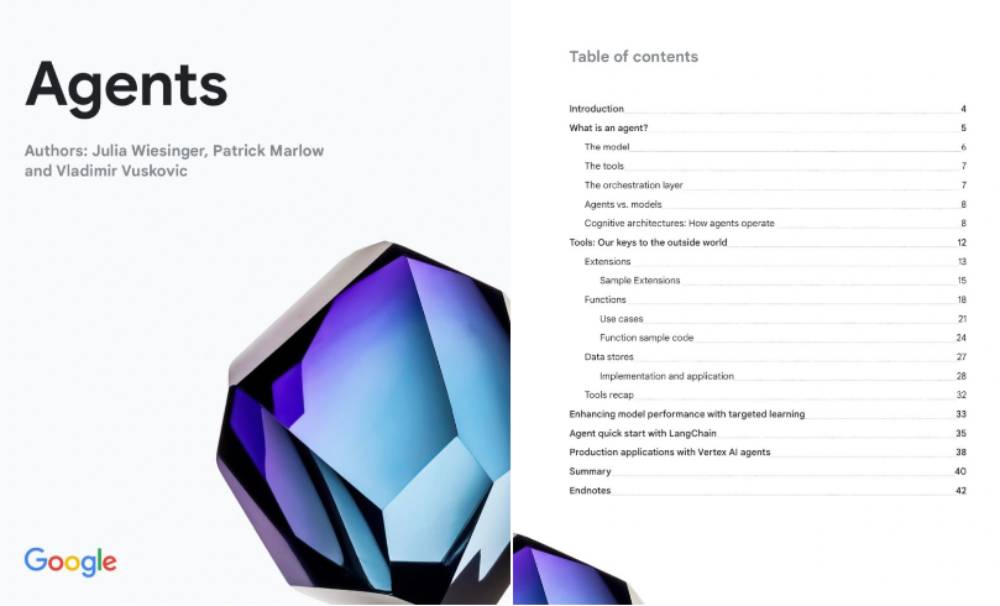
| Agents | Google releases whitepaper on AI Agents, covers basics of LLM agents and langchain implementation |
⇧ 16,739 Likes |
| What's New |
Google publishes a whitepaper that explains how AI agents combine reasoning, tools, and external data to perform autonomous tasks. These agents transform large language models (LLMs) into systems that automate workflows and execute real-world actions.
Key Architectural Components
The whitepaper identifies three core elements for building AI agents:
- Decision Engine: The LLM plans and executes tasks using reasoning frameworks like ReAct or Chain-of-Thought.
- Tool Integration: Agents access APIs, databases, and real-time data streams to perform tasks.
- Orchestration Layer: The system manages task execution, decision flows, and tool interactions.
Tool Categories
The tools are divided into three categories based on their functionalities:
Extensions: Let agents call APIs directly for autonomous execution.
Functions: Enable developers to handle execution client-side with more control.
Data Stores: Provide retrieval-augmented generation (RAG) for accessing large external datasets.
Implementation and Scalability
Google outlines practical implementation strategies using frameworks like LangChain and managed services like Vertex AI. LangChain simplifies prototyping and testing, while Vertex AI supports scaling agents for production. These tools allow you to build, test, and scale agents for complex workflows.
Applications and Use Cases
Agents combine reasoning and tool usage to complete tasks such as personalized recommendations, automated workflows, and database queries.
For example, an agent can retrieve a user’s purchase history via a database API and generate tailored outputs or execute API-based transactions.
Google’s framework standardizes how agents operate, ensuring reliable autonomous task execution across applications.
| |
| Read more
|
|
|
|
| Need speech recognition that’s faster, smarter, and more Reliable? |
Flow from Speechmatics simplifies voice-powered interactions with a single API call that handles listening, thinking, and responding.
Manage group conversations, interruptions, and noisy environments without piecing together multiple tools.
Speechmatics provides:
Real-time, accurate speech-to-text, even in noisy settings.
Support for all languages, accents, and dialects.
Tools for handling group conversations effectively. Build systems that capture every word. Try Speechmatics now. |
| Experience the difference today
| partner with us → |
|
|
|
TRENDING SIGNALS
| Lip Sync Model |
|
⇧ 2,592 Likes | |
Agents |
|
⇧ 1,836 Likes | |
Model Architecture |
|
⇧ 1,258 Likes | |
Language Model |
|
⇧ 927 Likes | |
AI Tool |
|
⇧ 1,472 Likes | | |
|
|
|
|
TOP TUTORIALS
| Language Models |
| ⇧ 1,835 Likes |
This practical course by Hugging Face helps you align language models with your specific use case. You'll learn instruction tuning, preference alignment using DPO/ORPO, LoRA, prompt tuning, and multimodal model adaptation. It covers creating synthetic datasets, evaluation, and efficient inference. The final capstone project applies these skills in a real-world scenario. |
| RAG |
| ⇧ 1,384 Likes |
This tutorial guides you through building a Graph RAG app that improves LLM accuracy using knowledge graphs. It covers data preparation, search refinement with MeSH terms, and article summarization. By combining vector databases for retrieval and knowledge graphs for metadata filtering, you’ll create an accurate, scalable RAG system adaptable across domains. |
| Audio Benchmarking |
| ⇧ 826 Likes |
Learn how to evaluate audio language models using the Big Bench Audio dataset. You'll explore reasoning performance across Speech to Speech, Speech to Text, Text to Speech, and Text to Text tasks. Initial results show GPT-4o drops from 92% accuracy on text tasks to 66% on Speech to Speech, revealing a significant performance gap. |
| |
| |
|
|
HOW TO
| Voice Cloning |
How To Convert eBooks to Audiobooks |
⇧ 490 Likes |
This guide walks you through converting eBooks into audiobooks with chapters and metadata using the ebook2audiobook tool. It uses dynamic AI models and voice cloning technology to generate high-quality audiobooks in over 1,100 languages. The process uses tools like Calibre, ffmpeg, XTTSv2, and Fairseq for seamless conversion.
Here’s how to convert your eBook to an audiobook:
Step 1Access the ebook2audiobook Colab notebook here.
Step 2Upload your non-DRM eBook to Colab in supported formats like PDF, EPUB, or TXT.
Step 3
Run the setup commands in the notebook to install required libraries.
Step 4Choose your preferred language and voice options.
Step 5Run the conversion command:
!python convert_ebook.py --input your_ebook_file --output output_file_path --language your_language --voice cloning_voice
Step 6
Download the generated audiobook with chapters and metadata. |
| Try now
|
|
|
|
At Alpha Signal, our mission is to build a sharp, engaged community focused on AI, machine learning, and cutting-edge language models, helping over 200,000 developers stay informed and ahead. We’re passionate about curating the best in AI, from top research and trending technical blogs to expert insights and tailored job opportunities. We keep you connected to the breakthroughs and discussions that matter, so you can stay in the loop without endless searching. We also work closely with partners who value the future of AI, including employers and advertisers who want to reach an audience as passionate about AI as we are.
Our partnerships are based on shared values of ethics, responsibility, and a commitment to building a better world through technology.Privacy is a priority at Alpha Signal. Our Privacy Policy clearly explains how we collect, store, and use your personal and non-personal information. By using our website, you accept these terms, which you can review on our website. This policy applies across all Alpha Signal pages, outlining your rights and how to contact us if you want to adjust the use of your information. We’re based in the United States. By using our site, you agree to be governed by U.S. laws. |
|
|
|
Looking to promote your company, product, service, or event to 200,000+ AI developers? Let's work together.
|
| Work with us
|
|
|
|
|
