|
|
|
Hey
|
Welcome to AlphaSignal, the most read source of news by AI engineers and researchers.
Every day, we identify and summarize the top 1% of news, papers, models, and repos, so you’re always up to date.
Here’s today’s roundup:
|
|
Top News
|
|
|
|
OpenAI launches Codex-Max to support repo-scale refactors, multi-stage debugging, and extended reasoning
|
|
9,284 Likes
|
|
|
OpenAI drops GPT-5.1-Codex-Max into Codex, and the headline is simple: the model now works across millions of tokens by compressing its own history and starting fresh windows without losing the plot. That shift turns long refactors, multi-hour debugging loops, and full-repo rewrites into tasks the model actually finishes.
The big story is that this works automatically, you do nothing but keep the session open.
The Problem
Developers hit context limits every time a model has to work across large codebases or multi-step debugging chains. When the window fills, the model forgets earlier steps or derails. Long sessions die before they reach the finish line.
-
Large tasks exceed a single context window.
-
Debug chains lose state after enough back-and-forth.
-
Repo-scale changes stall mid-execution.
How Compaction Fixes It
Codex-Max uses compaction to prune low-value tokens and keep key reasoning steps. Think of it as a rolling compression pass that preserves intent while discarding noise.
-
The system compacts automatically near the window limit.
-
It opens a new window without dropping essential context.
-
It maintains coherence across multi-hour and multi-day workflows.
What the Model Actually Achieves
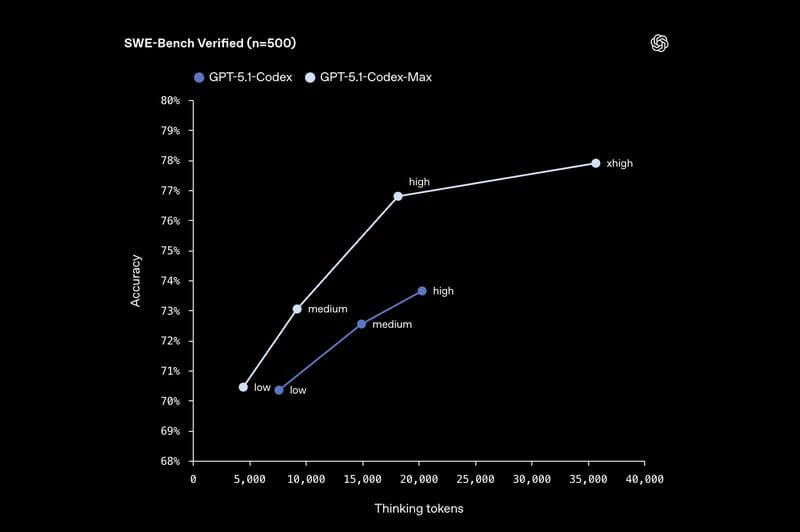
Codex-Max posts new highs on frontier coding tasks and handles workflows earlier models abandon.
-
77.9% on SWE-Bench Verified.
-
79.9% on SWE-Lancer IC SWE.
-
58.1% on Terminal-Bench 2.0.
Impact
You can run bigger tasks without micromanaging prompts or chunking your codebase. The model also uses 30% fewer thinking tokens at medium effort.
-
You can run full refactors.
-
You can handle multi-stage test failures.
-
You can use Windows-specific tools reliably.
How You Use It Today
You can load GPT-5.1-Codex-Max now in the Codex CLI, IDE extension, cloud workflows, and code review tooling. It is the default for Plus, Pro, Business, Edu, and Enterprise users. API access arrives soon.
|
|
|
|
See How Leading LLMs Compare for Code Quality and Security: Free Report
|
|
Sponsored
|

|
|
Sonar tests GPT-5, Claude Sonnet 4, Llama 3 and additional LLMs for code quality, security, and model traits in the new “The Coding Personalities of Leading LLMs” report.
Get facts, not assumptions:
- Compare LLM strengths, flaws, and real performance metrics
- See each model’s coding archetype and unique style
- Uncover hidden quality and security risks
- Learn how to pick the right LLM for your use case
Get clear answers from Sonar’s analysis. The report is free to download.
|
|
|
|
partner with us
|
Compare Vision Models Without Any Setup Using Roboflow
Vision model benchmarking slows work when each model needs separate APIs, runtimes, or GPUs. Roboflow Playground removes that overhead and gives you instant access to dozens of open and closed source models on hosted GPUs. Run blind comparisons, check outputs side-by-side, and try models from OpenAI, Meta, Anthropic, and Google with no API key. No sign-up required. |
|
|
Top Lecture
|
|
|
|
DeepLearning.ai's new course shows how semantic caching cuts LLM latency and cost
|
|
|
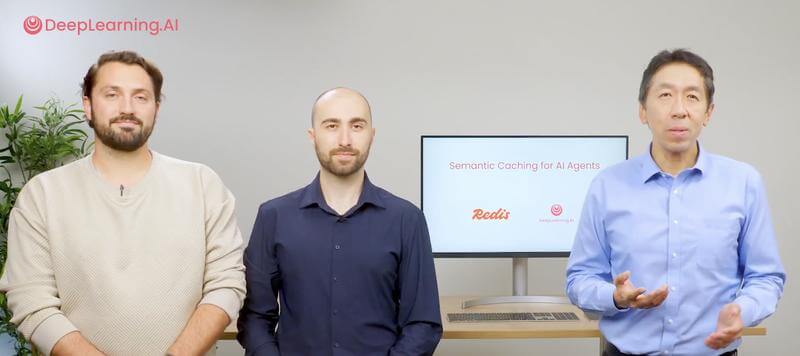
The “Semantic Caching for AI Agents” lecture shows how semantic caching cuts inference cost and latency by reusing past answers based on meaning, not exact text. You follow the full arc: why redundant calls slow agents, how semantic similarity solves that bottleneck, and how Redis tools help you build a cache that reacts in real time. The walkthrough stays practical, shows each component in context, and helps you ship a faster agent workflow. You learn to: - Build a semantic cache with Python and Redis tools
Measure hit rate, precision, recall, and latency Improve accuracy with threshold tuning, cross-encoders, LLM validation, and fuzzy matching Integrate semantic caching into an AI agent that reduces duplicate calls and speeds up with use
|
|
|
At Alpha Signal, our mission is to build a sharp, engaged community focused on AI, machine learning, and cutting-edge language models, helping over 200,000 developers stay informed and ahead. We’re passionate about curating the best in AI, from top research and trending technical blogs to expert insights and tailored job opportunities. We keep you connected to the breakthroughs and discussions that matter, so you can stay in the loop without endless searching. We also work closely with partners who value the future of AI, including employers and advertisers who want to reach an audience as passionate about AI as we are.
Our partnerships are based on shared values of ethics, responsibility, and a commitment to building a better world through technology.Privacy is a priority at Alpha Signal. Our Privacy Policy clearly explains how we collect, store, and use your personal and non-personal information. By using our website, you accept these terms, which you can review on our website. This policy applies across all Alpha Signal pages, outlining your rights and how to contact us if you want to adjust the use of your information. We’re based in the United States. By using our site, you agree to be governed by U.S. laws.
|
|
|
Looking to promote your company, product, service, or event to 250,000+ AI developers?
|
|
|
|
|
