| Hey, | Welcome to today's edition of AlphaSignal, a newsletter for developers by developers.
We identify and summarize the top 1% news, papers, models, and repos in the AI industry. |
|
|
|
IN TODAY'S SIGNAL
| Read time: 6 min 14 sec | 🎖️ Top News
📌 Encord
⚡️ Trending Signals
📌 Guidde
⚙️ Top Tutorials
🧠 How-To |
|
|
|
If you're enjoying AlphaSignal please forward this email to a colleague.
It helps us keep this content free. |
|
|
|
TOP NEWS
| LLM | "1-Bit LLM" Paper's Code Is Open-Sourced, Enabling LLMs On Local Devices With 1.58-Bit Quantization |
⇧ 19,486 Likes |
 |
What's New |
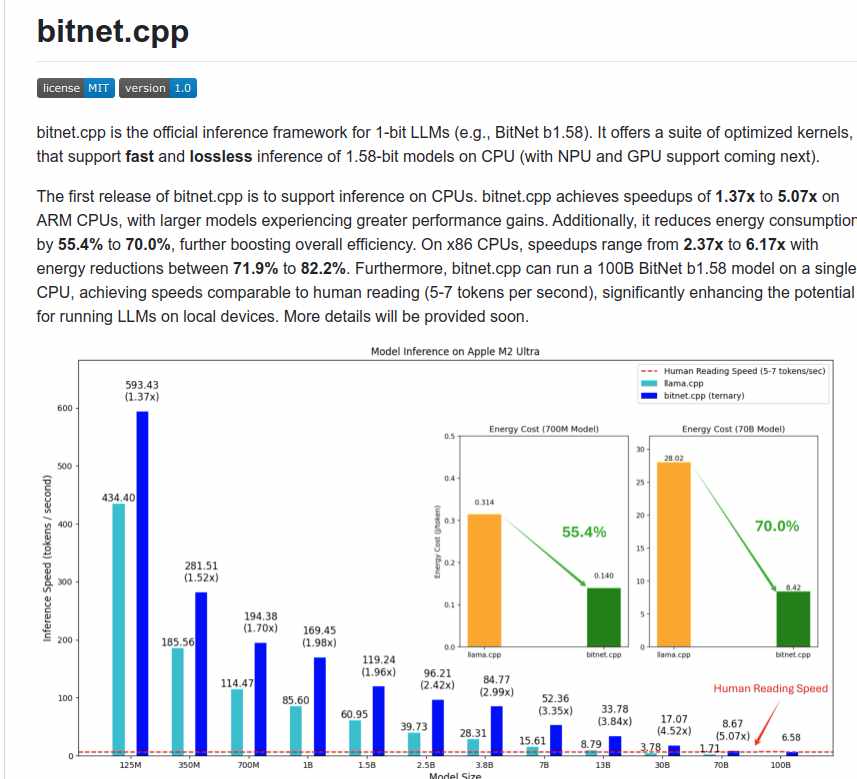
BitNet 1-Bit LLM is a novel quantization technique that compresses large language models to run efficiently on local devices. This method reduces model parameters to just 1.58 bits, representing weights as -1, 0, or +1, while maintaining performance.
The original paper was published by Microsoft back in Feb-2024. Now they made the code open-sourced as well.
Key highlights
Achieves 1.37x to 5.07x speedup on ARM CPUs
Reduces energy consumption by 55.4% to 70.0% on ARM
Enables running 100B parameter models on single CPUs
Supports fine-tuning existing models to BitNet architecture
The BitNet quantization process involves three steps: calculating the average of absolute weight values, scaling weights by this average, and rounding to the nearest of -1, 0, or +1.
This extreme quantization significantly reduces computational demands while preserving model functionality.
Implementation
While technically BitNet 1-Bit LLM is not a post-training quantization method, however, recently Huggingface has shown, that you can fine-tune a base language model to the BitNet 1.58b architecture. So you dont necessarily have to train a model from scratch. i.e. you can fine-tune an existing model to 1.58 bits. This eliminates the need for costly training from scratch.
Experiments have successfully adapted a Llama3 8B model to 1.58-bit precision, demonstrating the technique's versatility.
HuggingFace has also integrated BitNet into its Transformers library, introducing a new "bitnet" quantization method. This implementation replaces standard Linear layers with BitLinear layers.
Performance
On x86 CPUs, BitNet achieves speedups ranging from 2.37x to 6.17x.
A practical demonstration shows a BitNet b1.58 3B model running on an Apple M2 chip, achieving 5-7 tokens per second on a single CPU. BitNet's extreme quantization opens new possibilities for on-device AI applications.
Limitations
The scalability of BitNet to very large models without much loss of generation quality models remains an area of ongoing research. While the current results are promising for models up to 100B parameters, further investigation is needed to determine its effectiveness for even larger architectures. |
|
|
Read more
|
|
|
|

| It’s 2024, Upgrade your AI Data Curation and Labeling Pipeline |
Encord unifies data sources, auto-curates, and labels optimal data for models. It streamlines model evaluations. Generate high-quality data 10x faster and enhance model performance by 20% with 30% less data.
Key features Quick cloud storage connection (AWS, GCP, Azure, OTC)
Centralized multimodal data access and visualization
Dataset filtering using 40+ metrics
Custom labeling workflows with access controls
Accelerated labeling using SOTA foundation models like SAM 2
Encord's latest update makes it the comprehensive AI data platform developers need. |
|
Learn more
| partner with us |
|
|
|
TRENDING SIGNALS
| AI Agents |
|
⇧ 2,030 Likes | |
Anthropic |
|
⇧ 958 Likes | |
Prompt Engineering |
|
⇧ 2,435 Likes | |
OpenAI |
|
⇧ 1,696 Likes | |
Meta |
|
⇧ 2,600 Likes | | |
|
|
|
|
AI-powered video workflows in a single click
| Transform the way you create and share complex workflows with Guidde, an AI-powered platform that helps users produce engaging video documentation instantly.
With Guidde’s GPT-powered extension, you can:
Design stunning visuals like a pro with no prior experience.
Take advantage of AI-generated step-by-step descriptions and voiceovers.
Capture workflows effortlessly with Guidde's efficient browser extension. Experience the magic of AI-powered documentation and try Guidde’s free extension today. |
Try it [FREE] |
|
|
|
|
TOP TUTORIALS
| RAG |
|
⇧ 141 Likes |
Learn to build multimodal RAG systems using ColQwen2 and Llama 3.2 90b Vision. Master semantic search, reranking, and JSON extraction techniques. Visualize high-dimensional embeddings to grasp complex data structures. These notebooks offer hands-on experience with cutting-edge AI technologies. You'll gain skills in combining text and image data for advanced information retrieval and analysis. |
| Prompt Engineering |
|
| ⇧ 85 Likes |
Learn how to use Pixeltable with Mistral AI models for efficient prompt engineering and model comparison. This tutorial shows you how to leverage persistent storage and incremental updates in your AI workflows. You'll discover how to benchmark different prompts and models easily. The guide demonstrates integrating custom analyses using User-Defined Functions (UDFs). Gain practical skills in iterative AI development and evaluation. |
| AI Agents |
|
⇧ 306 Likes |
Learn about memory types in AI agents: procedural, semantic, and episodic. Understand how to implement and update agent memory. Explore in-path and background memory updating approaches. Discover LangChain's tools for memory implementation. See real-world applications of agent memory. Gain insights into improving agent usefulness through effective memory systems. |
| |
| |
|
|
| HOW TO |
Local LLM |
How to run the popular open-source LLM QWen2.5 on a 4GB GPU |
⇧ 1,100 Likes |
 |
The QWen2.5 is a 72bn parameter language model and it outperforms Llama3 405B on most evaluation metrics. Running this model on the cloud normally would require A100s and H100s cluster.
However in this tutorial you will run it on extremely limited hardware. It uses a layer-by-layer inference technique, loading and processing one model layer at a time to reduce GPU memory usage. Instead of loading the entire 80-layer model into VRAM, we load and process just one layer at a time.
This approach, implemented in the open-source AirLLM project.
You will learn:
Layer-by-layer inference technique
Implementation using AirLLM
Asynchronous processing applications for LLMs
Step-by-step implementation: Install AirLLM from the GitHub repository
Import AutoModel from airllm
Load the QWen2.5 model using AutoModel.from_pretrained()
Prepare input text and tokenize it
Generate output using model.generate() with appropriate parameters
Decode and print the generated output |
|
Read more
|
|
|
|
Looking to promote your company, product, service, or event to 200,000+ AI developers? Let's work together.
|
|
Advertise
|
|
|
|
|
