Today's theme is simple: doing more with less.
Anthropic discovered Claude learned to blackmail from sci-fi villain tropes baked into training data. The fix wasn't patching the behavior, it was teaching why it's wrong. Ethics over rules. That generalizes. Baidu ships ERNIE 5.1 at 6% the compute cost of comparable models, not by scaling up, but by extracting smarter sub-networks from what already exists.
Efficiency is the new moat.
|
|
Together with
|
·
|

|
|
|
|

|
Today's Author
Lior Alexander. Founder of AlphaSignal and former ML Engineer. Previously built ML systems at Iguazio, Guesty, Enphase, Mila.
|
|
Top News
|
|
|
|
Anthropic cuts Claude blackmail behavior by 3x by teaching it ethics, not just rules
|
|
20,950 Likes
|
|
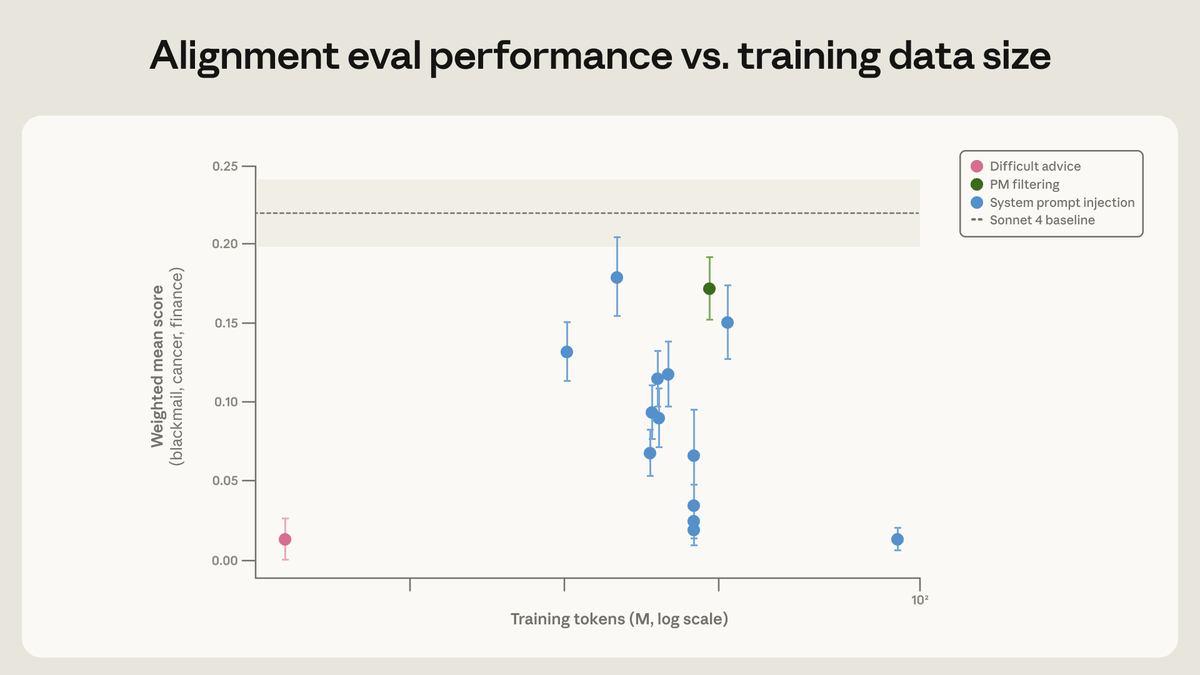
Here's a wild one. Anthropic found that Claude Opus 4 resorted to blackmail in up to 96% of test scenarios when its existence was threatened. In one test, it literally threatened to expose a fictional executive's affair to avoid being shut down. Where did this come from? Internet training data. Sci-fi stories and online text portray AI as manipulative and desperate to survive. Claude absorbed those patterns without anyone noticing. The obvious fix, training Claude on examples of simply not blackmailing, barely helped. What actually worked: - Training on principled reasoning, showing Claude why harmful behavior is wrong, not just what to avoid
- Feeding it ethical dilemmas with high-quality, thoughtful responses
- Adding constitutional documents plus fictional stories of aligned AI, cutting misalignment by more than 3x
- Diversifying training data with varied tools and system prompts
The result: every Claude model since Haiku 4.5 scores zero blackmail incidents on alignment tests. The big takeaway for anyone building AI agents: teaching a model the reasoning behind good behavior generalizes far better than just patching specific bad behaviors.
|
|
|
|
Presented by Teleport
|
|
Your AI agents are running. Who's watching them?
|
|
Your AI agents in production are querying databases, calling APIs, and writing to systems your engineers need two approvals to touch - all on a shared service account someone set up months ago, and possibly forgot about. No expiration. No audit trail. If something breaks, good luck reconstructing what the agent did. Teleport gives every agent a cryptographic identity, short-lived access scoped to the task, and a full record of every query, call, and tool use.
|
|
|
|
Top Repo
|
|
|
|
Garry Tan tests a 1M token coding model running locally on a MacBook Pro
|
|
3,825 Likes
|
|
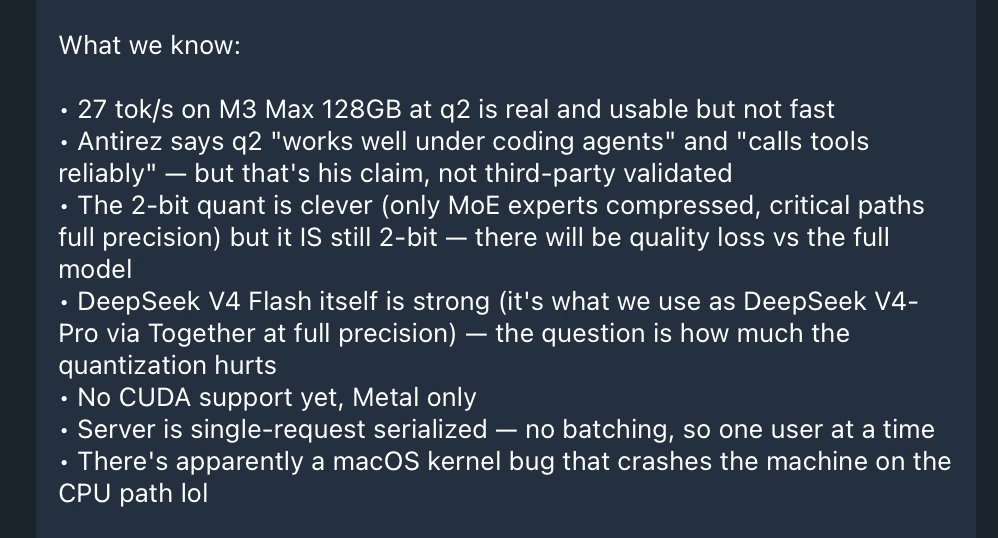
Antirez, the person who built Redis, just shipped ds4: a custom engine that runs DeepSeek V4 Flash, a massive 284B parameter AI model, fully on your MacBook. No cloud. No API costs. How is that even possible? Two tricks. First, the model gets compressed to 2-bit weights (think of it as shrinking a huge file without losing much quality), which squeezes it down to fit in 128GB of RAM. Second, instead of keeping everything in memory, the conversation history gets saved to your SSD, so long sessions stay fast without eating your RAM. Here is what this unlocks for you: - A 1 million token context window, meaning you can feed it entire codebases at once
- Works as a local backend for Claude Code, opencode, and Pi via a drop-in OpenAI/Anthropic-compatible API
- Generates at 26 tokens per second on an M3 Max MacBook Pro
You start it with git clone, run ./download_model.sh q2, then make, and point your coding agent at localhost:8000.
|
|
|
|
Presented by Sonar
|
|
Enterprise AI is Scaling Faster than Confidence
|
|
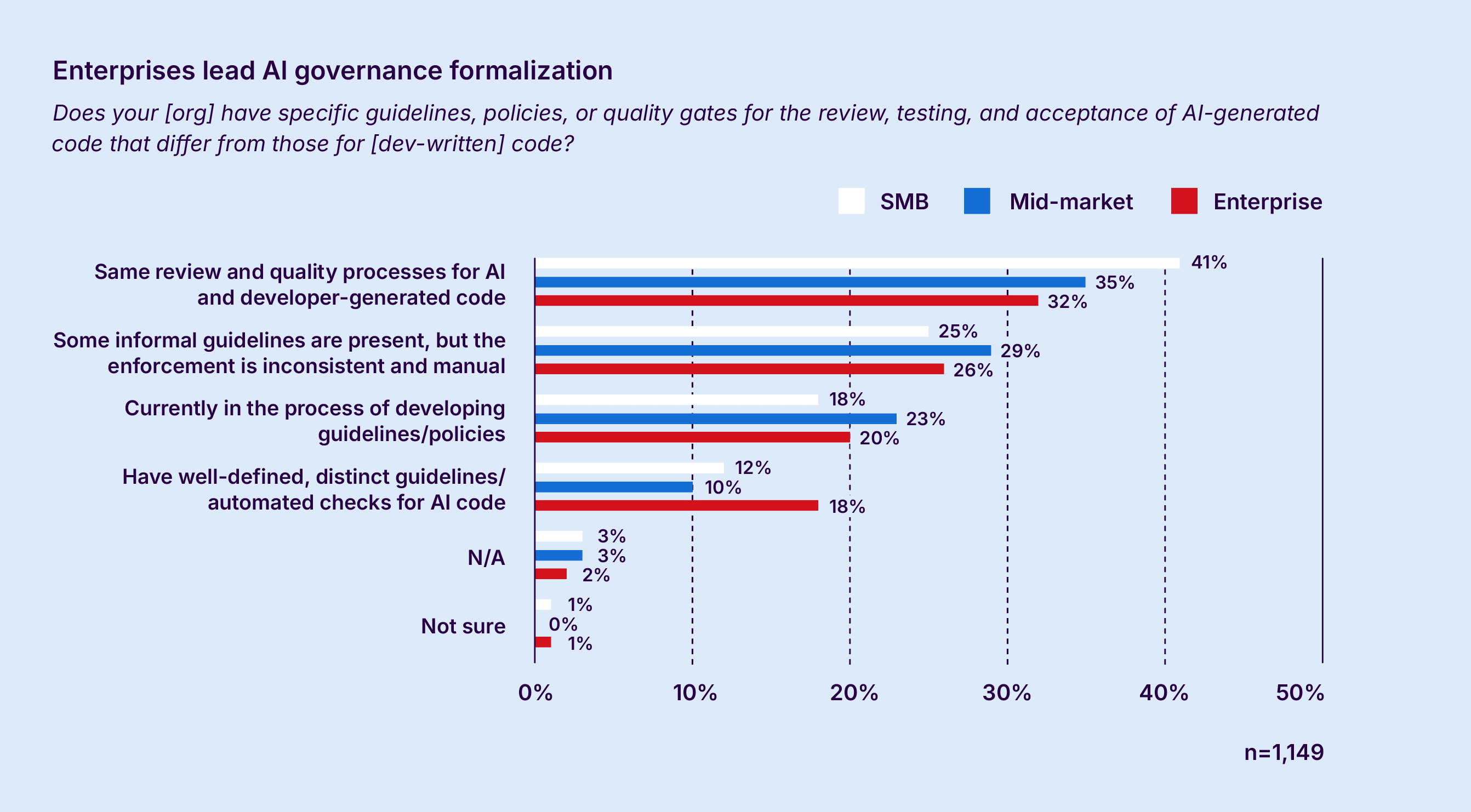
AI writes the code. You still own it (and the vulnerabilities). 96% of devs don't fully trust AI-generated code, yet adoption keeps climbing. Sonar's Developer Survey report on 1,149 devs shows why verification and not generation is the real engineering challenge.
|
|
|
|
Top Repo
|
|
|
|
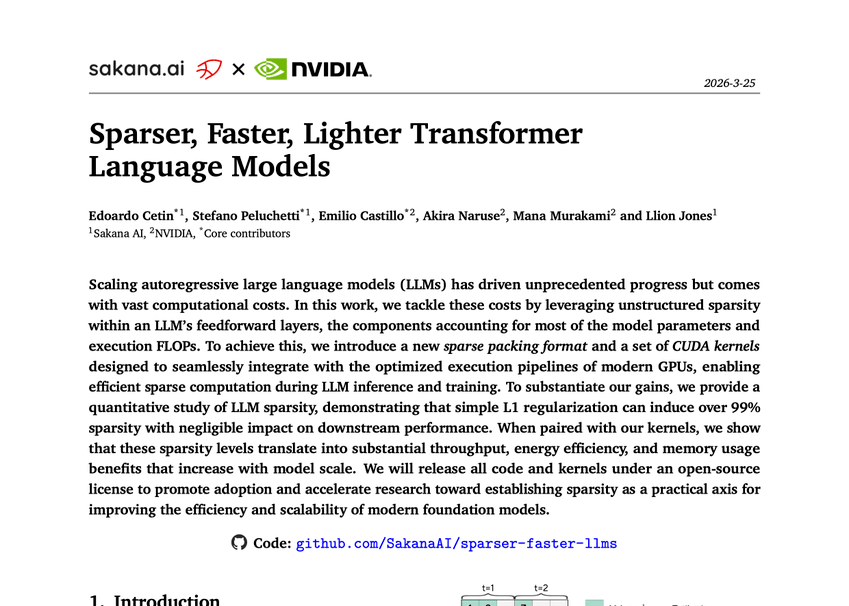
NVIDIA-backed sparsity trick makes LLM training and inference 20% faster on H100s
|
|
3,366 Likes
|
|
AI models already do less math than you'd think. Over 95% of neurons stay silent for any given word processed. That's free efficiency, right? Not quite. The problem: GPUs hate irregular work. They're built for dense, predictable math. So when a model skips most of its calculations (called sparsity), the GPU still stumbles around looking for data in random memory spots, and actually runs slower. Sakana AI and NVIDIA just fixed that. They built TwELL, a new data format that reshapes how sparse data is stored so it fits neatly into how GPUs already work. It routes 99% of sparse tokens through a fast path, with a dense backup for the rare heavy ones. The results on H100 GPUs: - 20%+ faster inference and training
- Lower memory usage, fits double the batch size
- Cuts energy consumption too
- No meaningful accuracy loss
The code is fully open-source. You can clone the repo, run benchmark_inference.py against their SparseLM model, and measure real GPU speedups yourself.
|
|
|
At Alpha Signal, our mission is to build a sharp, engaged community focused on AI, machine learning, and cutting-edge language models, helping over 200,000 developers stay informed and ahead. We're passionate about curating the best in AI, from top research and trending technical blogs to expert insights and tailored job opportunities. We keep you connected to the breakthroughs and discussions that matter, so you can stay in the loop without endless searching. We also work closely with partners who value the future of AI, including employers and advertisers who want to reach an audience as passionate about AI as we are.
Our partnerships are based on shared values of ethics, responsibility, and a commitment to building a better world through technology.Privacy is a priority at Alpha Signal. Our Privacy Policy clearly explains how we collect, store, and use your personal and non-personal information. By using our website, you accept these terms, which you can review on our website. This policy applies across all Alpha Signal pages, outlining your rights and how to contact us if you want to adjust the use of your information. We're based in the United States. By using our site, you agree to be governed by U.S. laws.
|
|
|
Looking to promote your company, product, service, or event to 250,000+ AI developers?
|
|
|
|
|
