| Hey, | Welcome to today's edition of AlphaSignal, a newsletter for developers by developers.
We identify and summarize the top 1% news, papers, models, and repos in the AI industry. |
|
|
|
IN TODAY'S SIGNAL
| Read time: 5 min 45 sec | 🎖️ Top News
📌 Particle
⚡️ Trending Signals
⚙️ Top Lectures
🧠 Deep Dive |
|
|
|
If you're enjoying AlphaSignal please forward this email to a colleague.
It helps us keep this content free. |
|
|
|
TOP NEWS
| Perplexity | Perplexity Introduces Internal Knowledge Search for Enterprises |
⇧ 1,773 Likes |
 |
What's New |
Perplexity introduces Internal Knowledge Search and Spaces, enabling simultaneous searches of organizational files and the web. This feature addresses the need for a unified tool to access both internal and external data, leveraging advanced LLMs like GPT-4 and Claude 3 to enhance search efficiency and relevance.
It integrates seamlessly into enterprise workflows, supporting up to 500 internal files accessible by all users within an organization.
Key Highlights
Comprehensive Search: Combines internal and web data in a single platform.
Advanced AI Models: Utilizes LLMs for improved data retrieval and synthesis.
File Capacity: Supports up to 500 internal files for enterprise users.
Collaboration Tools: Includes Perplexity Spaces for team-based research.
Customization Options: Allows selection of AI models and custom response settings.
Perplexity Spaces and its Collaboration Features
Perplexity Spaces offers customizable AI-powered collaboration hubs, allowing teams to upload persistent files, choose preferred AI models, and set custom response instructions. This functionality supports effective teamwork by providing a centralized location for organizing research activities and sharing insights. Once you’ve set up your Space, you can invite collaborators and connect internal files. Then customize the AI assistant by choosing your preferred AI model and setting specific instructions for how it should respond.
Technical Specifications
The system uses advanced LLMs to ensure accurate and relevant search results across varied data sources. It addresses potential issues like data duplication or outdated information through user-driven file selection and management. The technical requirements for implementation are minimal, ensuring broad applicability across different organizational environments.
Integration with Existing Systems
Internal Knowledge Search integrates with enterprise systems, enhancing existing workflows without disrupting them. The feature's design ensures compatibility with current enterprise infrastructure, facilitating easy implementation.
|
|
|
Read more
|
|
|
|

| Spectra 2024: Explore Intelligence for Anything, Anywhere on October 23rd | Particle's annual virtual conference, Spectra, starts October 23rd.
The event focuses on "Intelligence for anything, anywhere" and features key figures in edge computing.
Speakers include Pete Warden (Useful Sensors CEO, TensorFlow pioneer), Zach Shelby and Jan Jongboom (Edge Impulse co-founders), Siddhika Nevrekar (Qualcomm AI Hub), Pete Bernard (tinyML Foundation), Vijay Janapa Reddi (MLCommons), Alasdair Allan (tech journalist), and Rick Bullotta (industry advisor).
Topics covered Embedding ML in devices while preserving privacy.
Critiquing AI gadgets like Humane Ai Pin and Rabbit R1, and
Optimizing development workflows.
Developers can gain insights to build the next generation of intelligent products and cut through industry hype.
|
|
Register for free
| partner with us |
|
|
|
TRENDING SIGNALS
| Google |
|
⇧ 1,619 Likes | |
OpenAI |
|
⇧ 1,700 Likes | |
Voice AI |
|
⇧ 2,501 Likes | |
Computer Vision |
|
⇧ 2,800 Likes | |
Anthropic |
|
⇧ 1,488 Likes | | |
|
|
|
|
TOP LECTURES
| AI Agent |
|
⇧ 863 Likes |
Learn to build serverless AI agents using Amazon Bedrock. You'll create a customer service bot that answers queries, retrieves information, and processes orders. The course covers integrating CRM systems, implementing code interpreters for calculations, and setting up guardrails to protect sensitive data. You'll deploy scalable, responsible AI agents ready for real-world use. |
| Prompt caching |
|
| ⇧ 999 Likes |
You'll learn about Anthropic's new Batch API pricing, offering up to 95% discounts on input tokens. We'll compare it with OpenAI's offerings, explore combined caching and batching strategies, and discuss implementation differences. You'll understand how to optimize costs for large-scale LLM applications using these new pricing structures. |
| Prompt Engineering |
|
⇧ 313 Likes |
You'll learn dynamic few-shot prompting using LlamaIndex workflows. This technique retrieves relevant examples based on input queries, improving LLM performance without full finetuning. You'll implement this for customer support, text-to-SQL, and structured output tasks. The approach uses retrieval-augmented generation, enhancing LLM capabilities by leveraging growing knowledge bases. You'll use LlamaIndex's workflow features for practical implementation. |
| |
|
|
|
|
|
TOP LECTURE
| LLM Finetuning |
Fine-tuning LLMs to 1.58-bit: compress models without sacrificing performance
| ⇧ 152 Likes |
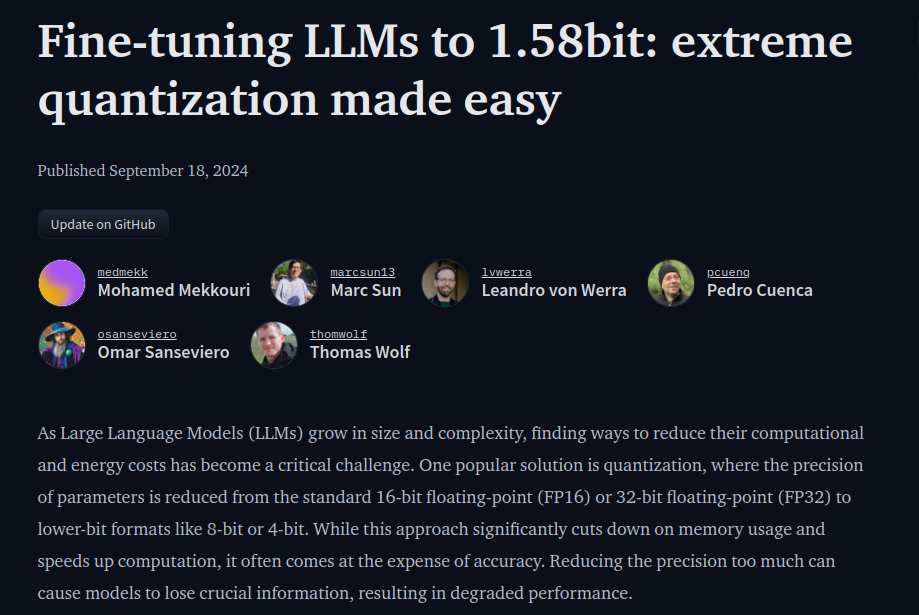 |
LLMs are growing larger, increasing computational and energy costs. 1.58-bit precision drastically reduces these costs by representing each parameter with only three values: -1, 0, and 1. This extreme quantization method can compress models significantly while maintaining competitive performance.
Here's how you can fine-tune LLMs to 1.58-bit precision: Start with a pre-trained model like Llama3 8B.
Replace standard Linear layers with BitLinear layers.
Implement a dynamic lambda scheduler for gradual quantization.
Use ternary weight quantization (-1, 0, 1) and 8-bit activation quantization.
Apply the Straight Through Estimator (STE) for backpropagation.
Fine-tune on a large dataset (10B-100B tokens) with optimized learning rates.
Implement custom CUDA or Triton kernels for efficient inference.
Evaluate performance using metrics like perplexity and MMLU scores.
In this blog, you'll learn to compress LLMs significantly while maintaining competitive performance on downstream tasks. |
|
Read the blog
|
|
|
|
Looking to promote your company, product, service, or event to 200,000+ AI developers? Let's work together.
|
|
Advertise
|
|
|
|
|
