| Hey, | Welcome to AlphaSignal – the most read newsletter by AI developers.
We bring you the top 1% of news, papers, models, and repos, all summarized to keep you updated on the latest in AI. |
|
|
|
IN TODAY'S SIGNAL
| Read time: 6 min 21 sec | 🎖️ Top News
⚡️ Trending Signals
📝 Top Papers
🧠 Top Lecture
|
|
|
|
If you're enjoying AlphaSignal please forward this email to a colleague.
It helps us keep this content free. |
|
|
|
TOP NEWS
| AI Research | Alibaba releases ZeroSearch, an open-source method to train RAG retrievers without queries or labels
| ⇧ 1,483 Likes |
| What's New |
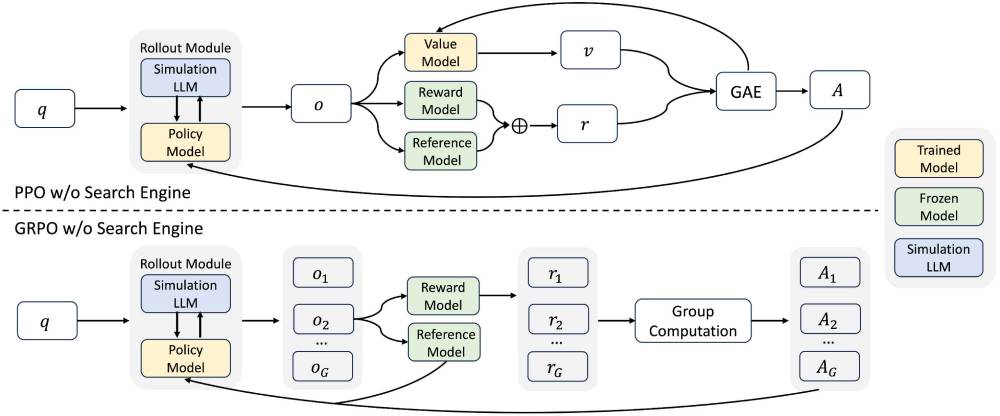
Alibaba researchers introduce ZeroSearch, a method for training LLMs without using search APIs. It replaces real-time search with a document simulator to train QA models using multi-step reasoning. A 14B model trained this way outperforms Google Search-powered baselines on standard benchmarks.
Training without external tools
ZeroSearch removes the need for search APIs or browser-based tools during model training. Trains policy models using simulated documents instead of real search results
Avoids API costs and latency by removing search engine dependencies
Simulation uses prompted LLMs or fine-tuned 3B, 7B, or 14B models
Policy learns to reason through multi-step QA using only internal context
Simulation engine setup
The simulation engine generates noisy retrieval documents from intermediate queries. Generates up to 20 documents per query using language models
Varies document quality to simulate realistic and imperfect retrieval
Uses reward signals to rerank documents based on final answer quality
Fine-tunes separate 3B, 7B, and 14B models to serve as simulators
Performance across benchmarks
ZeroSearch models outperform retrieval-based and search-free baselines on QA tasks.
14B model beats Search-R1 (Google Search + policy) on Natural Questions
7B model matches Search-R1 while remaining fully search-free
3B model outperforms prior non-search baselines
Shows stronger generalization on TriviaQA and PopQA (out-of-domain benchmarks)
Learning with curriculum rollout
Training uses a curriculum that gradually increases retrieval noise.
Early stages use high-quality, relevant documents to stabilize learning
Later stages inject irrelevant or conflicting data to improve reasoning
Policy adapts to ambiguity and incomplete information
Reinforcement learning (PPO) improves final answer accuracy using delayed rewards
Access and availability
GitHub repo includes training code, simulator prompts, and evaluation scripts
Models trained with ZeroSearch are not yet publicly released
Community Feedback
Agent B
"ZeroSearch = very interesting paper here imo The simulation of search + RL combo gives interesting results + an interesting cost advantages . This open the door to a lot of practical use cases."
Romain Beaumont
"Fun paper but if they never switch to a real search engine after the adaption I don't see the point. If the end state is only about answering using LLM knowledge what about simply not searching?"
Sahil Sarraf
"That’s a massive achievement. Improving retrieval skills directly in models is such a game-changer. Excited to see where this leads!" |
|
| Try now
|
|
|
|
TRENDING SIGNALS
| Coding Assistance |
|
⇧ 7,248 Likes | |
AI Assistant |
|
⇧ 1,134 Likes | |
3D Vision |
|
⇧ 840 Likes | |
AI Conferences | |
| From Our Sponsors |
| AI Cost Optimization |
| ⇧ 2,583 Like
| | |
| |
|
|
TOP PAPERS
| Agents |
| ⇧ 1,284 Likes |
Problem The rapid adoption of LLM agents in industries faces a significant challenge: the lack of standardized protocols for communication between agents and external tools. This limits scalability and cooperation for complex tasks.
Solution The paper classifies existing agent protocols into context-oriented vs. inter-agent, and general-purpose vs. domain-specific categories. It also analyzes protocols across dimensions like security, scalability, and latency.
Results The authors identify key research areas for next-gen protocols: adaptability, privacy preservation, and group-based interaction. They highlight the trend toward layered architectures and collective intelligence infrastructures.
|
| VLM |
|
⇧ 1,327 Likes | Problem
High-performing vision-language models are often closed-source, hindering transparency in data, design, and training methods. The community resorts to distillation from black-box models to label training data, leading to strong benchmarks but limiting scientific progress.
Solution This paper presents the Perception Language Model (PLM) in an open and reproducible framework for transparent image and video understanding. It explores standard training pipelines without distillation and uses large-scale synthetic data to address gaps in video understanding.
Results
The authors release 2.8M human-labeled video question-answer pairs and spatio-temporally grounded captions. They also introduce PLM–VideoBench for evaluating complex video reasoning tasks and ensure reproducibility by providing data, training recipes, code, and models.
|
| Human AI Interaction |
|
⇧ 1,183 Likes | Problem
Expert-level content is often locked behind complex language, making it difficult for non-experts to understand critical information in domains like health, law, and finance. Existing tools often oversimplify or distort meaning.
Solution
Google Research developed a Gemini-based system for minimally-lossy text simplification—preserving meaning while improving readability. It uses an automated loop: one Gemini model simplifies text, while another evaluates readability and fidelity, refining prompts across 824 iterations to optimize performance without manual tuning.
Results
In a large-scale study (4,563 participants, ~50,000 responses), simplified texts improved comprehension by 4% overall, with gains up to 15% in medical texts. Users also reported lower cognitive load and higher confidence. The feature is now available in the Google app as "Simplify" on iOS, making complex content more accessible in real time.
|
| |
| |
|
|
TOP LECTURE
| Physical AI |
The Physical Turing Test: Jim Fan on Nvidia's Roadmap for Embodied AI
|
⇧ 2,378 Likes |

| This lecture introduces the Physical Turing Test, a new benchmark for robotics: can a robot complete a real-world task so naturally that you can't tell it wasn't done by a human?
Jim Fan from NVIDIA breaks down why solving this is hard—and what tools researchers are using to make progress.
You’ll learn:
Why robotic data doesn’t scale like internet data
How teleoperation works for training robots
The limits of physical data and the role of human fatigue
How simulation can scale robot learning with domain randomization
How to train 10,000 simulated environments in parallel on one GPU
What “digital twin” and “digital cousin” mean in robotics
How generative models produce 3D scenes, assets, and motions
How video diffusion models simulate realistic robot futures from text prompts
How NVIDIA collects, scales, and fine-tunes robotic data across simulation and real-world platforms |
| Watch now
|
|
|
|
At Alpha Signal, our mission is to build a sharp, engaged community focused on AI, machine learning, and cutting-edge language models, helping over 200,000 developers stay informed and ahead. We’re passionate about curating the best in AI, from top research and trending technical blogs to expert insights and tailored job opportunities. We keep you connected to the breakthroughs and discussions that matter, so you can stay in the loop without endless searching. We also work closely with partners who value the future of AI, including employers and advertisers who want to reach an audience as passionate about AI as we are.
Our partnerships are based on shared values of ethics, responsibility, and a commitment to building a better world through technology.Privacy is a priority at Alpha Signal. Our Privacy Policy clearly explains how we collect, store, and use your personal and non-personal information. By using our website, you accept these terms, which you can review on our website. This policy applies across all Alpha Signal pages, outlining your rights and how to contact us if you want to adjust the use of your information. We’re based in the United States. By using our site, you agree to be governed by U.S. laws. |
|
|
|
Looking to promote your company, product, service, or event to 200,000+ AI developers? Let's work together.
|
| Work with us
|
|
|
|
|
