Enterprise data infrastructure runs on tabular and relational data that hold decades of user behavior, financial transactions, and supply chain logs.
The majority of high-value predictive tasks still rely on traditional machine learning algorithms that require custom ETL pipelines, manual feature-engineering, and tuning hyperparameters for every dataset.
And while large language models transformed how we process text and video, relational data remains largely untouched by the new generation of AI technology.
A new class of Tabular Foundation Models (TFMs) changes this equation. They apply the same "give it a prompt, get an answer" logic of language models to rows and columns. This delivers instant, zero-shot predictions on unseen tables without any per-dataset training.
For developers, TFMs turn weeks of machine learning pipeline development into minutes. They unlock instant, scalable capabilities for critical enterprise workloads such as fraud detection, customer intelligence, and advanced agentic workflows.
From slow ML cycles to the LLM mismatch
Processing tabular data currently relies on algorithms like XGBoost and LightGBM. While highly accurate, their iteration cycle is slow. Every time a database schema changes, developers must rebuild the pipeline, clean the data, and retrain the model from scratch to maintain accuracy.
Language models solved this friction for text via In-Context Learning (ICL). You drop a document into the prompt and get answers immediately. Developers naturally want to drop a CSV or SQL table into an LLM to bypass the traditional ML lifecycle entirely.
Standard language models fail at this task because their architecture reads sequentially from left to right. Tables are two-dimensional and permutation-invariant. Swapping two rows or columns does not change the underlying mathematical meaning of the dataset, but it completely derails a text model's sequential understanding.
Standard tokenizers also shred continuous numerical values and categorical types into arbitrary text tokens. An LLM might read "100.50" as three separate tokens, destroying the column-wise distributions and statistical regularities that machine learning models need to make accurate predictions.
Compute costs also become a challenge. Flattening a massive enterprise dataset into a text string and computing the attention values requires massive compute power and fills context windows before the model can learn the mathematical relationships between the data points.
The tabular foundation model landscape
A new generation of foundation models has been explicitly designed to perform few-shot and zero-shot learning directly on tabular data. Instead of learning language, these models learn the mathematical learning process itself.
At inference time, they treat tabular prediction as an ICL task. The target dataset acts as the prompt, and the model predicts outcomes for new rows in a single forward pass without training.
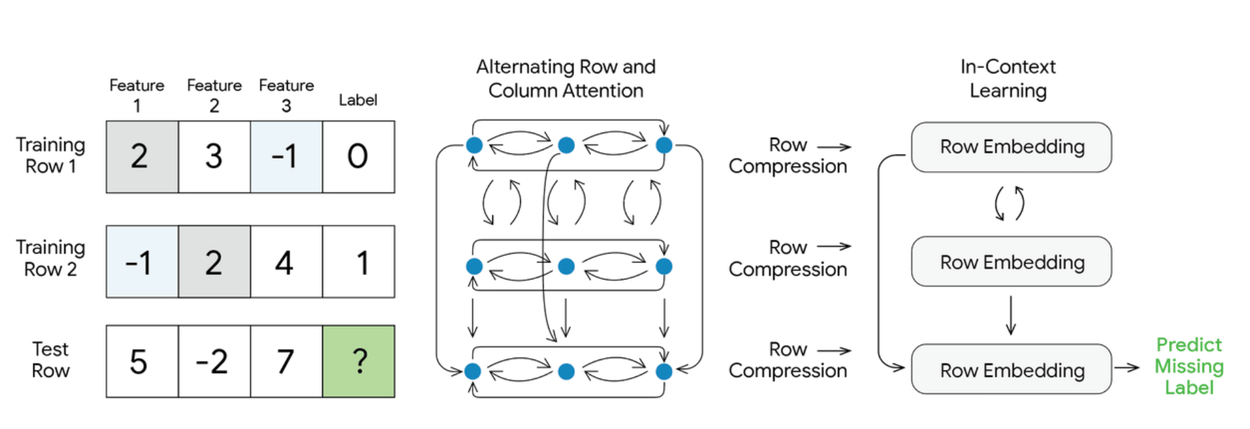
TabFM by Google Research uses an alternating row and column attention mechanism to score new query rows based on context examples. Trained entirely on synthetic datasets, TabFM encodes strong inductive biases while avoiding data privacy issues.
TabFM is open-source and accessible via GitHub with JAX and PyTorch backends under the Apache 2.0 license (it can be used for commercial applications). Google is also integrating TabFM natively into BigQuery. Soon, data analysts will be able to run zero-shot predictions directly in their data warehouse without building ML models.
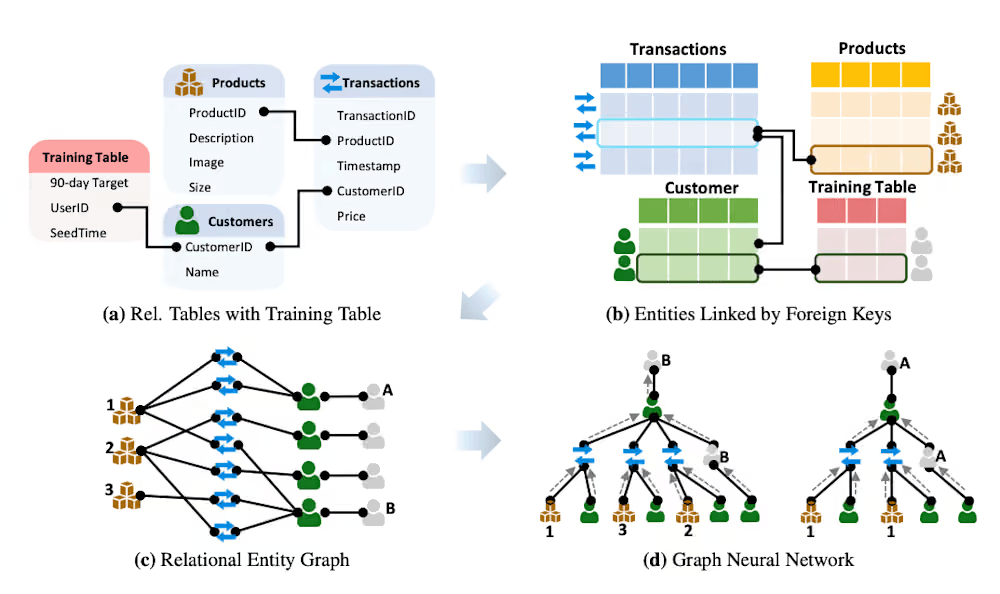
KumoRFM by Nvidia moves beyond single tables by modeling relational data as graphs of interconnected tables. It predicts outcomes across complex enterprise schemas without requiring developers to flatten multiple databases into a massive CSV file.
Nvidia acquired Kumo in June and integrated it into its Structured Data and Graph Models (SDGM) ecosystem. This acquisition signals that large tech players see immense commercial value in tabular foundation models. Developers can access KumoRFM via the Nvidia SDK to run predictions directly against their data warehouses.
TabPFN by Prior Labs pioneered this space with Prior-Data Fitted Networks. It treats tabular prediction as a completion problem, guessing the missing column based on strong mathematical priors baked in during synthetic pre-training.
Backed by a highly cited Nature paper, TabPFN is highly accessible for developers. It can be used as a fully managed cloud-based service via the Prior Labs API or downloaded locally as an open-source Python package. (It has a modified Apache 2.0 license that requires you to prominently display Prior Labs on your product.)
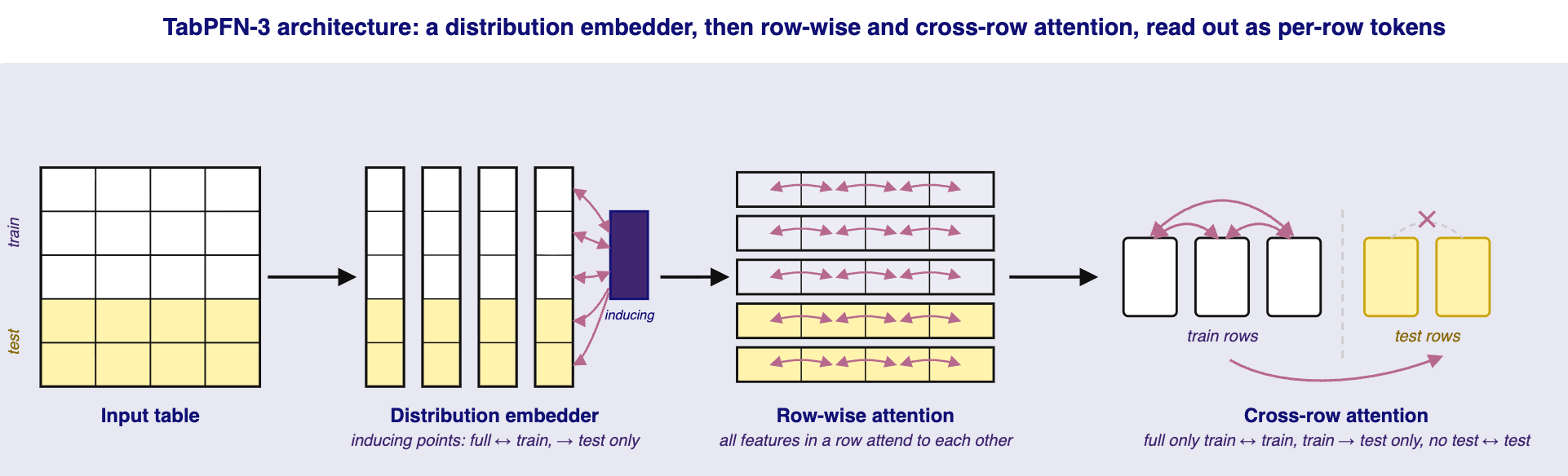
TabICL (Inria/SODA Team) uses a two-stage architecture featuring distribution-aware column embedding followed by row-wise attention. This solves the scalability issue of in-context learning for large tabular datasets.
TabICL accommodates up to 500,000 samples and 500 features without the quadratic memory cost of LLMs. It runs up to 10x faster than TabPFNv2 on large datasets and is fully open-source on GitHub, making it a powerful tool for developers pushing the boundaries of local ICL scalability.
The pragmatic reality check
While TFMs offer instantaneous zero-shot predictions, they introduce a distinct training-inference tradeoff. They have higher compute costs and higher latency at inference time because the model must run a forward pass over the entire tabular data for every prediction.
Classic machine learning algorithms like XGBoost require a massive upfront cost for training and tuning. However, once trained, their inference phase is incredibly lightweight. They process predictions with near-zero latency and cost fractions of a cent to run at scale.
For applications where the context changes frequently and task diversity is high, the higher costs of TFMs pay off by saving you the pains of constant retraining and tuning of ML models.
For high-volume tasks that require high-frequency, millisecond-latency scoring, traditional ML remains superior. Real-time credit card fraud prevention APIs or high-frequency algorithmic trading systems cannot afford the inference latency of a massive transformer.
For these tasks, adopt a dual-stack architectural roadmap. In the prototyping and discovery phase, use TFMs to quickly test hypotheses, evaluate fast-moving schemas, and solve cold-start problems without spending weeks building ETL pipelines.
Once the problem space is well-defined and the schema is stable, transition to the scaling phase. Pay the one-time cost to train and tune a classic XGBoost model. This approach minimizes production cloud compute costs while giving you the speed to execute millions of queries per second.
Beyond standalone pipelines, TFMs unlock a new paradigm for agentic workflows. The agents can use LLM backbones for reasoning, planning, and language generation.
When an AI agent needs to forecast inventory or evaluate a customer's risk profile to answer a prompt, the LLM can route the dataset and query to a TFM, retrieve the zero-shot predictions, and use the results to formulate a strategic, natural-language response.
This combination of language-based reasoning and specialized tabular inference points to a future where enterprise AI can finally understand and act on the entire corporate data stack.