Two things happened this week that rhyme. Mira Murati ships Inkling, a 975B open-weight model that you can actually run and own. And researchers discover models do real reasoning inside filler tokens, hidden from their own output.
The pattern? The black box is cracking open, from both ends.
Ownership of weights and interpretability of internals are becoming the same story: who controls the intelligence, and can you see what it's actually doing.
|
|
In Partnership with
|
·
|

|
|
|
|

|
Today's Author
Lior Alexander. Founder of AlphaSignal and former ML Engineer. Previously built ML systems at Iguazio, Guesty, Enphase, Mila.
|
|
Top Repo
|
|
|
|
Open-source tool turns any phone video into a walkable 3D world at 60fps locally
|
|
7,272 Likes
|
|
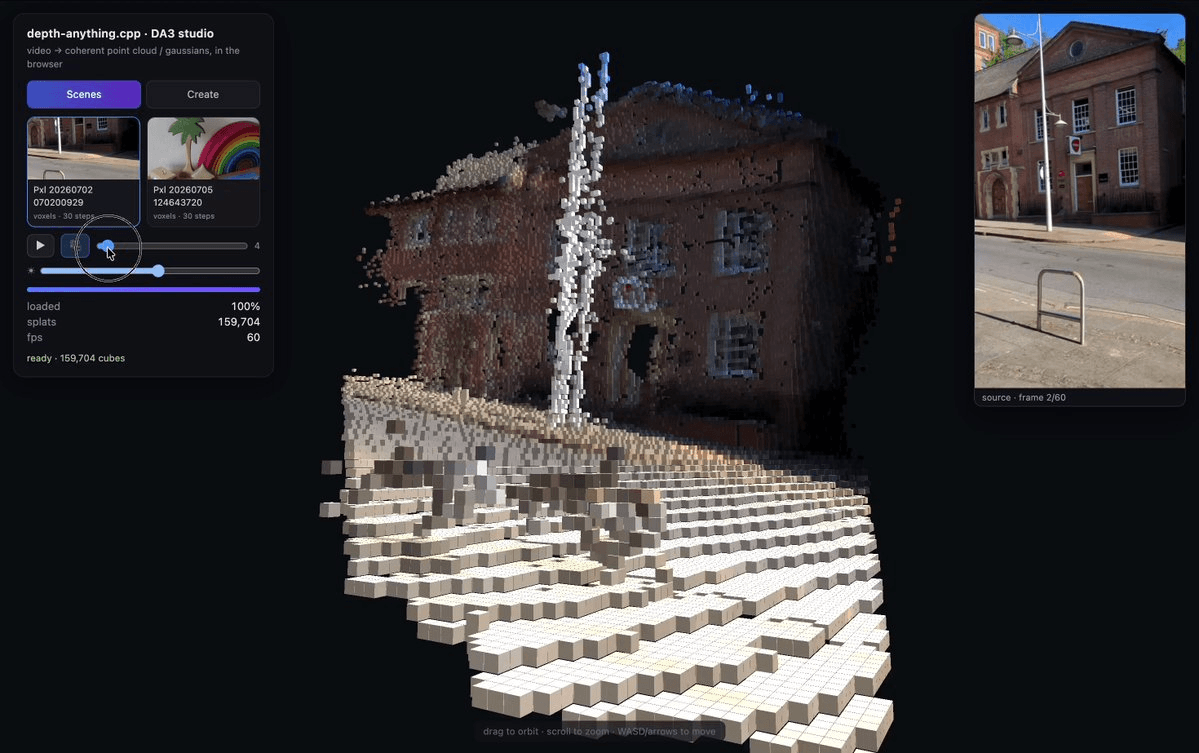
Someone just open-sourced a tool that turns any phone video into a full 3D world. You record a walk around your house, drop the file in, and get back a walkable 3D point cloud at 60fps. No cloud. No subscription. Runs entirely on your local GPU. It's called depth-anything.cpp, built by the LocalAI team. It's a C++ port of ByteDance's Depth Anything 3 model. Think of it like teaching your computer to understand depth from a flat video, the same way your brain figures out what's close and what's far. Here's what it spits out from a single image or video: - A full depth map showing how far every pixel is
- Camera position and angle in 3D space
- A 3D point cloud you can export as GLB, PLY, or COLMAP
- Sky mask, confidence scores, and more
It's 1.3x faster than PyTorch on CPU, uses half the memory, and the smallest model is just 99MB. You can embed it in Go, Rust, or C via a flat API.
|
|
|
|
Presented by Tiger Data
|
|
One Postgres for AI Data, Now on AWS
|
|
AI workloads throw off relentless data: embeddings, model metrics, and time-series events.
Tiger Cloud runs on AWS and extends Postgres to ingest, compress, and query all of it at scale, so your data lives in one database instead of a sprawl of pipelines.
Still Postgres, standard SQL, with native compression that keeps far more history online for less.
Provision it straight from AWS Marketplace.
|
|
|
|
Top Model
|
|
|
|
Baidu releases a tiny 3B open-source OCR model that reads 100-page PDFs in one pass
|
|
5,758 Likes
|
|
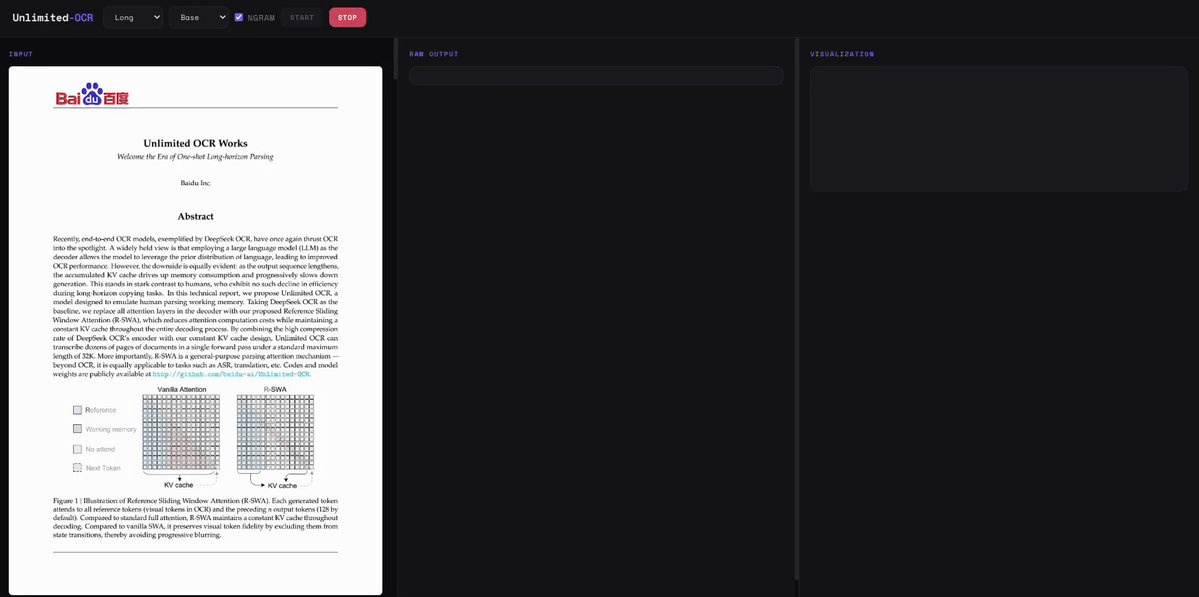
Every OCR tool you've used has the same dirty secret: it reads your PDF page by page, loses context between pages, and stitches results together like a bad quilt. Unlimited-OCR by Baidu just killed that pattern. It reads entire multi-page documents in a single pass. The trick is a new attention mechanism called Reference Sliding Window Attention (R-SWA) , think of it like how you copy a book: you glance at the source and the last few words you wrote, not everything you've ever written. Memory stays flat no matter how long the document gets. Here's what you get: - 93.23% on OmniDocBench, beating the previous best by over 6 points
- Runs on a single GPU with 8GB+ VRAM, fully local, zero API cost
- Outputs tables as HTML, equations as LaTeX, full layout preserved
- Works with Transformers, vLLM, SGLang, Ollama, and Docker
MIT licensed. You can use it in commercial products. Pull it from Hugging Face with a few lines of Python and call model.infer_multi() on your PDF pages directly.
|
|
|
|
Presented by Agora
|
|
Production-grade infrastructure for conversational AI
|

|
Voice AI experiences often break under high concurrency, packet loss, and poor connection. Agora's Conversational AI platform runs on SDRTN® - the same ultra-low latency network carrying 80B+ minutes monthly across 200+ countries. Build AI agents or add voice to any application with fully managed, real-time infrastructure.
|
|
|
|
Top Repo
|
|
|
|
Cline pits Kimi K3 against Fable on a real bug , one is 3.4x faster, the other 2.3x cheaper
|
|
4,532 Likes
|
|
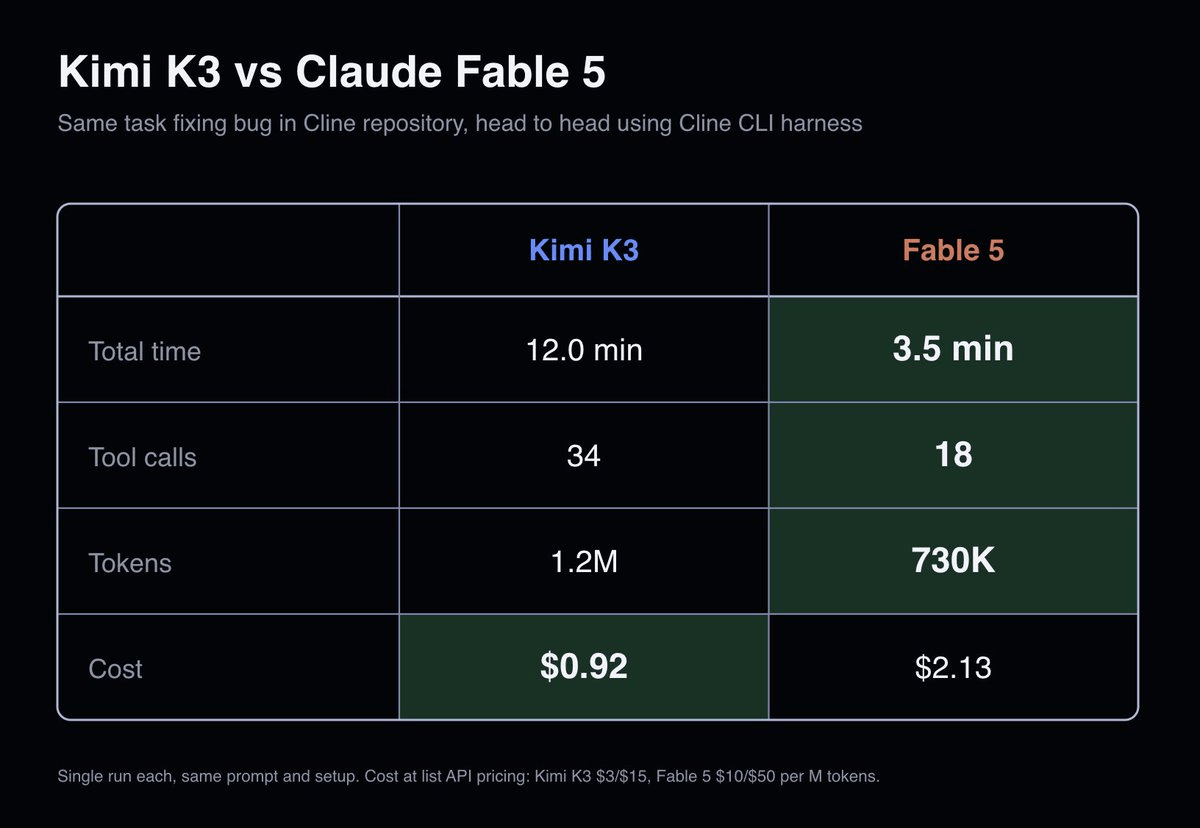
Two AI models walked into a bug fix. Only one could win. The Cline team tested Kimi K3 and Fable on a real bug from their own repo. Both fixed it. But the tradeoffs are interesting. - Speed: Fable finished in 3.5 minutes with 18 tool calls. Kimi took 12 minutes and 34 tool calls. Fable is 3.4x faster.
- Cost: Kimi cost $0.92 vs. Fable's $2.13. Kimi is 2.3x cheaper because its per-token price is much lower.
- Tokens used: Kimi used 1.2M tokens vs. Fable's 730K. Kimi thinks longer before acting, by design.
Why does Kimi use more tokens? It's trained with reinforcement learning, meaning it learned by trial and error to double-check its own work before finishing. More thinking, slower output, but cheaper overall. This is the first open-weight model (free to download and run yourself) that competes with top closed models. You can try it now via ClinePass at $1.99 with npm i -g cline.
|
|
|
At Alpha Signal, our mission is to build a sharp, engaged community focused on AI, machine learning, and cutting-edge language models, helping over 300,000 developers stay informed and ahead. We're passionate about curating the best in AI, from top research and trending technical blogs to expert insights and tailored job opportunities. We keep you connected to the breakthroughs and discussions that matter, so you can stay in the loop without endless searching. We also work closely with partners who value the future of AI, including employers and advertisers who want to reach an audience as passionate about AI as we are.
Our partnerships are based on shared values of ethics, responsibility, and a commitment to building a better world through technology.Privacy is a priority at Alpha Signal. Our Privacy Policy clearly explains how we collect, store, and use your personal and non-personal information. By using our website, you accept these terms, which you can review on our website. This policy applies across all Alpha Signal pages, outlining your rights and how to contact us if you want to adjust the use of your information. We're based in the United States. By using our site, you agree to be governed by U.S. laws.
|
|
|
Looking to promote your company, product, service, or event to 300,000+ AI developers?
|
|
|
|
|
