| Hey, | Welcome to today's edition of AlphaSignal, a newsletter for developers by developers.
We identify and summarize the top 1% news, papers, models, and repos in the AI industry. |
|
|
|
IN TODAY'S SIGNAL
| Read time: 4 min 35 sec | 🎖️ Top News
📌 Encord
⚡️ Trending Signals
🛠️ Top of Github
Llm-twin-course: for automated research and report generation using LlamaIndex.
llama3-from-scratch: llama3 implementation, one matrix multiplication at a time.
Graphrag: modular graph-based Retrieval-Augmented Generation (RAG) system.
🧠 Lecture |
|
|
|
If you're enjoying AlphaSignal please forward this email to a colleague.
It helps us keep this content free. |
|
|
|
TOP NEWS
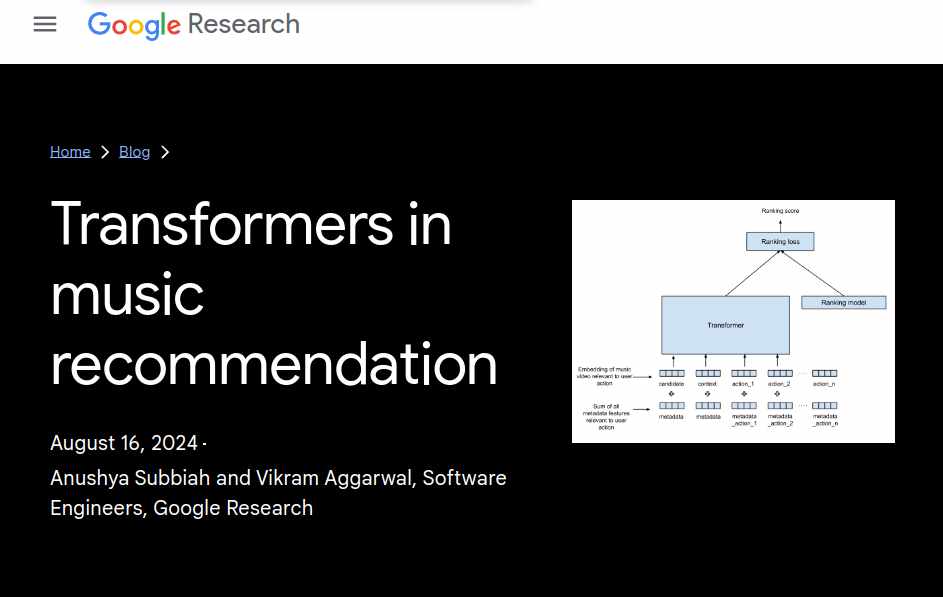
| Recommendation System | Google enhanced YouTube music recommendation, using Transformers taking user actions as important signals |
⇧ 467 Likes |
 |
What's New |
Google developed a new music recommendation system for YouTube Music, leveraging Transformer models to process user action sequences. This system aims to improve personalization by understanding the context of user behaviors within the platform's 100 million song catalog.
Key components Intention of action (e.g., interrupt, select, autoplay) Salience metrics (percentage played, time since last action) Metadata (artist, language) Music track identifiers The core innovation
It combines Transformer architecture with existing ranking models. It processes user actions such as likes, dislikes, and skips as sequential input data and then converts these actions into vectors. Finally combining them with music track embeddings to create input tokens for the Transformer. The Transformer's output merges with the existing ranking model through a multi-layer neural network. The research team co-trained the Transformer with the ranking model on multiple objectives, potentially mitigating cold start problems for new users or tracks. How user preferences are handled for recommendation
To address context-specific preferences, the system adapts recommendations based on current user activities. For example, it can suggest upbeat music during workouts despite previous skips of similar tracks in other situations.
Results
Performance improvements were observed in both offline analysis and live experiments, with a reduction in skip rates and an increase in user listening time. These metrics directly reflect the system's ability to better match user preferences in real-time.
Future developments may include extending this technique to retrieval models and incorporating non-sequential features within the Transformer architecture. While specific computational requirements weren't detailed, the successful deployment at YouTube Music's scale suggests effective optimization for real-time performance. | |
|
Read more
|
|
|
|

| Drowning in Data? Why Poor Quality Data is Killing Your AI Models (and how to fix it)
|
Is poor data quality secretly sabotaging your AI projects? Encord’s latest webinar reveals how to ensure your data pipelines capture the most valuable data for breakthrough model performance.
Discover how to:
Automatically surface the most relevant data for your specific AI needs Apply techniques to intelligently curate petabytes of data Unify data across all modalities, tools, systems and teams
Don't let poor data ruin your AI models – join the webinar and unlock the full potential of your AI products.
|
|
Reserve your place now
| partner with us |
|
|
|
TRENDING SIGNALS
| Robotics |
|
⇧3,635 Likes | |
Video Generation |
|
⇧ 1,114 Likes | |
Image Generation |
|
⇧ 754 Likes | |
LLM Agent |
|
⇧ 121 Likes | |
Text to Image |
| ⇧ 378 Likes |
| |
|
|
|
|
|
TRENDING REPOS
| LLM | |
☆ 2, 207 Stars | Helps you build a production-ready LLM & RAG system that mimics
someone by incorporating his or her style and personality into an LLM. You'll create four microservices: data collection, feature pipeline, training pipeline, and inference pipeline. It covers ETL, streaming, fine-tuning, RAG, and MLOps best practices using tools like AWS, Qwak, and CometML. | |
Llama3 |
|
| ☆ 12,445 Stars |
Learn to implement Llama 3 from scratch. You'll build each component: tokenization, embedding, attention, and feed-forward layers. It guides you through complex math and tensor operations, demonstrating LLM internals step-by-step. You'll create a working 8B parameter model. |
| RAG |
|
☆ 15,614 Stars |
Helps you extract structured data from text using LLMs. It builds knowledge graphs to enhance LLM reasoning on private data. The system improves information retrieval and question answering. It offers a solution accelerator for Azure integration. Prompt tuning is recommended for optimal results. |
| |
| |
|
|
| TOP LECTURE |
LLM |
Comprehensive overview of Large Language Models (LLMs) |
⇧ 293 Likes |
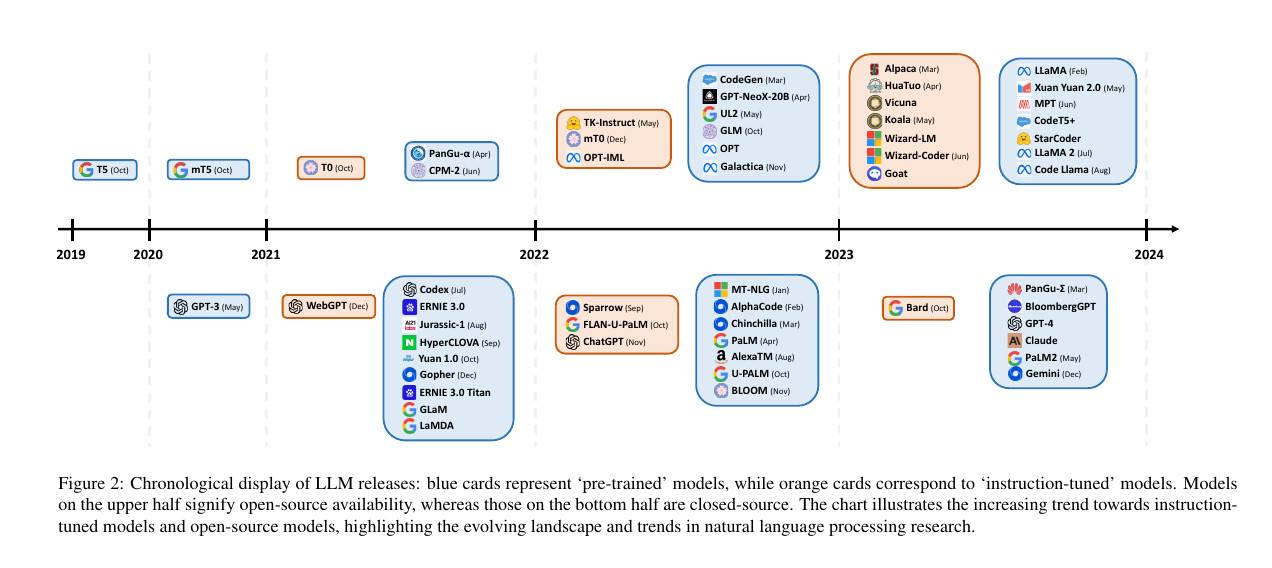 |
This paper provides a detailed examination of the current state and future directions of LLM technology. It covers the fundamental concepts, architectures, training methods, and applications of LLMs.
You will learn about:
LLM architectures and their components Pre-training and fine-tuning techniques Scaling laws and computational requirements Prompting strategies and in-context learning Multimodal LLMs and their applications Retrieval-augmented generation Efficient fine-tuning methods LLM evaluation metrics and benchmarks Ethical considerations and limitations Current research directions and open problems This overview equips you with the knowledge to work with and develop LLM-based systems effectively. |
|
Read the paper
|
|
|
|
Want to promote your company, product, service, or event to 190,000+ AI researchers and engineers?
|
|
Sponsor
|
|
|
|
|
