| Hey, | Welcome to today's edition of AlphaSignal, a newsletter for developers by developers.
We identify and summarize the top 1% news, papers, models, and repos in the AI industry. |
|
|
|
IN TODAY'S SIGNAL
| Read time: 5 min 1 sec | 🎖️ Top News
📌 Galileo
⚡️ Trending Signals
📄 Top 3 Papers
🧠 Python Tip |
|
|
|
If you're enjoying AlphaSignal please forward this email to a colleague.
It helps us keep this content free. |
|
|
|
TOP NEWS
| Language Models | Deepmind secretly drops the most powerful LLM in the industry |
⇧ 1532 Likes |
 |
What's New |
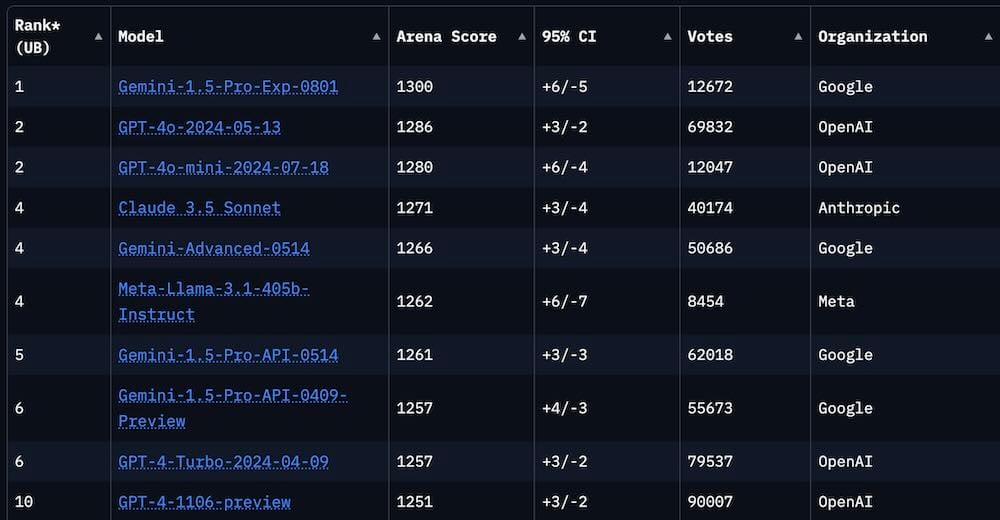
DeepMind has launched Gemini 1.5 Pro (Experimental 0801), a large language model that tops the LMSYS leaderboard. It scored 1300, surpassing models like GPT-4.0 with 1286 and Claude 3.5 Sonnet with 1271. This model has gained strong community approval, reflected in its 12,672 votes.
Key Innovations and Architecture Gemini 1.5 Pro uses a Mixture-of-Experts (MoE) architecture that efficiently distributes tasks across specialized subnetworks, enabling the model to handle complex tasks more effectively. Its context window of 2 million tokens allows it to process extensive information, far surpassing GPT-4's 32,000-token capacity.
Multilingual and Technical Proficiency This model excels in multilingual tasks, ranking first in languages such as Chinese, Japanese, German, and Russian. In technical domains, it shows strong performance:
- Math: Ranks 1st to 3rd
- Instruction-Following: Ranks 1st to 2nd
- Coding: Ranks 3rd to 5th
- Hard Prompts (English): Ranks 2nd to 5th
Integration and Multimodal Capabilities
You can test Gemini 1.5 Pro through Google AI Studio and the Gemini API. It integrates easily into applications via platforms like AI Studio and Vertex AI. Its multimodal capabilities allow it to process text, images, and video, making it adaptable for various data types and applications. | |
|
Try gemini 0801
|
|
|
|
| LLM Hallucination Index: RAG Special |
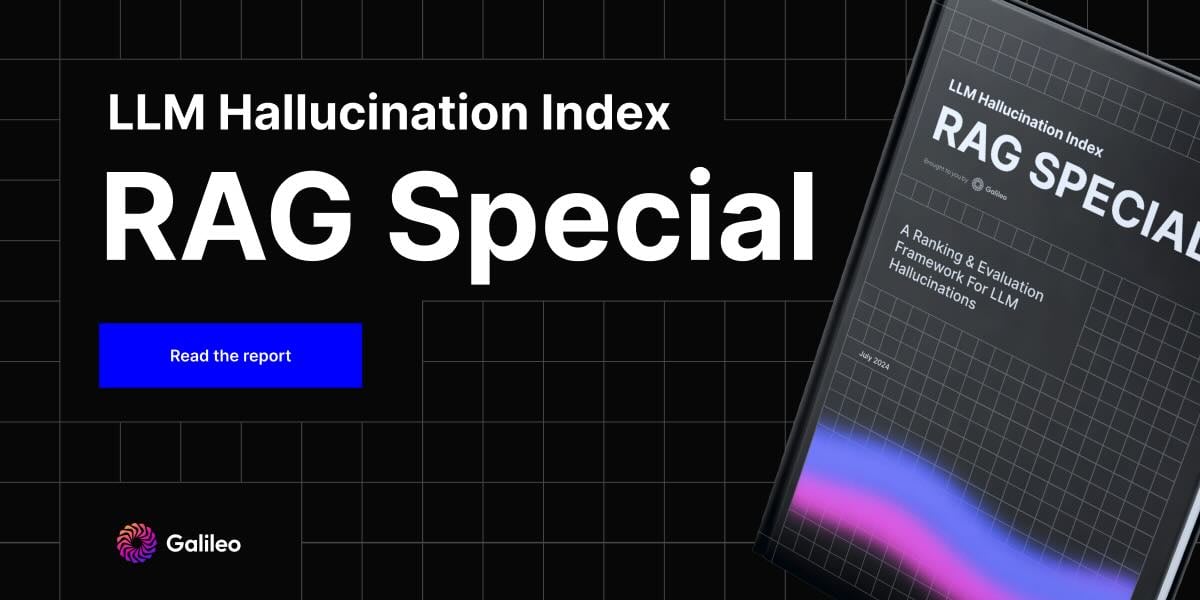
Ever wondered what's the best LLM to use for RAG? The LLM Hallucination Index can be used to answer this.
Galileo evaluated 22 open/closed models across 3 RAG tasks and provides insights on cost, verbosity, and performance to help choose the optimal LLM depending on the use case.
Some key findings:
1. Anthropic outperforms OpenAI – Claude beats GPT.
2. Open-source is quickly closing the gap with closed-source.
3. Larger is not always better – Llama outperformed bigger models. |
|
Read the report
| partner with us |
|
|
|
TRENDING SIGNALS
| Agents |
|
⇧ 1829 Likes | |
Image Generation |
|
⇧ 1225 Likes | |
Prompt Engineering |
|
⇧ 451 Likes | |
Models |
| ⇧ 629 Likes |
| Image-to-3D |
|
⇧ 2311 Likes | | |
|
|
|
|
TOP PAPERS
| Model Training |
|
⇧ 2821 Likes | Problem
Training large-scale text-to-image diffusion models requires significant computational resources, creating barriers for researchers with limited budgets. Current models need proprietary datasets or large image collections and incur costs as high as $28,400, making participation difficult.
Solution The authors propose a deferred masking strategy that preprocesses image patches before masking, allowing a 75% reduction in computational cost without significant performance loss. This approach enables training a 1.16 billion parameter sparse transformer on a micro-budget using only 37 million images.
Results The model achieves a Fréchet Inception Distance (FID) of 12.7 on COCO, reducing training costs by 118× compared to Stable Diffusion, with a $1,890 cost in 2.6 days on 8×H100 GPUs.
|
| Foundational Models |
|
⇧ 908 Likes | Problem
Efficient and privacy-focused language models were needed for real-time AI applications on devices, ensuring user privacy without sacrificing performance. Existing models often struggled with speed, efficiency, and privacy compliance, especially for on-device use.
Solution Apple introduced two models: AFM-on-device (∼3 billion parameters) for efficient processing on devices, and AFM-server for Private Cloud Compute. These models leverage quantization and LoRA adapters to improve speed and efficiency while adhering to strict privacy standards by excluding personal data.
Results AFM-server scored 75.3% on MMLU 5-shot and 72.4% on GSM8K, surpassing many existing benchmarks. AFM-on-device excelled in summarization tasks, demonstrating superior quality with high "good" response ratios. |
| Transformers |
|
⇧ 1873 Likes | Problem
Traditional transformer models face increasing computational costs due to the linear growth of feedforward (FFW) layers as model size increases, limiting scalability and efficiency.
Solution
The "Mixture of A Million Experts" paper from DeepMind introduces the Parameter Efficient Expert Retrieval (PEER) architecture. PEER leverages product key retrieval for efficient routing among over a million tiny experts, decoupling computational cost from parameter count.
Results In language modeling tasks, PEER outperformed dense FFW, coarse-grained MoE, and PKM layers. It achieved lower perplexities (e.g., 16.34 on C4 dataset) with reduced FLOP budgets (6e18 and 2e19), demonstrating superior efficiency and scalability. |
| |
| |
|
|
PYTHON TIP
| Using sqlite-vec for Vector Similarity Search in Python |
sqlite-vec is a small SQLite extension for fast vector searches, written in pure C, with no dependencies. It allows storing and querying vectors in SQLite and runs on various platforms like Linux, MacOS, Windows, and more.
When to Use It: Use sqlite-vec when you need a lightweight, embedded solution for vector similarity search. It is ideal for applications that require vector data handling on-device or at the edge, such as mobile apps, IoT devices, or local AI model inference.
Applications:
- Recommendation systems based on vector similarity
- Image and audio search by embedding vectors
- Real-time search in resource-constrained environments
Check the blog |
pip install sqlite-vec

import sqlite3
import sqlite_vec
from sqlite_vec import serialize_float32

db = sqlite3.connect(":memory:")
db.enable_load_extension(True)

sqlite_vec.load(db)
db.enable_load_extension(False)

embedding = [0.1, 0.2, 0.3, 0.4]
result = db.execute('SELECT vec_length(?)',
        [serialize_float32(embedding)])

print(result.fetchone()[0])  # Outputs: 4
| Note: For NumPy arrays, cast to 32-bit floats with .astype(np.float32).
Ensure SQLite version is 3.41 or higher for full feature compatibility. Use pysqlite3 if you need a newer SQLite version than your Python installation provides. |
|
|
|
Want to promote your company, product, service, or event to 200,000+ AI researchers and engineers?
|
|
Sponsor
|
|
|
|
|
