Hey | Welcome to this week's edition of AlphaSignal.
Whether you are a researcher, engineer, developer, or data scientist, our summaries ensure you're always up-to-date with the latest breakthroughs in AI.
Let's get into it!
Lior |
|
|
|
IN TODAY'S EMAIL | Read Time: 4 min 45 sec |
|
|
|
NEWS | Karpathy Leaves OpenAI and Releases BPE Algorithm Implementation | 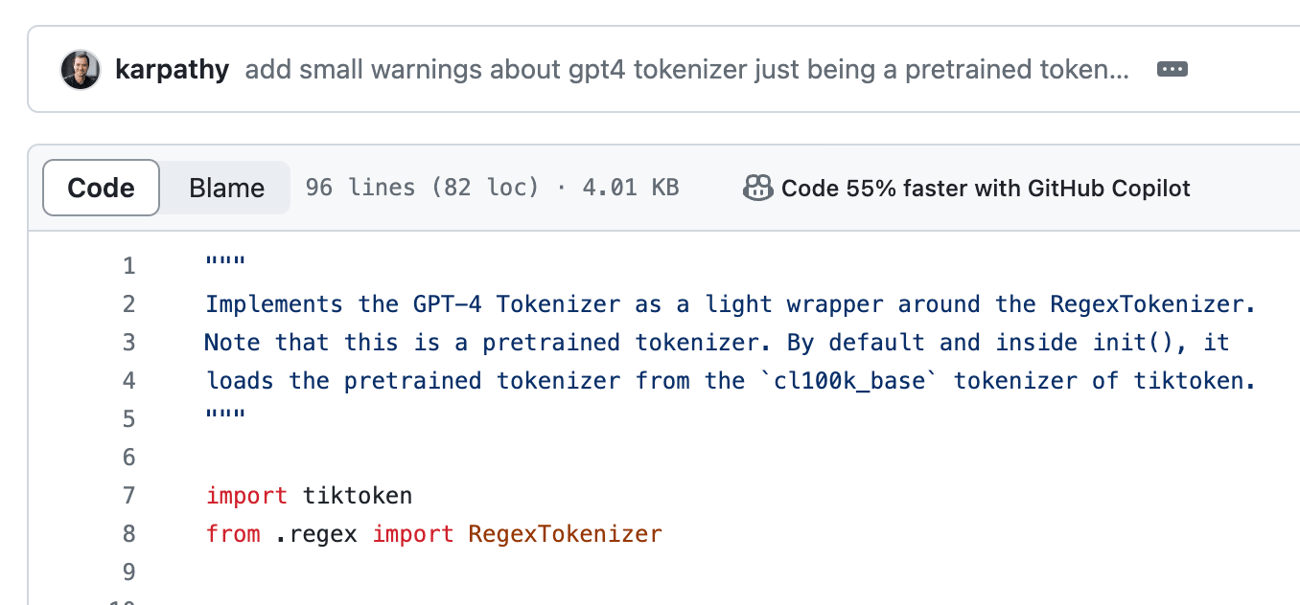 | What's New? | Andrej Karpathy, known for his significant contributions to OpenAI and as the former head of Tesla's autopilot team, recently announced his departure from OpenAI to dedicate time to personal projects, and he's already making waves.
Karpathy clarified that his decision to leave was amicable, with no underlying issues prompting the move. After rejoining OpenAI about a year ago—having first left in 2017—his projects and responsibilities have now been transferred to another senior researcher at the organization.
Karpathy's work at OpenAI included developing a conversational AI assistant, drawing inspiration from the fictional J.A.R.V.I.S system seen in movies, with the goal of creating a genuinely useful AI tool.
Following his departure, he has shared his latest work: an implementation of the Byte Pair Encoding (BPE) algorithm.
Byte Pair Encoding (BPE) is a fundamental algorithm used for tokenization in large language models (LLMs) like GPT. It operates at the byte level, handling UTF-8 encoded strings, which allows it to process a wide range of human languages and symbols efficiently. The approach was popularized for LLMs by the GPT-2 paper and has been adopted by modern models such as GPT, Llama, and Mistral.
Remarkably, Karpathy managed to present this complex algorithm in a clear, educational, and minimalistic manner, using only 70 lines of pure Python code. | | Check bpe |
|
|
|
 | Join AI leaders for GenAI Productionize 2024 | GenAI Productionize 2024 is a virtual industry summit focused on productionizing generative AI within the enterprise.
Join AI experts from Coinbase, LinkedIn, Roblox, Databricks, JPMorgan Chase, Comcast, Fidelity and more for insights and actionable strategies on generative AI governance, frameworks, and practical techniques for evaluation and observability.
Register for GenAI Productionize 2024 to learn:
- How organizations have successfully adopted enterprise GenAI - Practical hands-on architecture and tool insights from leading GenAI builders - The emerging enterprise GenAI stack, from orchestration to evaluation, inference, retrieval and more
| | Register now (free) | partner with us |
|
|
|
TOP OF GITHUB | --------------------- Meta developed V-JEPA, a model that learns from videos to understand object interactions without needing much data, making it 6 times more efficient. It's trained by guessing hidden parts of videos, and performs well on major benchmarks like Kinetics-400 (82.0%) and others.
Yann LeCun believes the V-JEPA model could be a first step toward artificial general intelligence. | | ---------------------
Stability AI released Stable Cascade, a generative model using Würstchen architecture for efficient text-to-image conversion, designed for local execution on consumer GPUs. It features a three-stage process with a 42x compression ratio and supports extensions like finetuning and ControlNet, providing faster and cost-effective training and inference. | | --------------------- Mistral AI launched Mistral Next, a GPT-4 class model, for testing on LMSYS via "direct chat." Early feedback suggests its logical reasoning and coding capabilities might match or exceed GPT-4, despite limited details on its parameters or training. | |
| |
|
|
NEWS | A New LLM Platform Reaches 500 tokens/second | 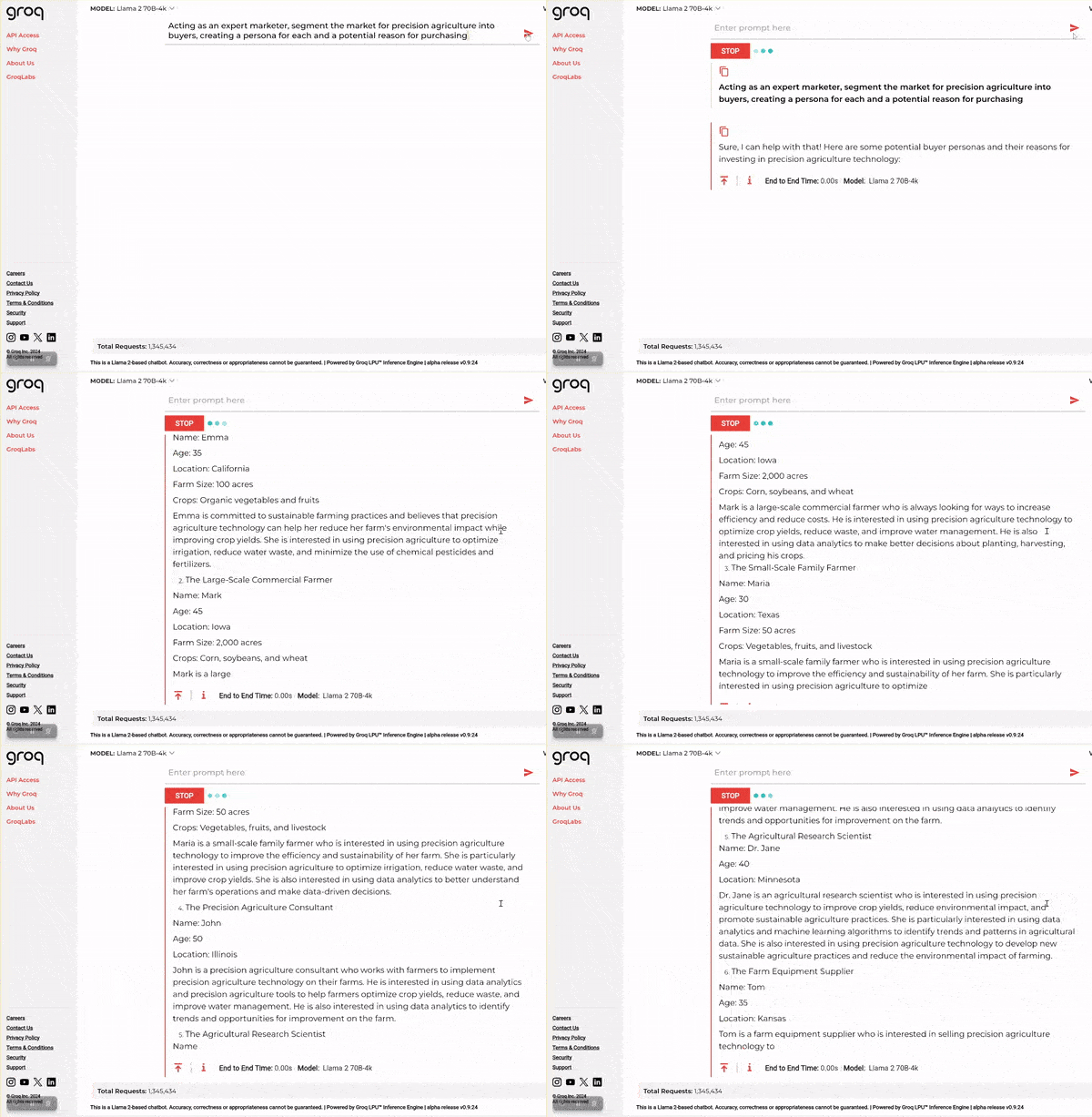 | What's New? | Groq, a relatively unknown name until recently, is shaking up the AI world.
Their new product allows users to chat with Open-Source LLMs at 500 tokens/second outperforming ChatGPT, Claude, and Gemini.
This breakthrough is largely attributed to Groq's custom Tensor Streaming Processor (TSP) technology, which utilizes a unique Linear Processor Unit (LPU) architecture.
Unlike traditional GPUs that rely on multiple cores for parallel processing tasks, Groq's LPUs focus on streamlining AI computations to deliver predictable performance, low latency, and superior energy efficiency.
This design maximizes each clock cycle's efficiency, ensuring consistent throughput and low latency. LPUs also excel in energy efficiency by minimizing thread management and core underutilization. Groq's chips can easily link together, avoiding traditional GPU cluster bottlenecks and allowing straightforward scalability.
This positions Groq's technology as a formidable competitor to NVIDIA's A100 and H100 GPUs.
However, Groq's technological breakthrough isn't the only reason it has been in the headlines. The company found itself at the center of a naming dispute with Elon Musk over his AI model named Grok, spelled with a "k"
Groq currently supports: LLaMa-2-70B and Mixtral-8x7B | | Try groq |
|
|
|
| | Want to promote your company, product, job, or event to 170,000+ AI researchers and engineers? You can reach out here. | |
|
|
|
|
