| Hey, | Welcome to AlphaSignal – the most read newsletter by AI developers.
We bring you the top 1% of news, papers, models, and repos, all summarized to keep you updated on the latest in AI. |
|
|
|
IN TODAY'S SIGNAL
| Read time: 5 min 15 sec | 🎖️ Top News
⚡️ Trending Signals
💻Top Lectures
🧠 Deep Dive A step by step overview explaining explains how to design, build, and scale reliable AI agents using LLMs, tools, and memory strategies. |
|
|
|
If you're enjoying AlphaSignal please forward this email to a colleague.
It helps us keep this content free. |
|
|
|
TOP NEWS
| LLMs | Google unveils Gemini 2.0 models, now supporting large-scale production tasks with multimodal reasoning
| ⇧ 16,485 Likes |
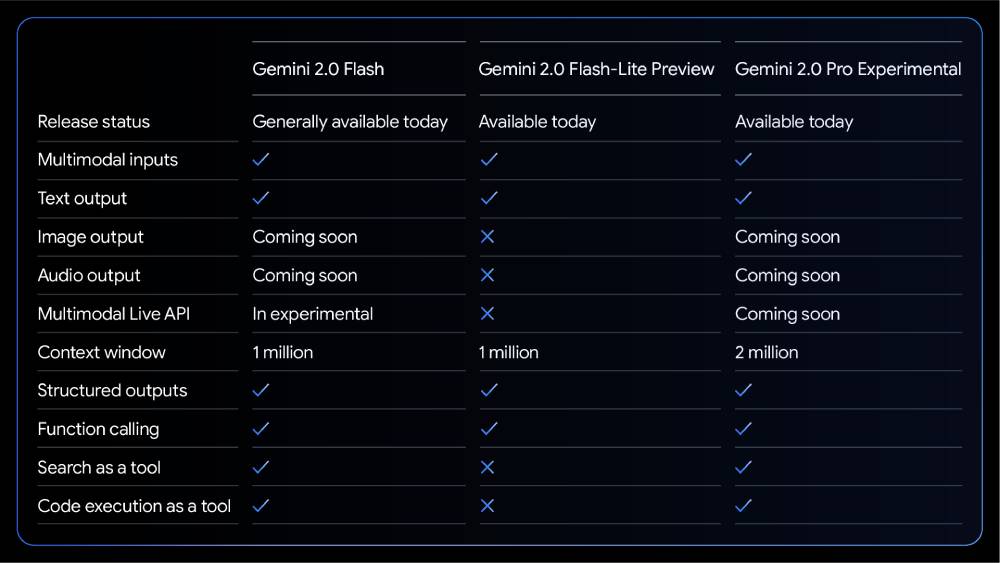
| What's New | Google makes Gemini 2.0 Flash generally available and introduces Flash-Lite and Pro Experimental. These models expand context windows, enhance multimodal reasoning, and improve coding capabilities.
Model Overview
- 2.0 Flash (General Access): It can handle real-time, large-scale production tasks with 1 million tokens. You can apply it to tasks requiring high-frequency text generation, multimodal data, and reasoning.
- 2.0 Flash-Lite (Public Preview): It optimizes cost without sacrificing speed. It generates one-line captions for 40,000 images for under $1 in AI Studio’s paid tier.
- 2.0 Pro Experimental: You can run complex reasoning and coding tasks using a 2-million-token context window. Analyze large documents, generate complex code, and call external tools like Google Search.
Performance
- The models can handle multimodal data with large context windows: 1 million tokens in Flash and Flash-Lite, 2 million tokens in Pro Experimental.
- Gemini 2.0 outperforms 1.5 Pro on tasks like general knowledge, multilingual understanding, and code generation.
- It achieves cost-efficient output with Flash-Lite, which delivers higher quality than 1.5 Flash without increasing cost or latency.
How Gemini 2.0 Compares to its Previous Models?
Gemini 2.0 models improve over the 1.5 series in efficiency, speed, and quality. 2.0 Flash is faster and higher quality than 1.5 Pro, optimized for large-scale, high-frequency tasks. 2.0 Flash-Lite outperforms 1.5 Flash while maintaining the same cost and speed. 2.0 Pro Experimental expands the context window to 2 million tokens, doubling 1.5 Pro’s limit, and enhances coding performance with better reasoning and tool integration.
Access and Availability
- Gemini 2.0 Flash is generally available via the Gemini API in Google AI Studio and Vertex AI.
- Gemini 2.0 Flash-Lite is in public preview in Google AI Studio and Vertex AI.
- Gemini 2.0 Pro Experimental is available in Google AI Studio, Vertex AI, and the Gemini app for Gemini Advanced users.
- 2.0 Flash Thinking Experimental is accessible in the Gemini app on desktop and mobile.
- You can integrate these models into production applications using the Gemini API.
| |
| Try now
|
|
|
|
TRENDING SIGNALS
| LLM |
|
⇧ 17,385 Likes | Video Generation |
|
⇧ 15,395 Likes | |
AI Safety |
|
⇧ 4,593 Likes | |
AI Tool |
|
⇧ 5,429 Likes | |
Agent |
|
⇧ 4,946 Likes | | |
|
|
|
|
TOP LECTURES
| LLMs |
| ⇧ 1,154 Likes |
This lecture is presented by Jay Alammar and Maarten Grootendorst, the authors of the book Hands-On Large Language Models. Here, learn how transformer LLMs process text through tokenization, embeddings, attention mechanisms, and transformer blocks. Understand recent improvements like KV cache, multi-query attention, and Mixture-of-Experts (MoE). Explore key components and their implementation in Hugging Face, and enhance your ability to build and analyze LLM-based applications. |
| Agents |
| ⇧ 841 Likes |
Learn about autonomous agents and how they differ from AI pipelines and standalone LLMs. Explore three popular frameworks—LangGraph, CrewAI, and OpenAI Swarm—through a hands-on Agentic Finance App example. Understand when to use each framework, and get a preview of debugging and observability topics in Part II. |
| Hardware Optimization |
| ⇧ 1,536 Likes |
Learn how to scale LLMs on TPUs by understanding hardware limitations, parallelism, and efficient training techniques. Explore how to estimate training costs, memory needs, and optimize performance using strategies like data, tensor, pipeline, and expert parallelism. Gain hands-on experience with LLaMA-3, and learn to profile and debug your code. |
| |
| |
|
|
DEEP DIVE
| Agent |
Building Reliable AI Agents: A Step-by-Step Guide |
AI agents process information, make decisions, and complete tasks in applications like chatbots and research tools. A well-designed agent requires a suitable LLM, structured control logic, and clear instructions. Here’s a step-by-step guide:
Choose the Right LLM Not all LLMs perform equally. Select one that excels in reasoning, supports chain-of-thought (CoT) prompting, and delivers consistent responses. Experiment with models and refine prompts for better results.
Define the Agent’s Control Logic Decide how your agent makes decisions: - Tool Use – Calls tools when needed, responds otherwise.
- Reflection – Generates, critiques, and refines responses.
- ReAct – Plans, executes, observes, and iterates.
- Plan-then-Execute – Outlines steps before execution.
Set Core Instructions & Features Define how the agent handles unclear queries, formats responses, and interacts with users. Clear system prompts ensure consistent behavior.
Implement a Memory Strategy
Use a sliding window for short-term memory, summaries for recall, or long-term storage for personalization.
Equip the Agent with Tools & APIs Define tool names, functions, input/output formats, and error handling to extend capabilities.
Clarify the Agent’s Role & Tasks A well-scoped agent performs better. Specify its mission, tasks, and limitations.
Handle Raw LLM Outputs
Post-process responses into structured formats, validate correctness, and ensure proper tool execution.
Scale to Multi-Agent Systems
For complex workflows, manage inter-agent communication, error handling, and task coordination. Example: One agent fetches data, another summarizes, and a third generates a report. |
|
|
|
At Alpha Signal, our mission is to build a sharp, engaged community focused on AI, machine learning, and cutting-edge language models, helping over 200,000 developers stay informed and ahead. We’re passionate about curating the best in AI, from top research and trending technical blogs to expert insights and tailored job opportunities. We keep you connected to the breakthroughs and discussions that matter, so you can stay in the loop without endless searching. We also work closely with partners who value the future of AI, including employers and advertisers who want to reach an audience as passionate about AI as we are.
Our partnerships are based on shared values of ethics, responsibility, and a commitment to building a better world through technology.Privacy is a priority at Alpha Signal. Our Privacy Policy clearly explains how we collect, store, and use your personal and non-personal information. By using our website, you accept these terms, which you can review on our website. This policy applies across all Alpha Signal pages, outlining your rights and how to contact us if you want to adjust the use of your information. We’re based in the United States. By using our site, you agree to be governed by U.S. laws. |
|
|
|
Looking to promote your company, product, service, or event to 200,000+ AI developers? Let's work together.
|
| Work with us
|
|
|
|
|
