Hey | Welcome to AlphaSignal, your weekly guide to the latest and most promising developments in the world of AI.
In this edition, we've meticulously scoured GitHub, HuggingFace, and every relevant code repository to identify the most trending and groundbreaking projects.
Let's get into it!
Lior |
|
|
|
IN TODAY'S EMAIL | Repo Highlight: Chatbot Arena Trending Repos: Powerinfer, mlx-examples Pytorch Tip: parallel inference Python Tip: custom sorting
| Reading time: 4 min 01 sec |
|
|
|
HIGHLIGHT REPO | ChatBot Arena | 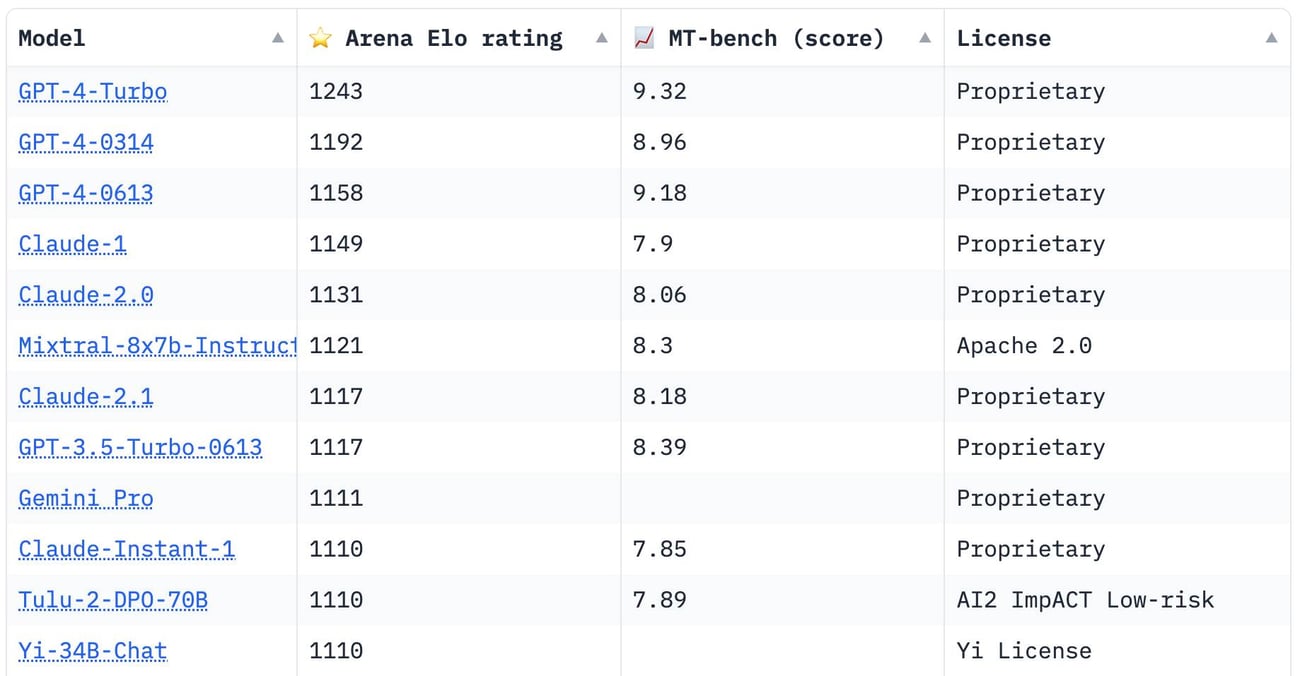 | What's New | "I pretty much only trust two LLM evals right now: Chatbot Arena and r/LocalLlama comments section" - Andrej Karpathy
Chatbot Arena is new a tool that allows you to compare the output of over 25 LLMs directly from your browser. It supports a mix of closed and open-source LLMs, including well-known ones like OpenAI's GPT-4Turbo and Mistral 8x7b.
It also lets users vote on which one provides better responses, and, this is where the magic is. Behind-the-scenes, you're creating the most robust LLM benchmark, one based on user experience. It’s like a real-world test lab where your votes shape the leaderboards. Think of it as crowdsourcing – the more you interact and vote, the clearer the picture we get of which models really deliver.
These votes feed into an Elo rating system, which is the same method used in chess to rank player skill. Each model starts with a base score, and gains or loses points based on the user votes - a win against a higher-ranked model scores more points, while losing to a lower-ranked model costs more.
This offers three big innovations: - It scales to many models without costly paired evaluations. The Elo system handles relative ranking even if models don't directly compete.
- New models can be quickly measured with a handful of matches. No need to wait for statistical significance across multiple comparisons.
- The leaderboard gives a clear view of state-of-the-art. As votes accumulate, model ratings converge.
The rankings already reveal some trends. Closed models like GPT-4 lead, but Mistral's mixture-of-experts architecture is closing the gap. And previous leaders like LLaMA now trail unexpectedly. | Highlights | - OpenAI remains the king of LLMs - Claude is second best performing closed model
- Closed models still outperform open models (but the gap is closing)
- Mistral 8x7b is the best open-source model right now
- Yi-34B is flying under the radar | | Try chatbot arena |
|
|
|
 | Don’t Let Hardware Availability Make You Miss Your Next Code Breakthrough
Remove the barriers to hardware access by using Intel’s latest CPUs, GPUs, and AI accelerators in the cloud.
Get your hands (and your code) on the latest Intel hardware and software technologies to build, test, optimize, and deploy AI, HPC and security workloads. Evaluate performance and acceleration on different hardware configurations. Build applications, develop your own prototypes, and benchmark your AI workloads. Learn with hands-on tutorials and real-world code samples. Streamline, scale, and speed up your development cycles.
Sign up for an account today—including free and enterprise options—and immediately begin leveraging the power, flexibility, and cost-effectiveness of Intel’s cloud-based development environment.
| | Sign up now | partner with us | |
| |
|
|
TOP OF GITHUB | PowerInfer (☆ 2.5k) A novel LLM inference engine designed for PCs with consumer-grade GPUs, like the NVIDIA RTX 4090. It utilizes a hybrid CPU/GPU approach and activation locality to optimize performance, achieving speeds close to server-grade GPUs. | | generative-ai (☆ 3.6k) It offers resources for developing and managing generative AI workflows. The newly added materials include notebooks and samples showing how to use Vertex AI Gemini API. This API allows access to the two models: Gemini Pro for language tasks and code generation, and Gemini Pro Vision with the support for the multimodal input. | | Pearl (☆ 1.8k) A production-ready reinforcement learning AI agent library open-sourced by Meta. Its goal is to support the creation of advanced AI agents for complex production scenarios with minimal effort. Pearl is designed to work well in situations where it doesn't have complete information, gets feedback infrequently, and where outcomes are unpredictable and change a lot. | | mlx-examples (☆ 2.9k) This repo contains a variety of standalone examples using the MLX framework (designed for machine learning on Apple silicon). Key examples include Transformer language model training, large-scale text generation with models like LLaMA and Mistral, image generation with Stable Diffusion, and speech recognition with OpenAI's Whisper. | | threestudio (☆ 4.5k) An advanced framework for creating diverse 3D content, capable of converting text prompts, single images, and few-shot images into 3D models using 2D text-to-image generation models. It features various custom extensions, including 4D-fy for 4D content creation and DreamCraft3D for high-quality image-to-3D conversions. | |
| |
|
|
Improve the Accuracy of your LLMs with this New Testing Guide | Kolena just released a comprehensive guide that identifies the key principles for creating reliable testing protocols and approaches for measuring model effectiveness in NLP problems such as text summarization or prompt engineering.
Designed for engineers and AI researchers, this guide is a crucial resource to ensure the robustness and accuracy of LLMs.
| | Download The Guide ↗ | |
| |
|
|
PYTORCH TIP | Parallel Inference on Multiple GPUs | Parallel inference using "torch.nn.parallel.DataParallel" or "torch.nn.parallel.DistributedDataParallel" in PyTorch allows for the distribution of model inference tasks across multiple GPUs.
This method is particularly beneficial for accelerating the inference process, especially when dealing with large-scale models or substantial datasets in environments with multiple GPUs. | When to Use | High-Volume Inference: Ideal for scenarios requiring fast processing of large batches of data during inference.
Resource-Intensive Models: Useful for deploying complex models that require significant computational resources.
Multi-GPU Environments: Applicable when multiple GPUs are available, maximizing their utility.
| Benefits | Increased Throughput: Achieves faster inference by distributing the workload across multiple GPUs.
Scalability: Allows models to handle larger datasets and more complex tasks than a single GPU could manage.
Efficient Utilization: Optimizes the use of available GPU resources, enhancing overall computational efficiency
|
import torch
import torch.nn as nn

# Define your model (example: simple NN)
class SimpleNN(nn.Module):
# Model definition here

model = SimpleNN()
device = torch.device(
"cuda"if torch.cuda.is_available()
else"cpu"
)
model.to(device)

# Wrap the model for parallel processing
if torch.cuda.device_count() > 1:
 model = nn.DataParallel(model)

# Load data and perform parallel inference
# data_loader = ...

for inputs in data_loader:
 inputs = inputs.to(device)
 outputs = model(inputs)
# Process outputs
|
|
|
|
TOP MODEL/SPACES | SOLAR-10.7B-Instruct-v1.0 This 10.7 billion parameter model excels in performance, surpassing models up to 30B parameters, including the Mixtral 8X7B. SOLAR-10.7B is optimized for fine-tuning, utilizing supervised fine-tuning (SFT) and direct preference optimization (DPO) methods with various datasets, ensuring robustness and adaptability. | | mixtral-46.7b-chat A high-quality sparse mixture of experts model (SMoE) which outperforms Llama 2 70B on most benchmarks with 6x faster inference. It is the strongest open-weight model with a permissive license and the best model overall regarding cost/performance trade-offs. | |
| |
|
|
PYTHON TIP | Custom Sorting | Using the “sorted()” function in combination with “lambda” expressions allows for custom sorting of data structures in Python. This technique is particularly powerful for sorting lists, tuples, or other iterable objects based on specific criteria defined in a lambda function. | When to Use | Complex Data Sorting: Ideal for sorting lists or arrays when standard sort criteria are insufficient or non-standard.
Sorting Objects: Useful for sorting objects based on one or more of their attributes.
Data Analysis: Enhances data analysis tasks where sorting is required based on custom logic.
| Benefits | Flexibility: Custom sort orders can be easily defined to meet specific requirements.
Conciseness: Lambda functions provide a concise way to specify sorting criteria inline.
Readability: Makes the code more readable and expressive by clearly stating the sorting criteria.
|
# Example list of tuples
data = [('apple', 2), ('orange', 3), ('banana', 1)]

# Custom sorting: sort by the
# second element of each tuple
sorted_data = sorted(data, key=lambda x: x[1])

print(”Example output:
“, sorted_data)

# Example output:
# [('banana', 1), ('apple', 2), ('orange', 3)]
|
|
|
|
| Thank You | | Want to promote your company, product, job, or event to 150,000+ AI researchers and engineers? You can reach out here. |
|
|
|
|
