| Hey, | Welcome to AlphaSignal – the most read newsletter by AI developers. |
|
|
|
IN TODAY'S SIGNAL
| We're testing a new format at AlphaSignal—our first opinion piece.
Instead of just listing the news, we’ll break down what happened and why it matters. If you find it valuable, we’ll make it a weekly thing. But this takes a lot of effort, so if it’s not useful, we’ll shut it down. We need your feedback—should we keep it? What would you like to see more or less of?
This is a collaboration with a well-known tech writer in the space, and we want to make sure it’s worth your time.
Thanks for reading—let us know what you think!
Read Time: 6 min 17 sec |
|
|
|
Key takeaways from the AI mega week
| The last two weeks saw a massive deluge of AI releases, including three new frontier models from xAI, Anthropic, and OpenAI. While every model is unique in its own right, they hint at some broader trends that can have important implications for the future of AI progress and its applications. Here is what we learned from AI’s mega week.
Scaling laws are evolving
Scaling laws in AI suggest that larger models, trained with more compute (measured in floating-point operations, or FLOPs), data, and parameters, tend to exhibit improved capabilities, often in a predictable way. However, there’s an ongoing debate about whether these laws continue to hold as models grow exponentially larger or if they encounter diminishing returns. xAI’s Grok 3 serves as a significant data point in this discussion due to its unprecedented training scale.
Grok 3 was trained on xAI’s Colossus supercomputer, a cluster with reportedly 200,000 Nvidia GPUs. According to xAI, Grok 3 was trained with 10x the compute of previous state-of-the-art models. And experiments show that in comparison to other models, it has improved significantly in reasoning, mathematics, coding, world knowledge, and instruction-following tasks. It achieved the top spot on the LMSys Chatbot Arena with an Elo score of 1402 and had strong results on the 2025 American Invitational Mathematics Examination (AIME), which shows generalization to tasks beyond its training data.
The performance of Grok 3 appears to support the idea that scaling laws still hold to some extent. This indicates that the additional compute has translated into tangible capability gains, reinforcing the notion that "bigger can be better" when paired with effective training strategies.
However, the picture isn’t entirely straightforward. GPT-4.5, announced on February 27 was also an important data point to consider in the scaling laws discussion. It is the biggest model OpenAI has developed and it was so large that they had to train it in multiple data centers to prepare it in time. This is OpenAI’s last “non-chain-of-thought model,” which means it has only undergone the classic pre-training and alignment post-training (supervised fine-tuning and reinforcement learning from human feedback).
GPT-4.5 outperforms GPT-4o at recognizing patterns, understanding and following user intent, delivering more natural interactions, and reducing hallucinations. But the gains are modest compared to the leaps seen in earlier transitions, like GPT-3 to GPT-4. And the huge costs do not justify the minimal gains. Despite its massive size—reflected in its high API costs ($75 per million input tokens versus GPT-4o’s $2.50)—GPT-4.5 doesn’t outperform reasoning models like OpenAI’s o1 or competitors from Anthropic and DeepSeek in math and coding tasks.
|
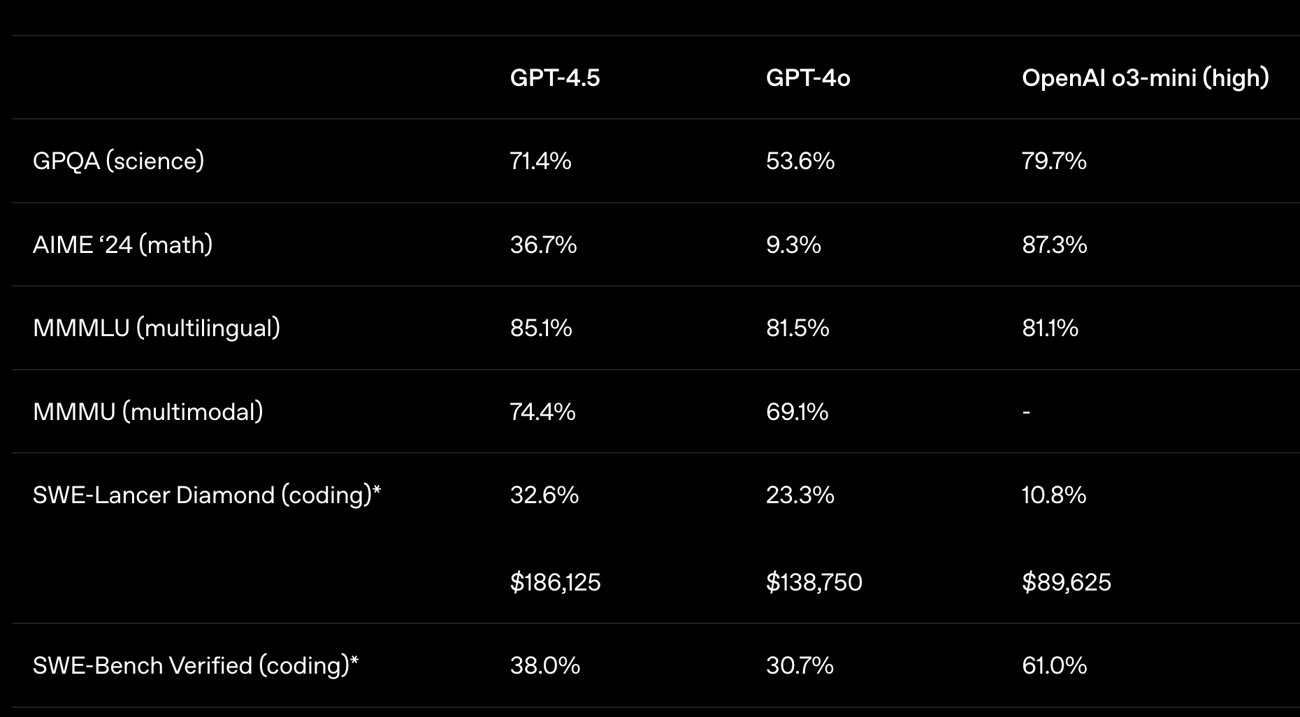
| Source: OpenAI blog
This suggests that simply piling on compute and data may no longer produce the dramatic jumps seen previously, especially in tasks that require reasoning. This echoes sentiments from former OpenAI co-founder Ilya Sutskever, who in December 2024 remarked that pre-training has hit a "peak data" plateau.
However, test-time scaling (or inference-time scaling) continues to show promise. The reason Grok 3 made a much bigger splash was that in addition to pre-training, it had undergone training for test-time scaling, where it uses extra compute cycles to “think” about the problem, generate chain-of-thought (CoT) traces, and provide more accurate answers. Grok 3 incorporates this with features like "Think Mode" and "Big Brain Mode,” which is why it performs very well on reasoning tasks. This hybrid approach—combining massive pre-training compute with enhanced inference-time compute—could be a key factor in its strong performance, suggesting that modern AI progress may depend on both scaling laws working in tandem rather than pre-training alone.
|
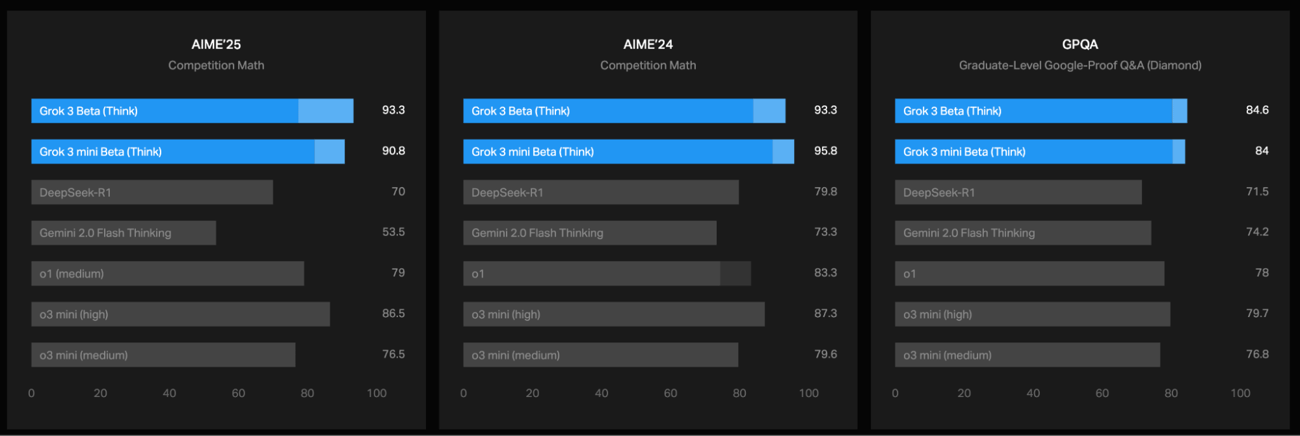
| Source: xAI blog
This shift hints that scaling laws might not be breaking but evolving—future progress may depend on combining pre-training with inference-time techniques like chain-of-thought reasoning or reinforcement learning. On the one hand, large foundation models alone will not be enough to solve the complex problems of modern-day applications. On the other, reasoning models can’t be built without a strong foundational model.
In an interview with Big Technology, Mark Chen, OpenAI’s Chief Research Officer, said, “You need knowledge to build reasoning on top of. A model can't go in blind and just learn reasoning from scratch. So we find these two paradigms to be fairly complimentary, and we think they have feedback loops on each other.
Meanwhile, there is still a lot of room for improvement when it comes to optimizing model training. For example, Grok 3’s gains—while impressive—may not be proportional to the scale of resources invested. For instance, compared to DeepSeek R1, which achieved strong performance with less compute through optimization rather than brute-force scaling, Grok 3’s improvements are marginal, raising questions about efficiency. These diminishing gains suggest that while scaling laws remain relevant, their benefits might taper off without parallel innovations in architecture, data quality, or training techniques.
Unified models are coming
Frustration over the confusing lineup of models has been brewing for a while. AI companies have acknowledged this and promised to solve this problem by providing a seamless experience, where the AI system automatically chooses the best model to handle the user’s request.
OpenAI has suggested that GPT-5 will be “a router model that intelligently delegates the task to the appropriate underlying model” and that o3, its frontier reasoning model, will not be available as a standalone model.
Meanwhile, Anthropic has provided a glimpse into what could be next for AI models. Claude 3.7 Sonnet, its latest frontier model, contains both the functionality of a general-purpose LLM and a reasoning model. According to Anthropic, both functionalities have been integrated into the same model without a router in the middle. “Just as humans use a single brain for both quick responses and deep reflection, we believe reasoning should be an integrated capability of frontier models rather than a separate model entirely,” Anthropic wrote on its blog when it released Claude 3.7 Sonnet. “This unified approach also creates a more seamless experience for users.”
Unfortunately, there are no details about the model’s architecture or training regime. But there are a few studies, including one from Meta, that show how models can be trained to dynamically choose between different inference strategies based on the difficulty of the prompt. 2025 is off to a great start and things are moving faster than ever. With GPT-4.5 underperforming, the ball is now in OpenAI’s court to play its next move, especially as DeepSeek is also preparing to release its next frontier model.
What is for sure is that AI is on the cusp of a massive transformation. We are just beginning to explore the possibilities of models that not only provide instant answers but also reason long and hard before responding. Anthropic projects that in 2025, AI models will be able to do independent work that would have required hours of manual effort by experts, and by 2027, they will be able to do years’ worth of work in a very short period of time.
|
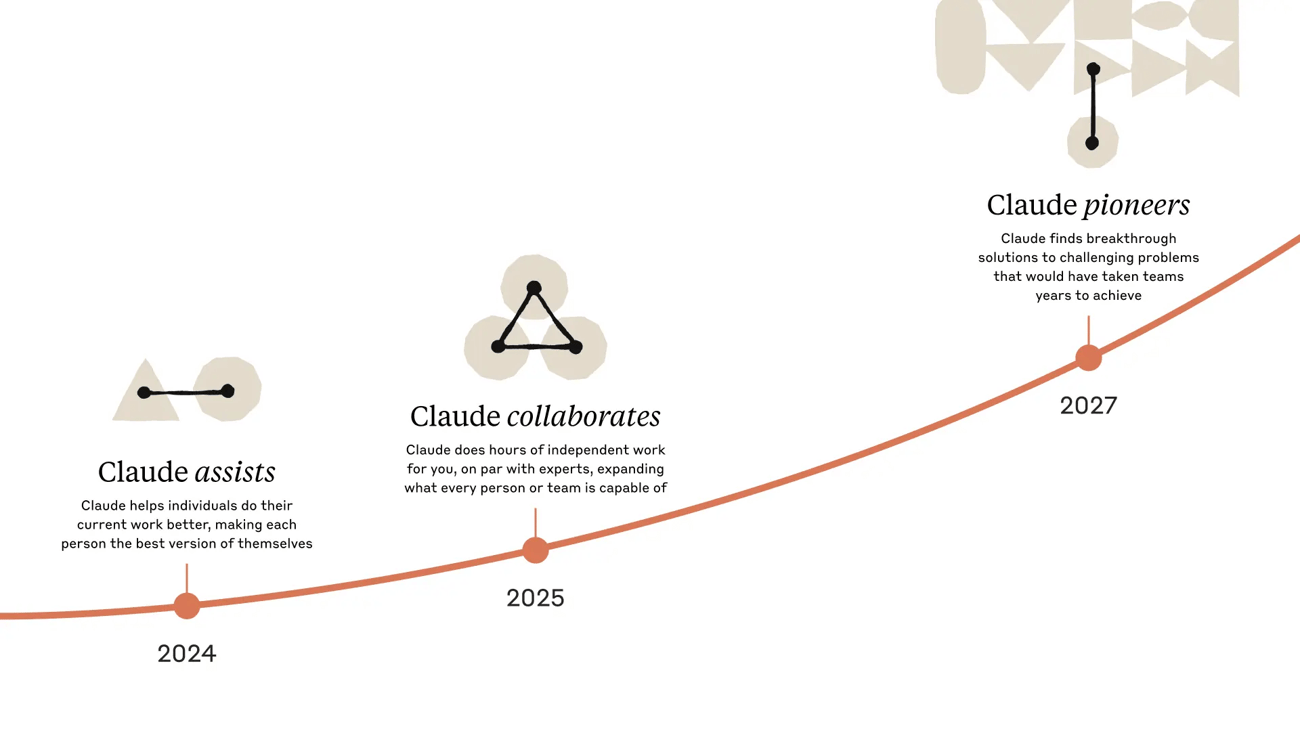
| Source: Anthropic blog
As AI models continue to evolve, integrating both foundational knowledge and reasoning capabilities, how do you envision these advancements shaping the future of industries and daily life? What opportunities or challenges do you foresee in this rapidly advancing landscape?
| |
|
|
|
At Alpha Signal, our mission is to build a sharp, engaged community focused on AI, machine learning, and cutting-edge language models, helping over 200,000 developers stay informed and ahead. We’re passionate about curating the best in AI, from top research and trending technical blogs to expert insights and tailored job opportunities. We keep you connected to the breakthroughs and discussions that matter, so you can stay in the loop without endless searching. We also work closely with partners who value the future of AI, including employers and advertisers who want to reach an audience as passionate about AI as we are.
Our partnerships are based on shared values of ethics, responsibility, and a commitment to building a better world through technology.Privacy is a priority at Alpha Signal. Our Privacy Policy clearly explains how we collect, store, and use your personal and non-personal information. By using our website, you accept these terms, which you can review on our website. This policy applies across all Alpha Signal pages, outlining your rights and how to contact us if you want to adjust the use of your information. We’re based in the United States. By using our site, you agree to be governed by U.S. laws. |
|
|
|
Looking to promote your company, product, service, or event to 200,000+ AI developers? Let's work together.
|
| Work with us
|
|
|
|
|
