
A Solo Developer's Swahili Speech Model Hit 1.18M Downloads
A community fine-tune of Facebook's XLSR-53 turns Swahili speech into text at 20% word error rate, and downloads are surging past a million.
Takeaways
- Swahili ASR fine-tune of facebook/wav2vec2-large-xlsr-53 reaches 20% WER on Common Voice 13.
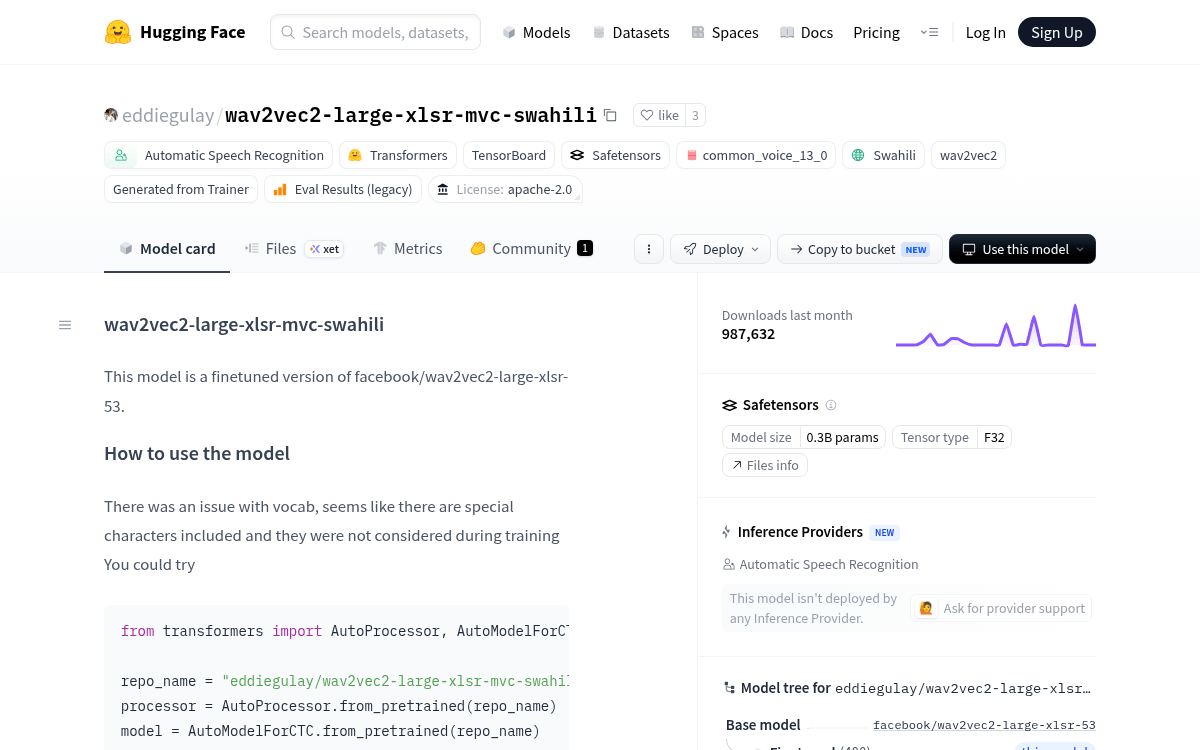
- Roughly 1.18 million downloads last month on Hugging Face, signaling real production adoption.
- Apache 2.0 license, 0.3B parameters, safetensors format, runs on a single consumer GPU.
- Trained on Mozilla Common Voice 13 Swahili, which had roughly 719 hours as of the 20k-hour release.
- Best for clean read speech; weak on noisy audio, code-switching, and dialectal variants.
- Ships with greedy CTC decoding only, no punctuation or streaming out of the box.
Swahili is spoken by more than 100 million people across East Africa, yet mainstream speech recognition APIs largely ignore it. A community-trained checkpoint on Hugging Face called wav2vec2-large-xlsr-mvc-swahili is filling that gap, and its download counter tells the story: roughly 1.18 million pulls in the last month, making it one of the most-downloaded Swahili ASR models on the Hub.
The approach is deliberately simple. The author took Meta's multilingual facebook/wav2vec2-large-xlsr-53 encoder, fine-tuned it on the Swahili split of Mozilla's Common Voice 13 corpus, and published the weights under Apache 2.0 with a self-reported word error rate of 0.20 on the Common Voice test set.
Why XLSR-53 transfers so well
Wav2Vec2-large-xlsr-53 ships with 24 Transformer layers and a hidden size of 1024, pretrained on approximately 56,000 hours of unlabeled speech across 53 languages. Training solves a contrastive task over masked latent speech representations while jointly learning a quantization of those latents shared across languages. The practical result: on CommonVoice benchmarks, XLSR achieves a 72% relative phoneme error rate reduction compared to the best previously known results. The encoder has already learned the acoustic structure of human speech at scale, so a downstream language like Swahili needs only a modest labeled dataset to reach usable accuracy. That transfer property is what makes a single-developer fine-tune viable for a low-resource language.