
Alibaba's gte-multilingual-base Beats Larger Rivals Across 75 Languages at 10x Speed
Alibaba's 305M-parameter encoder handles 75 languages and 8192-token context while running 10x faster than LLM-based embedders, with dense and sparse outputs.
Takeaways
- Alibaba's gte-multilingual-base is a 305M encoder supporting 75 languages and 8192-token context.
- Runs roughly 10x faster than decoder-LLM embedders like gte-qwen2-1.5b-instruct.
- Outputs dense vectors, elastic 128-768 dim truncation, and sparse token weights from one pass.
- Evaluated on MIRACL, MLDR, MKQA, BEIR, LoCo and MTEB across four languages.
- Built on transformer++ (BERT + RoPE + GLU) with XLM-R vocabulary, Apache 2.0 licensed.
- Full recipe in the mGTE paper published at EMNLP Industry Track.
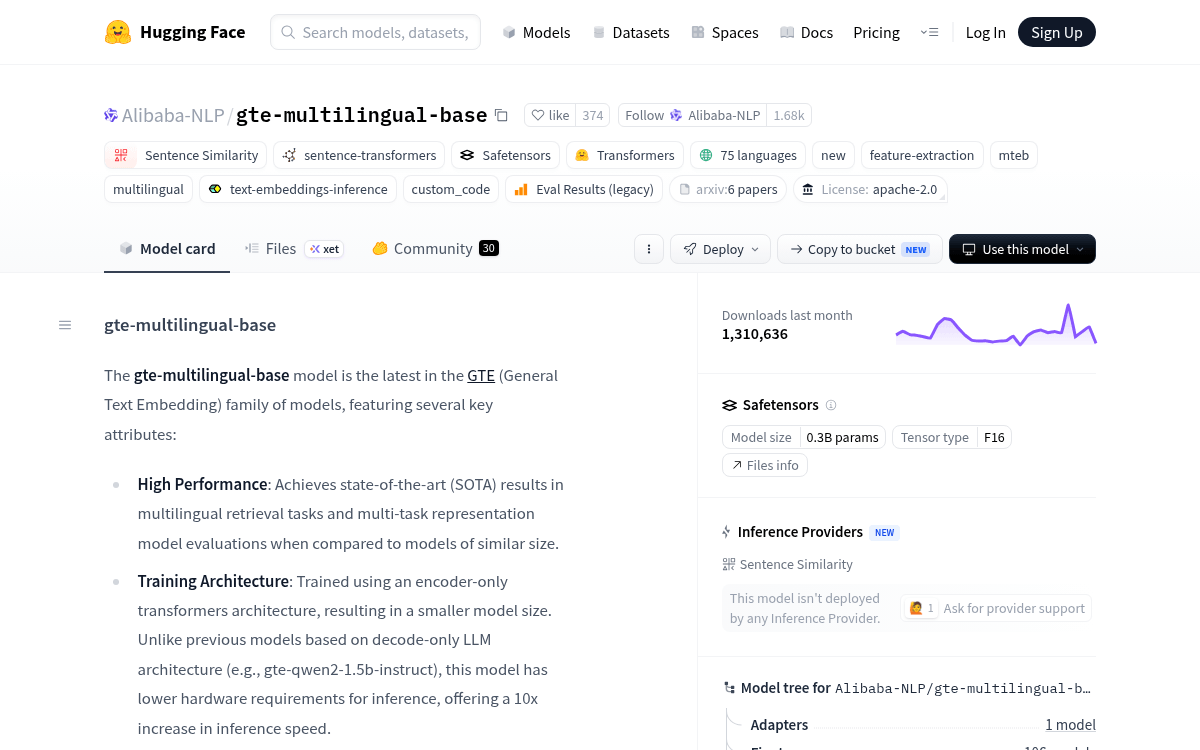
Alibaba's Tongyi Lab has been quietly building one of the most practical multilingual embedding models available, and gte-multilingual-base keeps climbing the Hugging Face charts with over 1.3 million downloads. The model is a compact 305M-parameter encoder that supports 75 languages, handles an 8192-token context window, and produces both dense and sparse vectors from the same forward pass. For anyone building multilingual search or RAG, it hits an unusual sweet spot between quality, speed, and footprint.
A deliberate step away from LLM-based embedders
The recent trend has been to turn 1B to 7B decoder LLMs into embedding models. They score well on benchmarks but are painful to deploy at retrieval scale. gte-multilingual-base is trained using an encoder-only transformer architecture, giving it lower hardware requirements and a 10x increase in inference speed compared to previous decoder-only LLM-based embedders like gte-qwen2-1.5b-instruct. That speed gap matters when you are encoding tens of millions of documents or serving live queries with tight latency budgets.
The backbone here is a transformer++ encoder (BERT with rotary position embeddings and GLU activations) using the XLM-R vocabulary, and the underlying text encoder outperforms the same-sized XLM-R-base on both GLUE and XTREME-R. Rotary embeddings are what enable the jump to 8192 tokens without the usual positional-encoding hacks.