
Alibaba's gte-Qwen2-1.5B Beats 7B Rivals on Retrieval at a Fraction of the Cost
Alibaba's compact 1.5B multilingual embedding model punches above its weight on MTEB, offering 32k context and 1536-dim vectors under Apache 2.0.
Takeaways
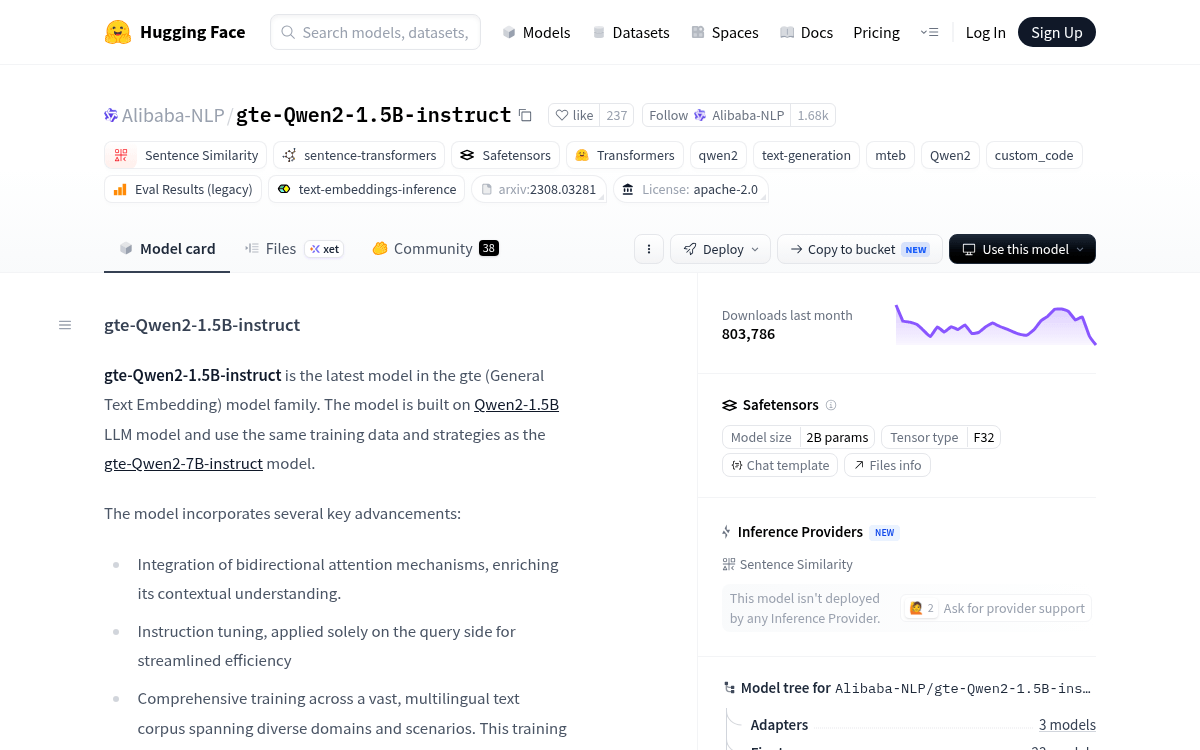
- gte-Qwen2-1.5B-instruct from Alibaba turns Qwen2-1.5B into a strong multilingual embedding model under Apache 2.0.
- Scores 67.16 on MTEB English and 67.65 on C-MTEB, close to 7B rivals at a fifth the size.
- Supports 32k context, 1536-dim embeddings, and query-side instruction tuning for task-specific retrieval.
- Uses bidirectional attention retrofitted onto a decoder LLM, inheriting Qwen2's long context and multilingual pretraining.
- Works with sentence-transformers, infinity, text-embeddings-inference, and quantized GGUF for CPU deployment.
- Encoder-only alternatives like gte-multilingual-base are roughly 10x faster if throughput matters more than raw MTEB score.
Alibaba's Tongyi Lab has been quietly turning small LLMs into strong open embedding models, and gte-Qwen2-1.5B-instruct is the compact workhorse of that family. It takes the Qwen2-1.5B language model and retrains it to produce dense text vectors rather than generate text, landing a model that fits on modest hardware while competing with 7B-class rivals on retrieval benchmarks.
The checkpoint has racked up close to a million monthly downloads on Hugging Face, making it one of the more widely deployed open embedding models in production RAG stacks. It ships under Apache 2.0, so commercial use, fine-tuning, quantization, and self-hosting are all unrestricted.
What you get
The core specs are tuned for real retrieval workloads. Built on Qwen2-1.5B, the model shares training data and strategies with the larger gte-Qwen2-7B-instruct, with bidirectional attention, instruction tuning applied only on the query side, and training across a multilingual corpus using both weakly supervised and supervised data.
- Model size: 1.5B parameters (roughly 6.62 GB in fp32, far less when quantized)
- Embedding dimension: 1536
- Max input: 32,000 tokens
- Languages: multilingual, with strong English, Chinese, French, and Polish coverage
- License: Apache 2.0
Two design choices are worth flagging. Switching from causal to bidirectional attention lets each token see the full sequence when forming an embedding, which is how encoder models like BERT work and why they historically dominated retrieval. Instruction tuning is applied only on the query side, meaning you prepend a task description to queries but embed documents as-is. That keeps your document index static even when you change tasks.