
Alibaba's MiniMax-H3 Cuts Video Generation Steps from 32 to 8
Alibaba PAI's Parallel Decoding Distillation LoRAs cut MiniMax-H3 video generation from 32 sampler steps down to 8 or 4, with no classifier-free guidance.
Takeaways
- Alibaba PAI released MiniMax-H3-Acc-LoRAs, cutting H3 inference from 32 to 8 steps
- Uses Parallel Decoding Distillation from arXiv 2607.26004 with a rank-64 trunk plus 32-head bank
- Two variants: FL2VA (first-and-last-frame) and Ref2VA (reference-image), each 1.4 GB BF16
- Runs at CFG 1.0 with euler sampler, no classifier-free guidance doubling
- Requires VideoX-Fun with diffusers >= 0.40.0, or dedicated ComfyUI node packs
- Plain LoRA loaders silently drop the head bank and lose most acceleration quality
Alibaba's PAI team has released a pair of acceleration adapters that make MiniMax-H3, the roughly 33B omni-modal video-and-audio model, usable on human timescales. MiniMax-H3-Acc-LoRAs collapses the base model's 32-step sampling schedule into 8 steps (or 4, if you push it) while keeping joint audio and video generation intact.
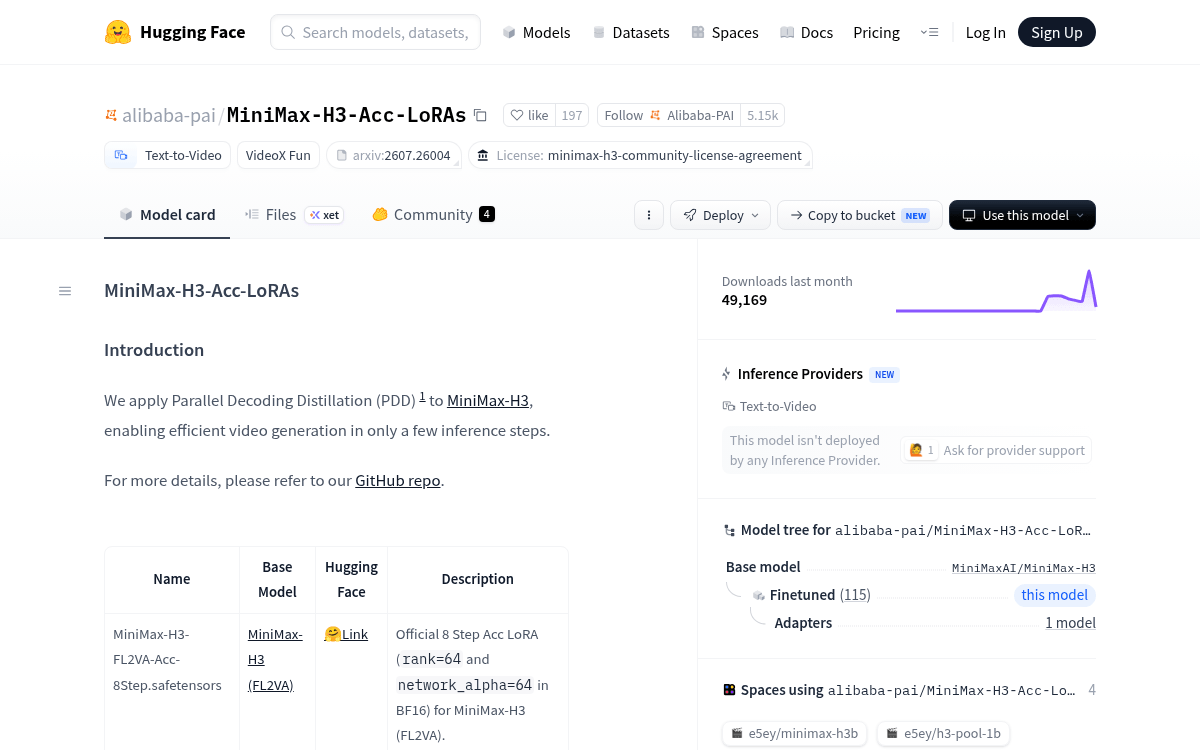
Two checkpoints ship with the release, matched to H3's two generation modes: MiniMax-H3-FL2VA-Acc-8Step.safetensors for first-and-last-frame-to-video-plus-audio, and MiniMax-H3-Ref2VA-Acc-8Step.safetensors for reference-image-to-video-plus-audio. Each file weighs 1.4 GB in BF16, rank 64, applied at strength 1.0 over the base H3 transformer.
More than weight deltas
These are not plain LoRA weight deltas. Alongside a rank-64 trunk LoRA (network_alpha = 64, BF16), each checkpoint carries a Parallel Decoding Distillation head bank: 32 per-interval copies of the final-layer video and audio projections, fused into a single mean-block-velocity head at each sampler step.
A plain LoRA loader cannot read these files. Dropping the head bank silently discards the distillation, so wiring them into a standard LoRA loader produces a model that runs, outputs something, and quietly throws away most of the acceleration benefit.