
Alibaba's Qwen3.6-27B Beats a 397B Model on Coding Running on One GPU
Alibaba's new 27B dense multimodal model matches Claude 4.5 Opus on Terminal-Bench and beats its own 397B predecessor on coding benchmarks.
Takeaways
- Alibaba released Qwen3.6-27B-FP8, an Apache-2.0 dense multimodal model with a 262K context.
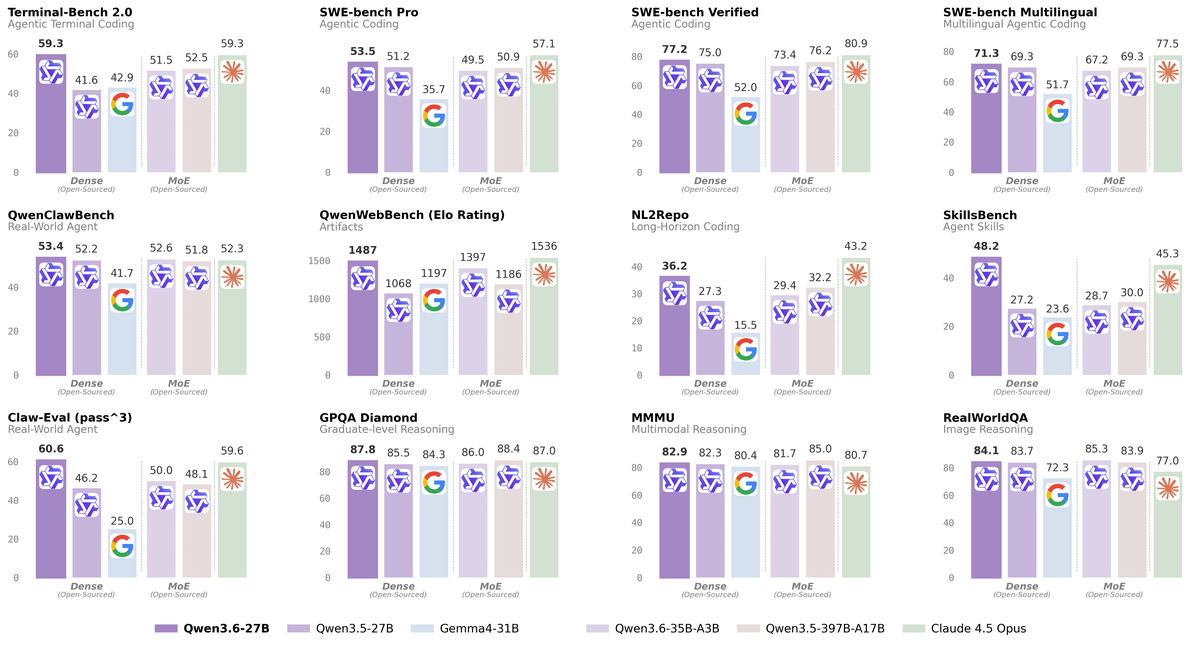
- Scores 77.2 on SWE-bench Verified, beating the previous 397B MoE flagship.
- Hits 59.3 on Terminal-Bench 2.0, matching Claude 4.5 Opus at 27B dense.
- Hybrid architecture: Gated DeltaNet linear attention plus Gated Attention layers.
- New preserve_thinking mode reuses reasoning traces across agent turns.
- Runs on ~18GB VRAM via FP8 block quantization, works with vLLM, SGLang, KTransformers.
Alibaba's Qwen team just dropped an FP8-quantized build of Qwen3.6-27B, and the numbers make you double-check the parameter count. The model is a 27-billion-parameter dense multimodal system that goes toe-to-toe with frontier closed-source rivals on agentic coding, while fitting comfortably on a single consumer GPU. The FP8 checkpoint is Apache-2.0 licensed, ships with a 262K native context window, and works out of the box with vLLM, SGLang, KTransformers, and Hugging Face Transformers.
A 27B that outruns a 397B
The headline result: Qwen3.6-27B outperforms the previous-generation Qwen3.5-397B-A17B MoE on every major coding benchmark the team reports. On SWE-bench Verified the score is 77.2 vs 76.2, SWE-bench Pro 53.5 vs 50.9, Terminal-Bench 2.0 59.3 vs 52.5, and SkillsBench 48.2 vs 30.0. On reasoning, it hits 87.8 on GPQA Diamond, competitive with models several times its size.
Terminal-Bench is the figure that raised eyebrows in the community. At 59.3%, Qwen3.6-27B matches Claude 4.5 Opus while running on a single 16-24GB GPU without sending code to anyone else's server. On SkillsBench, it lands at 48.2% against 30.0% for the 397B model the same team shipped months earlier, a 77% relative jump at 14.8x fewer parameters.
What is actually inside it
The architecture is more than a plain transformer. It interleaves linear attention with softmax attention in a fixed pattern, plus a vision encoder wired in directly rather than adapted on. Highlights from the model card:
- Hybrid attention stack: 64 layers arranged as
16 × (3 × (Gated DeltaNet → FFN) → 1 × (Gated Attention → FFN))