
Alibaba's Qwen3.6-27B Beats Its Own 397B Model on Every Coding Benchmark
Alibaba's new dense 27B multimodal model matches a 397B MoE on coding benchmarks, ships with 262K context and reasoning that persists across turns.
Takeaways
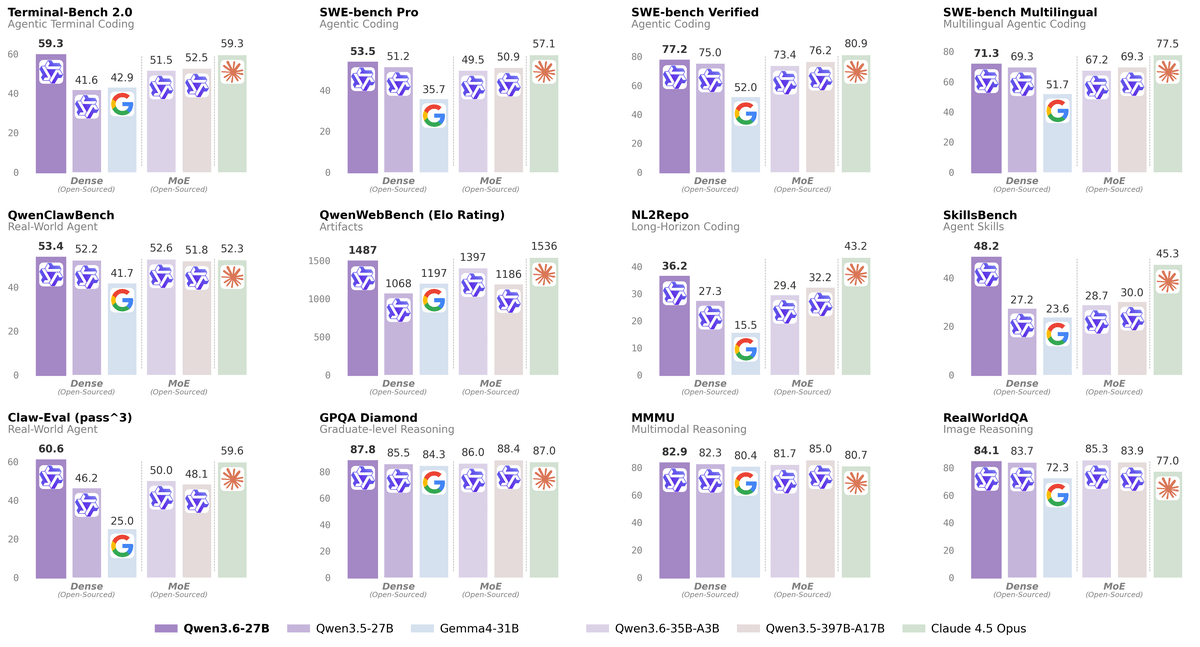
- Qwen3.6-27B is a dense 27B multimodal model beating Alibaba's own 397B MoE on coding
- Scores 77.2 on SWE-bench Verified and ties Claude 4.5 Opus on Terminal-Bench 2.0 at 59.3
- New Thinking Preservation feature retains chain-of-thought across turns for multi-step agent workflows
- Native 262K context extensible to 1M via YaRN, handles text, images, and video
- Apache 2.0 on Hugging Face, runs at Q4 in 16.8 GB VRAM on consumer GPUs
- OpenRouter pricing: $0.30/M input, $2.00/M output tokens across seven providers
Alibaba's Qwen team just open-sourced Qwen3.6-27B, a dense 27-billion-parameter multimodal model that outperforms the team's own previous-generation 397B Mixture-of-Experts flagship across every major agentic coding benchmark. It handles text, images, and video, comes with a 262,144-token native context window, and ships under Apache 2.0 in a size that fits on a single consumer GPU when quantized.
The headline claim from the team is that Qwen3.6-27B delivers substantial improvements across agentic coding benchmarks, surpassing models with up to 15x its total parameter count. The numbers back it up.
Benchmarks that actually move
Coding-focused evaluations are where this release earns its keep. With only 27B parameters, it beats Qwen3.5-397B-A17B (397B total, 17B active) on every major coding benchmark, including SWE-bench Verified (77.2 vs. 76.2), SWE-bench Pro (53.5 vs. 50.9), Terminal-Bench 2.0 (59.3 vs. 52.5), and SkillsBench (48.2 vs. 30.0). On Terminal-Bench 2.0 it ties Claude 4.5 Opus at 59.3.
Reasoning holds up too. Qwen3.6-27B posts 87.8 on GPQA Diamond, competitive with models several times its size, 94.1 on AIME 2026, and 83.9 on LiveCodeBench v6, closing the gap on proprietary frontier systems.
The multimodal side carries real weight. On MMMU it hits 82.9, on VlmsAreBlind it reaches 97.0, and on AndroidWorld, a GUI agent benchmark that runs on real Android apps, it scores 70.3. That combination of agentic coding, long context, and vision in a single 27B package is what distinguishes this release from earlier Qwen checkpoints, which had to pick one focus per model size.
Thinking that survives the next turn
The most architecturally interesting change is a feature called Thinking Preservation. Standard reasoning models generate a chain-of-thought during each response, then discard that trace before the next turn. The next message starts from scratch, so the model has to re-derive context it has already worked through. That is wasteful in multi-turn agent workflows where the model is iteratively developing the same codebase across dozens of turns.