
Alibaba's Qwen3-ASR Beats Whisper Across 52 Languages With a Single Open Model
Alibaba's Qwen3-ASR brings LLM-grade multilingual speech recognition to 52 languages, beating commercial APIs on key benchmarks under Apache 2.0
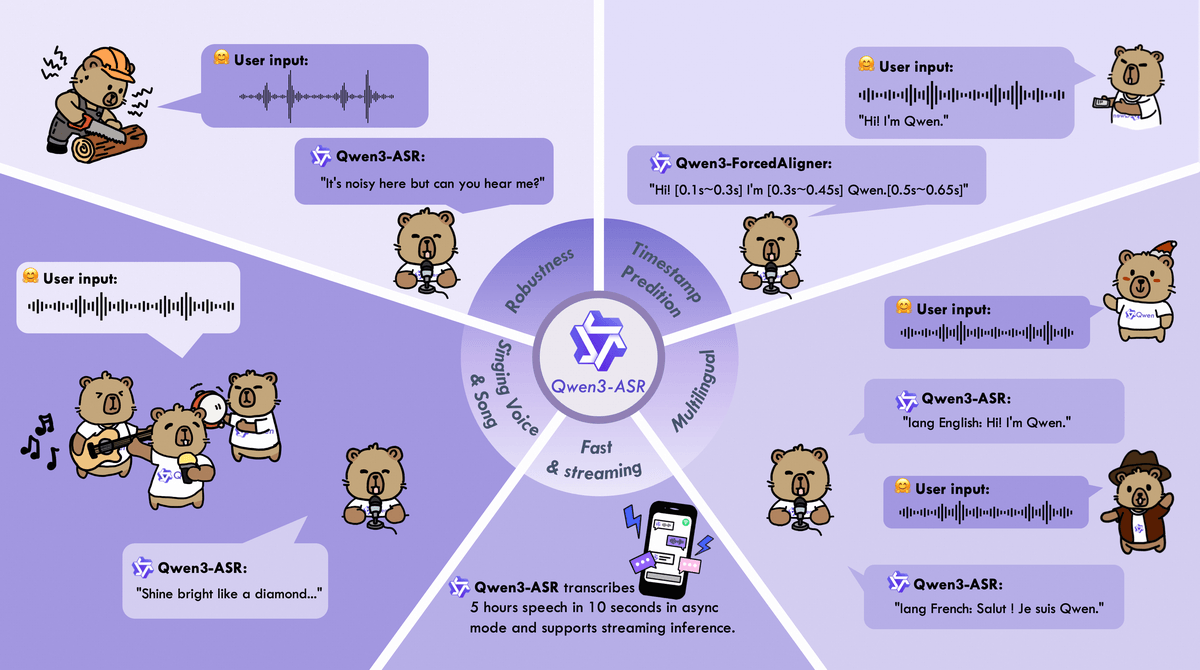
Takeaways
- Two open-source ASR models released: Qwen3-ASR-0.6B and 1.7B under Apache 2.0, supporting 52 languages and dialects.
- LLM-based architecture: Audio Transformer (AuT) encoder feeds into a Qwen3 language model decoder, trained on 40M hours of audio and 3T tokens.
- Single model for streaming and offline: A dynamic 1-8s attention window enables both real-time and batch transcription from one checkpoint.
- Strong benchmarks: 1.7B achieves 5.59% mean WER on the HF Open ASR Leaderboard; 97.9% language ID accuracy vs. 94.1% for Whisper-large-v3.
- Bundled forced aligner: Qwen3-ForcedAligner-0.6B provides word-level timestamps for 11 languages using a non-autoregressive slot-filling approach.
- Available now: Via Hugging Face Transformers (from source), GitHub, DashScope API, and Azure AI Foundry.
Alibaba's Qwen team has open-sourced Qwen3-ASR, a family of automatic speech recognition models that takes a fundamentally different approach from Whisper-style encoders: instead of a dedicated speech model, it plugs a custom audio encoder directly into a Qwen3 language model decoder. The result is a system that handles 52 languages and dialects, streams in real time, transcribes singing over background music, and produces word-level timestamps -- all from a single set of weights.
The family includes Qwen3-ASR-1.7B and Qwen3-ASR-0.6B, both supporting language identification and ASR for 52 languages and dialects, leveraging large-scale speech training data and the strong audio understanding ability of their foundation model Qwen3-Omni. Both models are released under Apache 2.0, meaning you can use them commercially without restriction.
One model, two modes
The headline engineering trick here is a dynamic attention window. The model uses a dynamic flash attention window size ranging from 1s to 8s, which allows Qwen3-ASR to perform both streaming inference with short chunks and offline inference with long queries. That means you don't need to pick a streaming model or a batch model -- the same checkpoint handles both, which dramatically simplifies deployment.
The 0.6B version reaches 2000x throughput at a concurrency of 128, and both models achieve streaming and offline unified inference with a single model, supporting transcription of long audio. Time-to-first-token latency reportedly drops to 92 milliseconds for the smaller variant -- low enough for real-time voice agents.
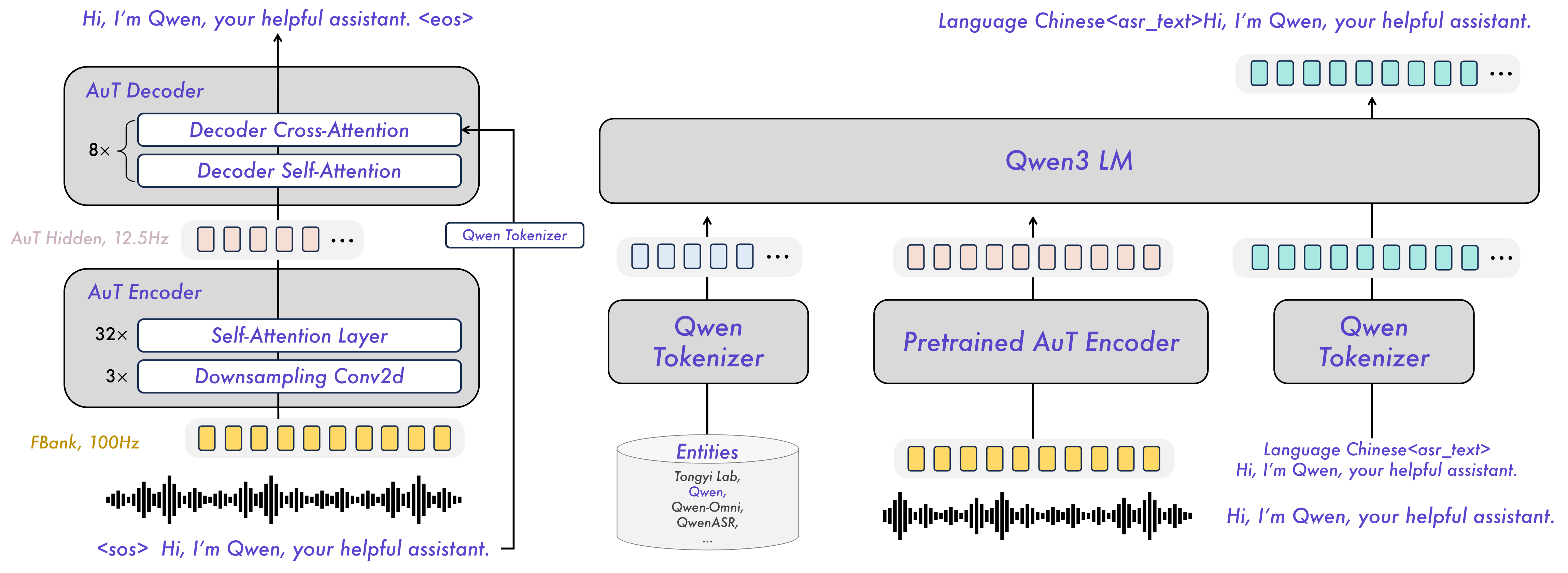
Under the hood: LLM meets audio
The architecture is a classic encoder-decoder stack, but with a twist at every layer. Qwen3-ASR-1.7B is built with Qwen3-1.7B, a projector, and an AuT encoder with 300M parameters and 1024 hidden size. Qwen3-ASR-0.6B is built with Qwen3-0.6B, a projector, and an AuT encoder with 180M parameters and a hidden size of 896. The AuT (Audio Transformer) encoder is the key piece -- it's not borrowed from Whisper, it was trained from scratch.