
Alibaba's Qwen3-Coder-480B Challenges Claude Sonnet With Open-Weight Agentic Coding
Alibaba's 480B parameter Mixture-of-Experts coder targets Claude Sonnet with a 256K native context, Apache 2.0 weights, and long-horizon agent training.
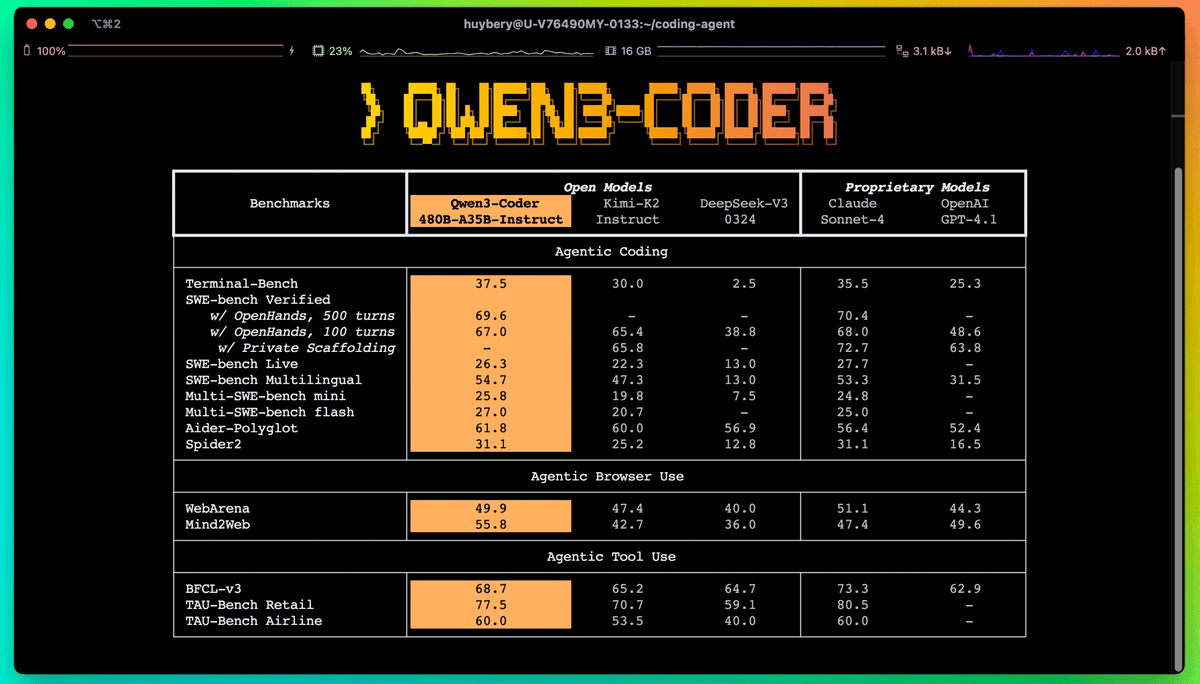
Takeaways
- Qwen released Qwen3-Coder-480B-A35B, a 480B MoE with 35B active parameters under Apache 2.0.
- Native 256K context extendable to 1M tokens via YaRN for repository-scale understanding.
- Trained on 7.5T tokens with 70% code ratio plus long-horizon Agent RL across 20,000 parallel environments.
- Reports performance comparable to Claude Sonnet 4 on agentic coding, browser-use, and tool-use benchmarks.
- Ships alongside Qwen Code CLI, an open-source Claude Code alternative forked from Gemini CLI.
- Deployable via vLLM, SGLang, Ollama, and llama.cpp with quantized variants for local use.
Alibaba's Qwen team released Qwen3-Coder-480B-A35B-Instruct, an open-weights code model that pushes the frontier of what you can run without paying a proprietary API. It's a Mixture-of-Experts model tuned for agentic coding, and the team is explicit that they built it to trade blows with Claude Sonnet rather than just other open models.
The specs: 480 billion total parameters with 35 billion activated, native 256K token context extendable to 1 million via YaRN extrapolation, and Apache 2.0 weights. It ships alongside a companion CLI agent designed to put the model to work.
Under the hood
The architecture leans into sparsity to keep inference costs manageable relative to the parameter count. Key specs from the model card:
- 480B total parameters, 35B activated per forward pass
- 62 layers with Grouped Query Attention (96 heads for Q, 8 for KV)
- 160 experts with 8 activated per token
- 262,144 native context length, extendable to ~1M via YaRN
- Non-thinking mode only, no
<think>blocks in output
One notable design choice: this is a pure instruct model with no reasoning mode. You won't get chain-of-thought scratchpads in the output, which keeps latency down for agentic loops where you're calling the model dozens of times per task.
How they trained it
The team pretrained on 7.5T tokens with a 70% code ratio, and natively supports 256K context extendable to 1M with YaRN, optimized for repo-scale and dynamic data like pull requests. That code ratio is aggressive by any standard, and the post-training phase leverages long-horizon reinforcement learning called Agent RL to improve multi-step planning and tool interaction.
The RL scaling is the part worth pausing on. In real-world software engineering tasks like SWE-Bench, Qwen3-Coder engages in multi-turn interaction with the environment, involving planning, using tools, receiving feedback, and making decisions. To make this tractable, the team built a scalable system capable of running 20,000 independent environments in parallel on Alibaba Cloud's infrastructure. That hints at where frontier coding progress is heading. Static datasets are saturating, and the real gains now come from spinning up sandboxed environments where the model can run code and learn from execution feedback at scale.