
Alibaba's Qwen3-VL Beats GPT-5 Nano on Most Tasks at 8B Parameters
Alibaba's new 8B vision-language model brings 256K context, 3D grounding, GUI agent skills, and 32-language OCR under an Apache 2.0 license.
Takeaways
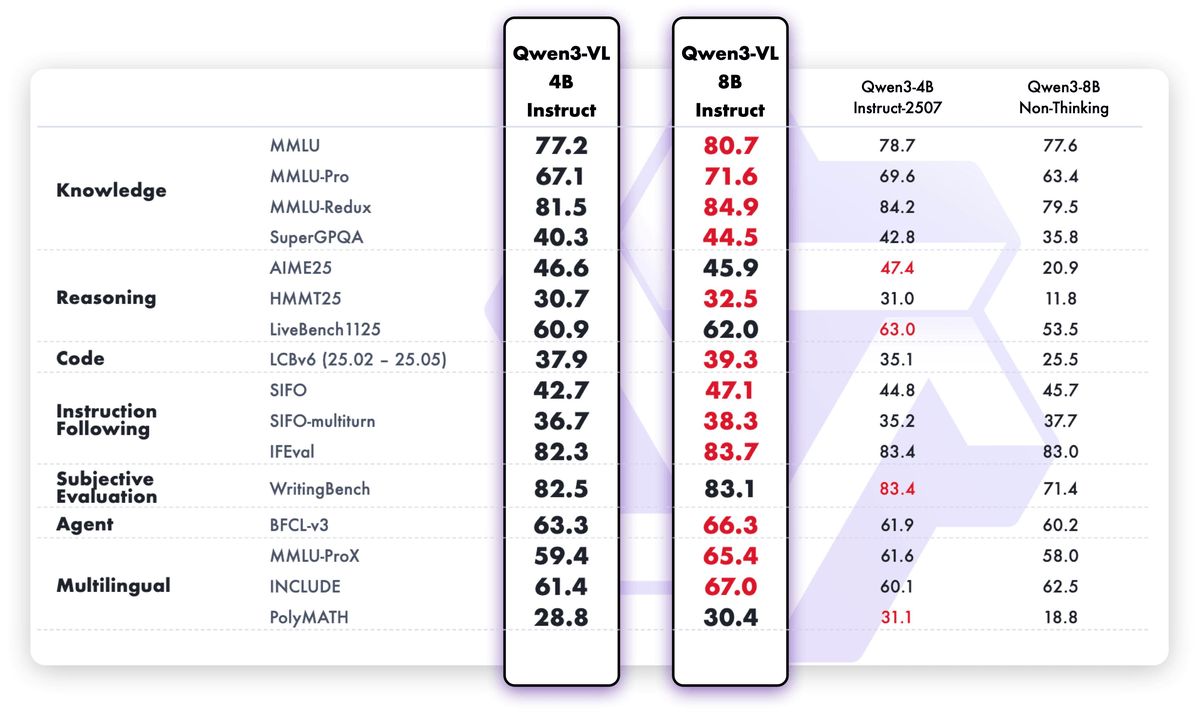
- Qwen released Qwen3-VL-8B-Instruct, an Apache 2.0 vision-language model with 9B parameters and 256K native context.
- New architecture: Interleaved-MRoPE, DeepStack multi-level ViT fusion, and Text-Timestamp Alignment for precise video event grounding.
- OCR expanded from 19 to 32 languages, with improved handling of blur, low light, and rare characters.
- Adds visual agent skills for PC and mobile GUI control, plus 2D and 3D spatial grounding for embodied AI.
- Hosted pricing around $0.117 input and $0.455 output per million tokens; runs on vLLM, SGLang, Ollama.
- Scores 8 on the Artificial Analysis Intelligence Index, above the 6 median for open-weight peers.
Alibaba's Qwen team just released Qwen3-VL-8B-Instruct, a compact multimodal model that packs the vision, video, and agent capabilities of the full Qwen3-VL family into a 9B-parameter checkpoint you can run on a single GPU. It carries an Apache 2.0 license, has already crossed 6.7M downloads, and targets a spot that has been oddly empty: an open-weight VLM small enough for edge deployment but serious enough to handle 256K-token contexts, 3D grounding, and GUI automation.
Pricing on hosted providers lands around $0.117 per million input tokens and $0.455 per million output tokens, and the weights are free to self-host. Released on October 14, 2025, the model is served on OpenRouter through Alibaba Cloud and Parasail, with vLLM, SGLang, Transformers, and Docker Model Runner all supported out of the box.
What's actually new under the hood
Qwen3-VL is not a light refresh. The team rebuilt three core pieces of the architecture, each targeting a specific failure mode of prior VLMs:
- Interleaved-MRoPE spreads positional information across time, width, and height frequencies so the model can track events over long videos without losing spatial detail.
- DeepStack fuses features from multiple layers of the vision transformer, which is what lets the model read small text and align pixels to tokens more tightly.
- Text-Timestamp Alignment replaces the older T-RoPE trick with direct grounding of events to timestamps, so you can ask when something happened in a video and get a second-level answer.