
Alibaba's Qwen3-VL Drops 235B Open Weights to Challenge GPT-5 and Claude
Alibaba's new open-weight vision-language model brings 256K context, GUI agent skills, and 3D grounding in a 235B MoE with only 22B active parameters.
Takeaways
- Qwen released Qwen3-VL-235B-A22B-Instruct, a 235B MoE vision-language model with 22B active parameters under Apache 2.0.
- Native 256K context expandable to 1M, with second-level video indexing across hours of footage.
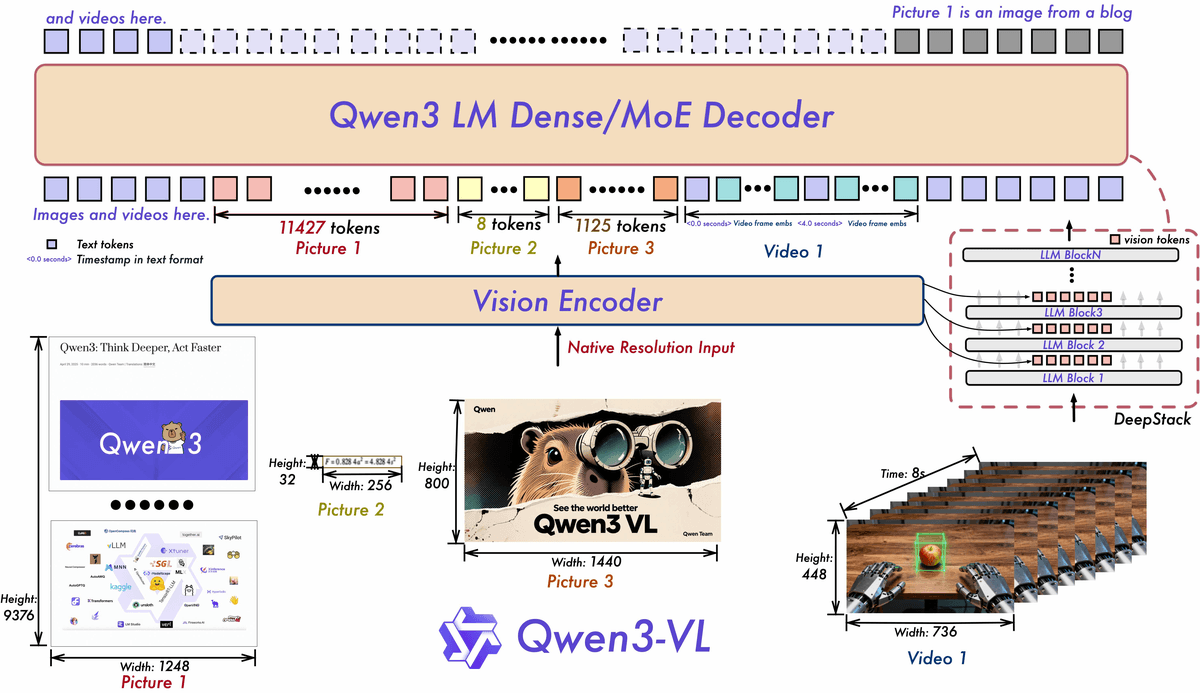
- New architecture: Interleaved-MRoPE, DeepStack multi-level ViT fusion, and Text-Timestamp Alignment for video.
- OCR expanded to 32 languages, plus 2D and 3D visual grounding for embodied AI use cases.
- Available via OpenRouter at $0.20/$0.88 per million input/output tokens, plus vLLM and SGLang.
- Competes with Gemini 2.5-Pro, GPT-5, and Claude Opus 4.1 on multimodal benchmarks while remaining open weight.
Alibaba's Qwen team has dropped the biggest entry yet in their vision-language lineup: Qwen3-VL-235B-A22B-Instruct, a Mixture-of-Experts multimodal model that pushes open weights into territory previously dominated by closed frontier systems. The architecture totals 235B parameters with 22B active per token, and this instruction-tuned variant is aligned for chat rather than long deliberation. Weights are live on Hugging Face under Apache 2.0, and the model has already been pulled over a million times.
What actually shipped
The release is a full generational jump for Qwen's vision stack rather than an incremental refresh. Upgrades land across the board: sharper text understanding and generation, deeper visual perception and reasoning, extended context length, stronger handling of spatial layout and video dynamics, and expanded agent behavior. Both Dense and MoE architectures are available, scaling from edge to cloud, with Instruct and reasoning-enhanced Thinking editions. The Instruct variant covered here is tuned for direct-answer chat.
Highlights that matter for anyone building on top of it:
- Native 256K context, expandable to 1M, which the team says handles books and hours-long video with second-level indexing.
- OCR across 32 languages, up from 19 in Qwen2.5-VL, with better handling of low light, blur, tilt, and rare or ancient characters.
- 2D and 3D grounding for spatial reasoning and embodied AI use cases.
- Visual coding that turns screenshots or videos into Draw.io diagrams, HTML, CSS, or JavaScript.
- GUI agent mode that recognizes PC and mobile interface elements, understands their function, and invokes tools to complete tasks.
Under the hood
The architecture introduces three notable changes over Qwen2.5-VL. Interleaved-MRoPE