
Amazon's Chronos-Bolt Forecasts Time Series 250x Faster Without Any Training
AutoGluon's 21M-parameter Chronos-Bolt Mini brings T5-based zero-shot time series forecasting to CPUs, with quantile outputs and Apache-2.0 licensing.
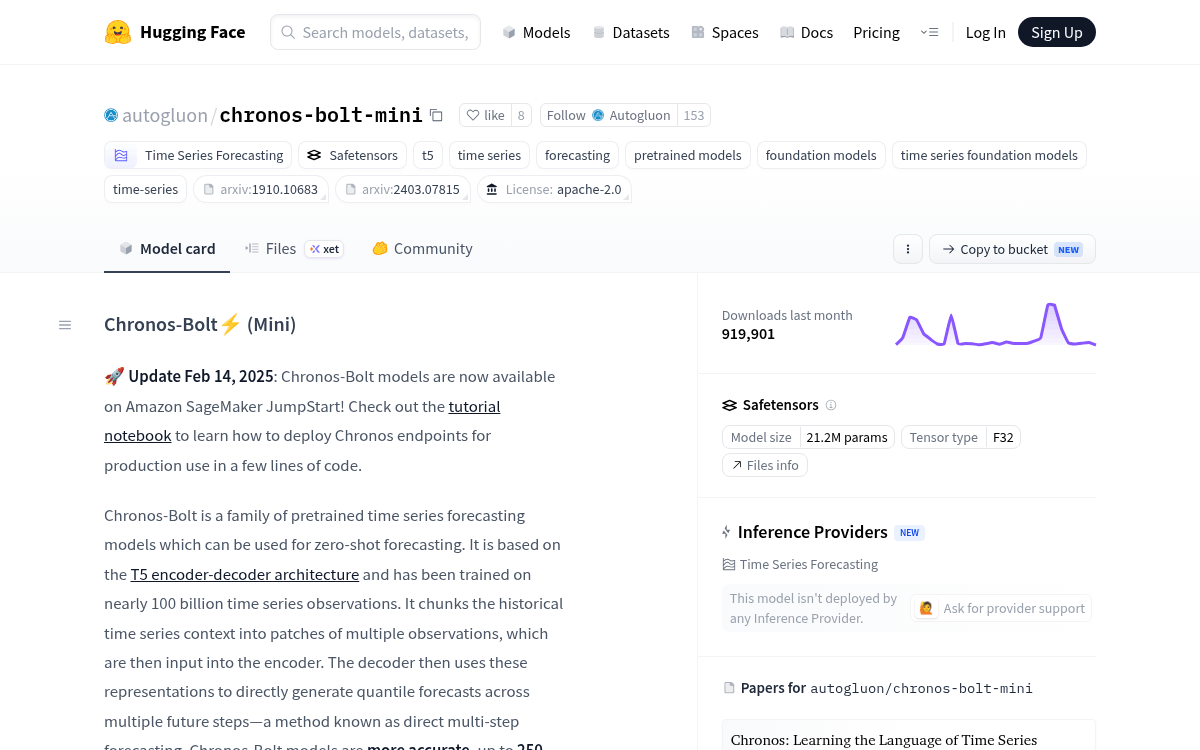
Takeaways
- Chronos-Bolt Mini is a 21M-parameter T5-based time series foundation model on Hugging Face under AutoGluon.
- Trained on nearly 100 billion time series observations for zero-shot probabilistic forecasting across domains.
- Claims up to 250x faster inference and 20x lower memory versus original Chronos models of equal size.
- Uses patched inputs and direct multi-step quantile decoding, runs on CPU without a GPU requirement.
- Available via AutoGluon TimeSeriesPredictor and Amazon SageMaker JumpStart, with fine-tuning supported.
- Apache-2.0 licensed with source in amazon-science/chronos-forecasting; covariates require Chronos-2.
Time series forecasting has been slower than NLP to reach its foundation-model moment, but the Chronos-Bolt Mini checkpoint on Hugging Face shows what one looks like in practice. Published under the AutoGluon organization and developed by Amazon Science, it is a 21M-parameter pretrained forecaster you can drop into a pipeline and use without any dataset-specific training.
The model card positions Chronos-Bolt as an efficiency-focused successor to the original Chronos family: a group of pretrained time series models built for zero-shot forecasting, based on the T5 encoder-decoder architecture and trained on nearly 100 billion observations. Mini sits between the 9M Tiny and 48M Small checkpoints.
Patches in, quantiles out
Under the hood, Chronos-Bolt treats forecasting as a sequence-to-sequence problem, with a twist compared to the first-generation Chronos models. It chunks the historical context into patches of multiple observations, feeds those patches into the encoder, and lets the decoder generate quantile forecasts across many future steps in a single pass. That approach is known as direct multi-step forecasting.
Two design choices matter here for anyone used to older neural forecasters:
- Patching: instead of feeding one timestep at a time, groups of observations become a single token. That shortens the sequence the transformer sees and cuts compute.