
audEERING's wav2vec2 Quietly Hits 1.5M Downloads Guessing Age and Gender From Voice
A wav2vec2-based speech model from audEERING predicts speaker age and gender from raw audio, quietly racking up 1.5 million downloads.
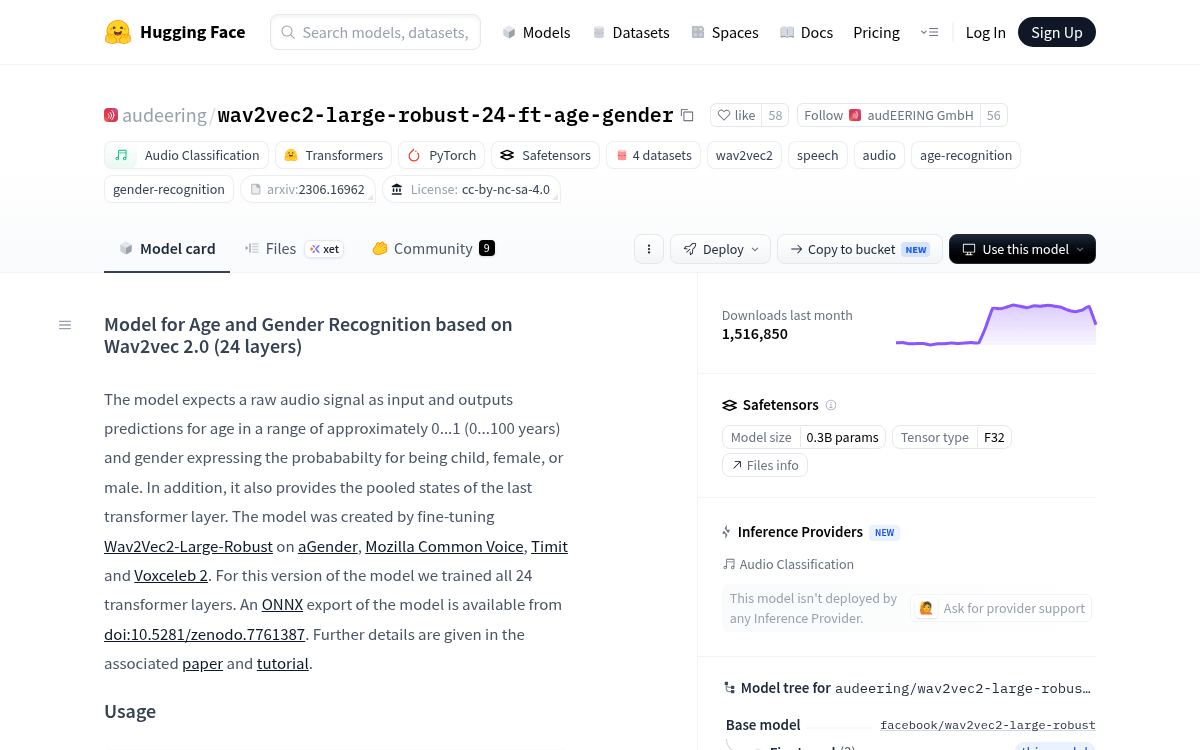
Takeaways
- audEERING's wav2vec2 age-gender model crossed 1.5M downloads on Hugging Face.
- Fine-tunes all 24 layers of Wav2Vec2-Large-Robust on aGender, Common Voice, Timit, and Voxceleb 2.
- Predicts age as a 0-100 scalar plus child/female/male probabilities from raw 16kHz audio.
- Reports 7.1-10.8 years age MAE and 91%+ gender accuracy in the paper.
- Also exposes pooled hidden states as reusable speaker embeddings for downstream tasks.
- Licensed CC-BY-NC-SA 4.0, so commercial deployment requires a separate agreement.
A speech model that guesses your age and gender from a few seconds of audio has quietly become one of the most downloaded audio classification models on Hugging Face. The wav2vec2-large-robust-24-ft-age-gender model from audEERING has crossed 1.5 million downloads, with community spaces built on top of it for speech analysis, emotion detection, and voice profiling.
The checkpoint is a fine-tune of Facebook's Wav2Vec2-Large-Robust that turns raw waveform input into two things at once: an estimated age and a probability distribution across child, female, and male. It weighs in at roughly 300M parameters and runs on CPU or GPU through the standard Transformers API.
What the model actually outputs
Feed in a raw audio signal and you get back an age prediction in the range 0 to 1 (representing 0 to 100 years), a gender distribution over child, female, and male, and the pooled states of the last transformer layer. That last output matters, because those pooled hidden states double as general-purpose speaker embeddings you can feed into downstream classifiers.
The architecture is straightforward. A shared wav2vec2 backbone feeds two small classification heads, one regressing a single age scalar and one producing three-way gender logits passed through softmax. Here is the essential forward pass:
outputs = self.wav2vec2(input_values)
hidden_states = torch.mean(outputs[0], dim=1)
logits_age = self.age(hidden_states)
logits_gender = torch.softmax(self.gender(hidden_states), dim=1)
return hidden_states, logits_age, logits_gender