
AutoGluon's Chronos-Bolt Beats Larger Models While Running 250x Faster
AutoGluon's Chronos-Bolt-Base packs a 205M-parameter T5 into a zero-shot forecaster that runs on CPU and beats models 3x its size.
Takeaways
- Chronos-Bolt-Base is a 205M T5-based time series foundation model from AutoGluon, available on Hugging Face
- Trained on nearly 100 billion time series observations for zero-shot forecasting across domains
- Up to 250x faster and 20x more memory-efficient than the original Chronos, with 5% lower error
- Base variant beats original Chronos Large on accuracy while running 600x faster on the same benchmark
- Runs on CPU, ships in tiny/mini/small/base sizes, Apache-2.0 licensed, deployable via SageMaker JumpStart
- Univariate by default but supports covariates through AutoGluon's covariate regressor wrapper
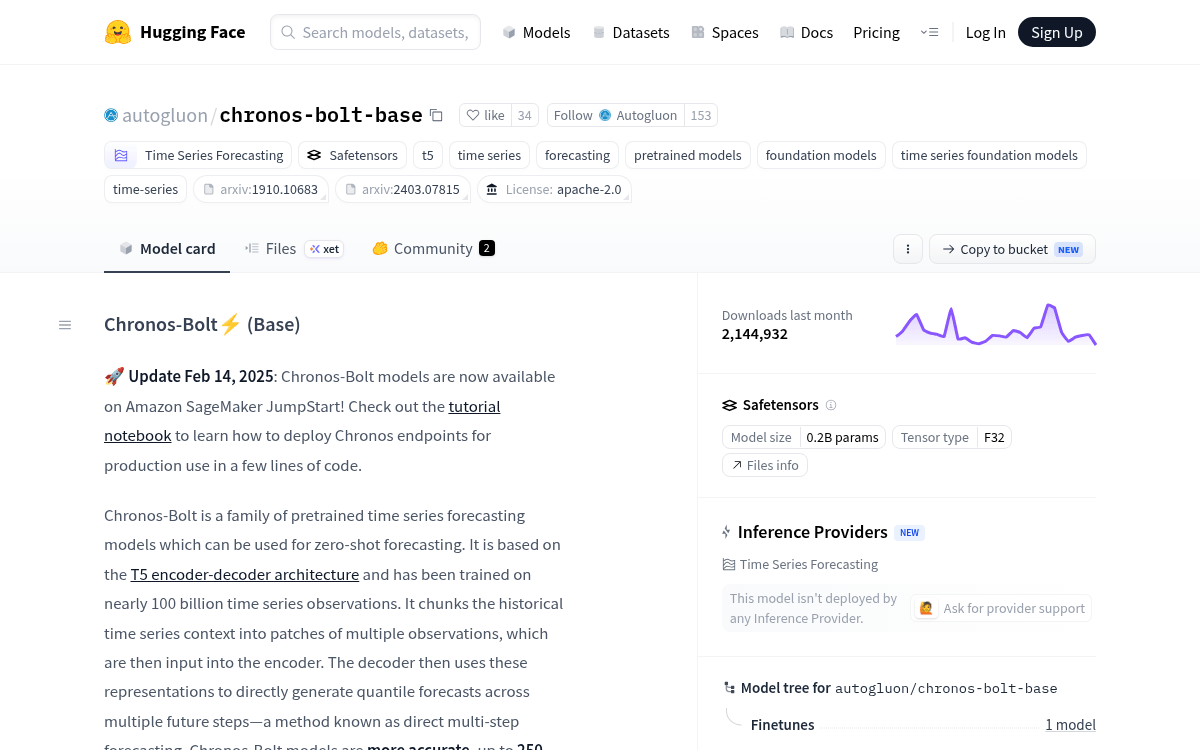
Time series forecasting has quietly become one of the more interesting frontiers for foundation models, and Chronos-Bolt-Base from the AutoGluon team shows why. The 205M-parameter model has crossed 2.14 million downloads on Hugging Face, making it one of the most-used pretrained forecasters in the wild. It ships under Apache-2.0, runs on CPU, and delivers zero-shot forecasts through a single line of code in AutoGluon.
Chronos-Bolt is built on the T5 encoder-decoder architecture and trained on nearly 100 billion time series observations. It chunks the historical context into patches of multiple observations, which feed into the encoder. The decoder then emits quantile forecasts for many future steps at once, rather than autoregressively sampling one token at a time like the original Chronos.
Where the 250x speedup comes from
Chronos-Bolt models are roughly 5% more accurate, up to 250x faster, and 20x more memory efficient than the original Chronos models of the same size. That gain comes from two design choices working together: patching the input so the encoder sees fewer tokens, and having the decoder emit all future quantiles directly instead of sampling them.