
Baidu's PaddleOCR-VL Beats Gemini 2.5 Pro at Document Parsing With 0.9B Parameters
Baidu's PaddleOCR-VL packs SOTA document parsing into a 0.9B vision-language model, beating 72B rivals while running on consumer GPUs.
Takeaways
- Baidu released PaddleOCR-VL, a 0.9B parameter document parsing VLM under Apache 2.0.
- Combines NaViT-style vision encoder with ERNIE-4.5-0.3B decoder for fast autoregressive generation.
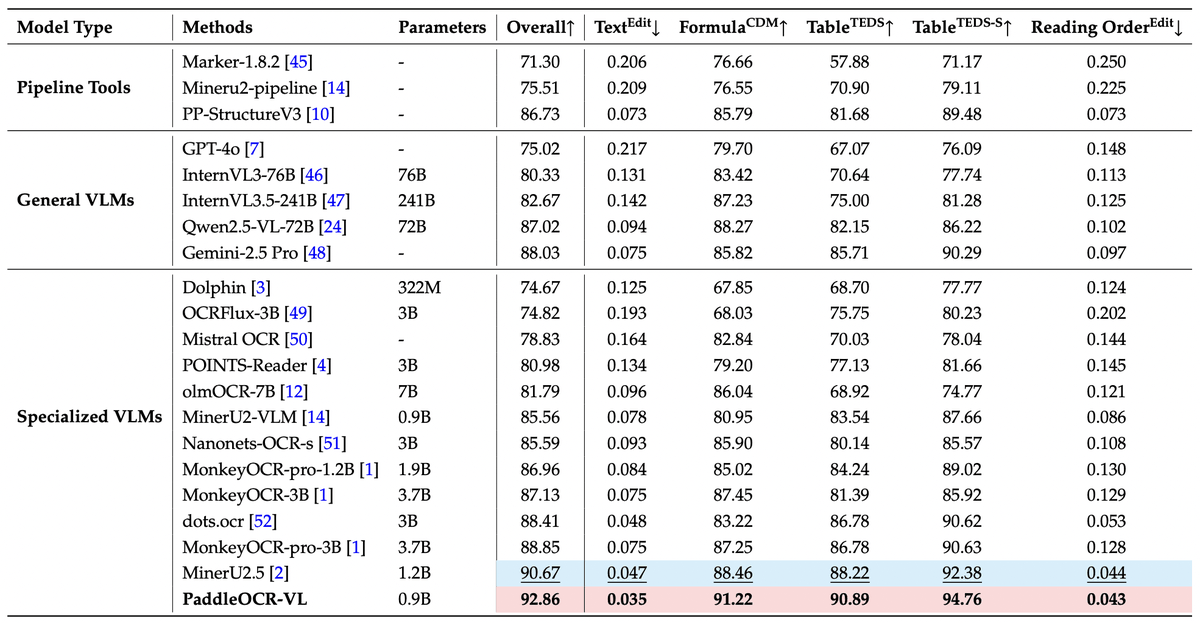
- Scores 92.56 on OmniDocBench v1.5, beating MinerU2.5, dots.ocr, and Qwen2.5-VL-72B.
- Supports 109 languages including Arabic, Hindi, Thai, Japanese, and handwritten text.
- Two-stage pipeline uses PP-DocLayoutV2 for layout then VLM for element recognition.
- Reaches 1.22 pages/s on A100 with vLLM, runs on RTX 5070 with 8.9GB VRAM.
Baidu's PaddlePaddle team has released PaddleOCR-VL, a document parsing system built around a 0.9B parameter vision-language model that trades brute-force scale for a carefully engineered pipeline. The core component, PaddleOCR-VL-0.9B, pairs a NaViT-style dynamic resolution visual encoder with the ERNIE-4.5-0.3B language model for element recognition. Weights ship under Apache 2.0 and already work with vLLM, SGLang, and the Hugging Face transformers library.
The size-to-performance ratio is what stands out. On the OmniDocBench v1.5 leaderboard, this sub-1B model outperforms Qwen2.5-VL-72B, Gemini 2.5 Pro, and the previous top specialist MinerU2.5-1.2B, while running faster and using less VRAM than any of them.

The two-stage bet against end-to-end
Most recent document parsers have gone end-to-end, feeding a whole page into a large VLM and asking it to emit structured output in one shot. PaddleOCR-VL splits the job in two. First, layout detection and reading order prediction identify the positional coordinates and sequence of elements including text blocks, tables, formulas, and charts. Only then does the VLM see cropped element images.
The layout module, PP-DocLayoutV2, combines an RT-DETR object detector for element localization with a small pointer network of six transformer layers that predicts reading order. The pointer network outputs an N by N matrix representing the relative ordering between each pair of elements, and a deterministic decoding algorithm recovers a consistent sequence.
The rationale is practical. End-to-end VLMs generate long autoregressive sequences, which is slow, memory-hungry, and prone to hallucination on multi-column or mixed text-graphic layouts. Decoupling layout from recognition avoids those failure modes and makes it easier to extend the system with new layout categories.