
Cohere Opens Command A+ as Its First 200B Apache 2.0 Frontier Model
Cohere open-sources Command A+, a 218B MoE model that runs on 2 H100s and unifies reasoning, vision, and multilingual agents under Apache 2.0
Takeaways
- Command A+ released open-source: Cohere's 218B MoE model (25B active) is now freely available under Apache 2.0 on Hugging Face.
- Runs on 2 H100s: W4A4 quantization enables deployment on as little as 2 x H100 or 1 x B200 GPU with negligible quality loss.
- Unified model: Replaces four separate Command A variants by combining reasoning, vision, multilingual (48 languages), and tool use in one model.
- Major agentic gains: Tau-squared-Bench Telecom jumped from 37% to 85%; agentic QA accuracy up 20% over Command A Reasoning.
- Native citations: Span-level grounding links model outputs directly to source documents inline during generation, not post-hoc.
- 63% throughput increase: Faster than Command A Reasoning at matched settings, with an additional 1.5-1.6x speedup from MoE-optimized speculative decoding.
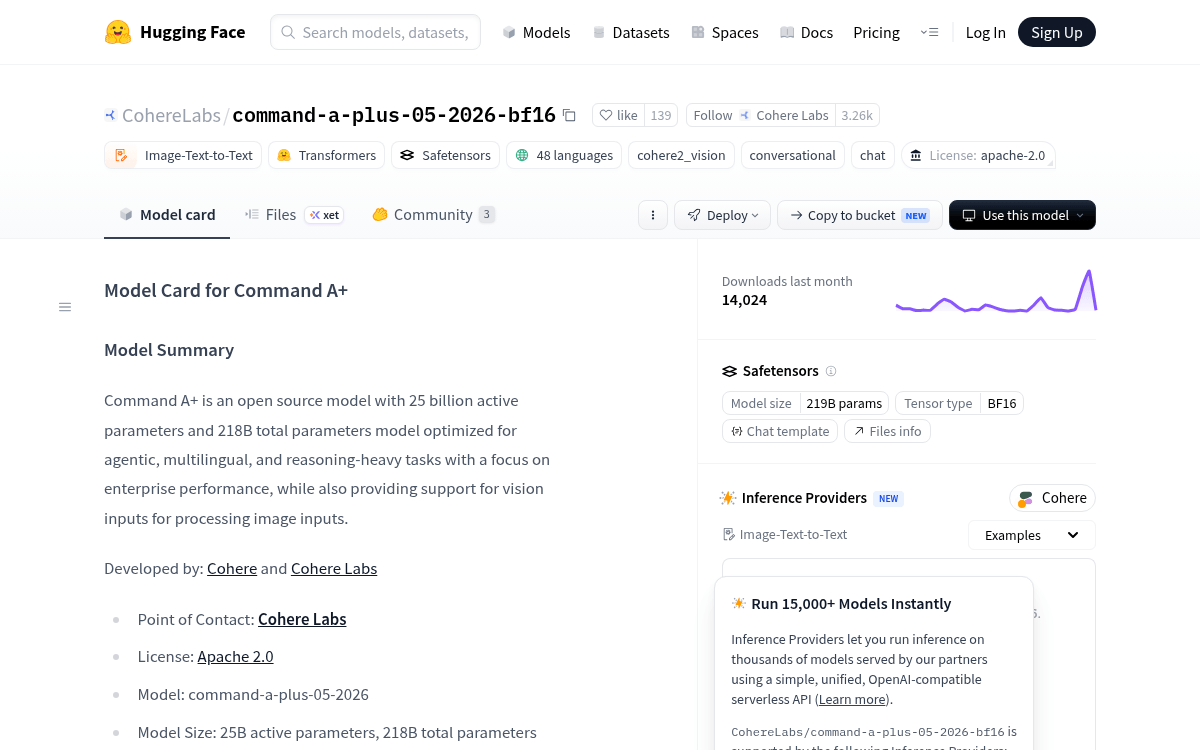
Cohere just open-sourced Command A+, its most capable model to date, and the move is significant for a few reasons at once. It is the company's first frontier model released under a true Apache 2.0 license, the first to break the 200B parameter mark, and the first to consolidate reasoning, vision, multilingual support, and tool use into a single set of weights. Previous Command variants handled each of those capabilities separately.
One model to rule them all
Command A+ is a Mixture-of-Experts (MoE) model built for high-performance agentic tasks with minimal compute overhead, born from a year of deploying Cohere's North enterprise platform with customers. The result is a model that replaces four separate Command A variants (Reasoning, Vision, Translate, and the base) with a single unified architecture.
- 218 billion total parameters, with 25 billion active at any given generation step
- 128K context window with native citation grounding
- 48 languages, including all official EU languages
- Vision and text on input, with full tool-use support
- Apache 2.0 license, weights freely downloadable from Hugging Face
The MoE design is the key to the efficiency story. Only 25 billion parameters are active during any single generation step, which balances frontier performance with efficient inference while using a fraction of the compute required by dense models.
The architecture under the hood
Command A+ is a decoder-only Sparse Mixture-of-Experts Transformer with 128 experts, out of which 8 are active per token, and a single shared expert applied to all tokens. The routing mechanism uses a normalized sigmoid over the top-k expert logits per token rather than the more common softmax, combined with additive-bias-based load balancing to keep token distribution even across experts.
The attention layers interleave sliding-window attention with Rotational Positional Embeddings and global attention layers without positional embeddings in a 3:1 ratio. Sliding-window attention (SWA) lets each token only attend to a local window of nearby tokens rather than the full sequence, which reduces memory and compute for long contexts while global layers handle long-range dependencies. The sparse MoE layer is trained in a fully dropless manner, meaning no tokens are ever discarded during training, which tends to improve quality at the cost of more careful load balancing.