
Comfy-Org Shrinks MiniMax H3's 123 GB Video Model to Run on a 3060
Comfy-Org repackaged MiniMax's H3 video model with pruned weights, custom quantizations, and workflows that squeeze a 2K omni-modal generator onto consumer GPUs.
Takeaways
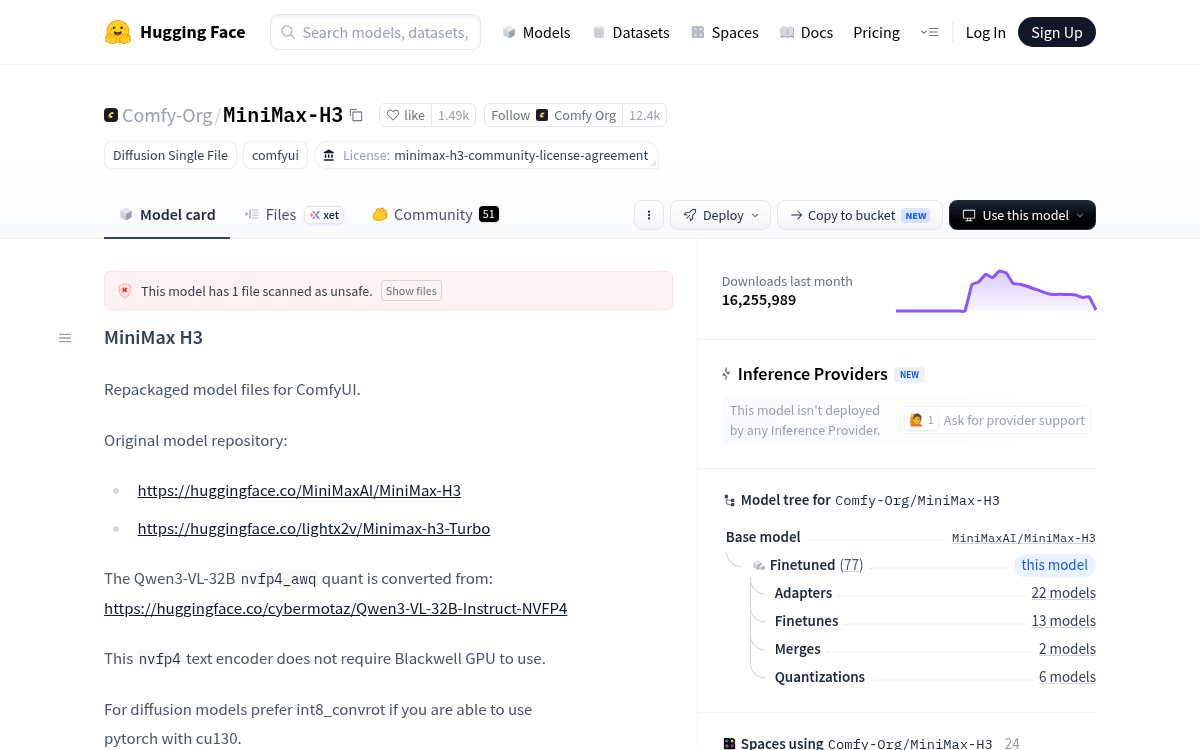
- Comfy-Org released a repackaged MiniMax H3 on Hugging Face with pruned, quantized checkpoints for ComfyUI.
- Modulation-weight pruning and int8 convrot quantization cut the footprint from 123.6 GB to 42.5 GB.
- Ships FL2VA and Ref2VA checkpoints plus a Qwen3-VL-32B text encoder in bf16, int8, fp8, and nvfp4 variants.
- Enables local text-to-video, image-to-video, and reference-to-video with native 24fps stereo audio in one pass.
- Runs 15-second generations on a 24 GB GPU; smaller variants target RTX 3060-class hardware.
- Local release covers H3-Base only; 2K regeneration and sparse attention remain hosted or forthcoming.
Comfy-Org has published a ComfyUI-native repackaging of MiniMax's H3 video model on Hugging Face, wrapping the newly open-weight omni-modal generator in pruned checkpoints, custom quantizations, and ready-to-run workflows. The Comfy-Org/MiniMax-H3 repository contains no new model. It is the engineering work that makes H3 actually fit on a single consumer GPU, complete with drop-in text-to-video, image-to-video, and reference-to-video graphs.
The underlying weights come from MiniMax, which open-sourced H3, the omni-modal video model behind the Hailuo line, publishing checkpoints on Hugging Face with native ComfyUI support landing the same day through pull request Comfy-Org/ComfyUI #15224. That PR added joint audio-video generation with four new nodes and six official workflow templates. Alongside the merge, Comfy-Org shipped the practical distribution layer: repackaged safetensors, pre-quantized variants, and a Qwen3-VL-32B text encoder converted to run without exotic hardware.
Squeezing 123 GB onto a 3060
The headline engineering achievement lives in the file sizes. Getting H3 to run well on consumer hardware took real ML work. The team found that the model's modulation weights, roughly 40% of the total parameters, could be pruned and replaced with a functionally equivalent lookup table, shrinking the memory footprint with no loss in output quality. The weights also ship with an accurate int8 convrot quantization, and custom kernels reduce peak VRAM during inference.
Total memory drops by 66%, from 123.6 GB in full precision to 42.5 GB with the smallest variants. Combined with dynamic VRAM offloading, a next-generation 2K video model can run locally on a GPU like the RTX 3060. A 24 GB card can complete a 15-second generation, and the repo has racked up more than 16 million downloads.