
Datalab's lift Matches Gemini Flash 3.5 Accuracy at 3x Faster Speed
Datalab open-sources lift, a 9B vision model that extracts structured JSON from PDFs at near-frontier accuracy with 3x faster latency than Gemini Flash 3.5
Takeaways
- lift is a new open-weight 9B vision model from Datalab that extracts structured JSON from PDFs and images using any JSON schema.
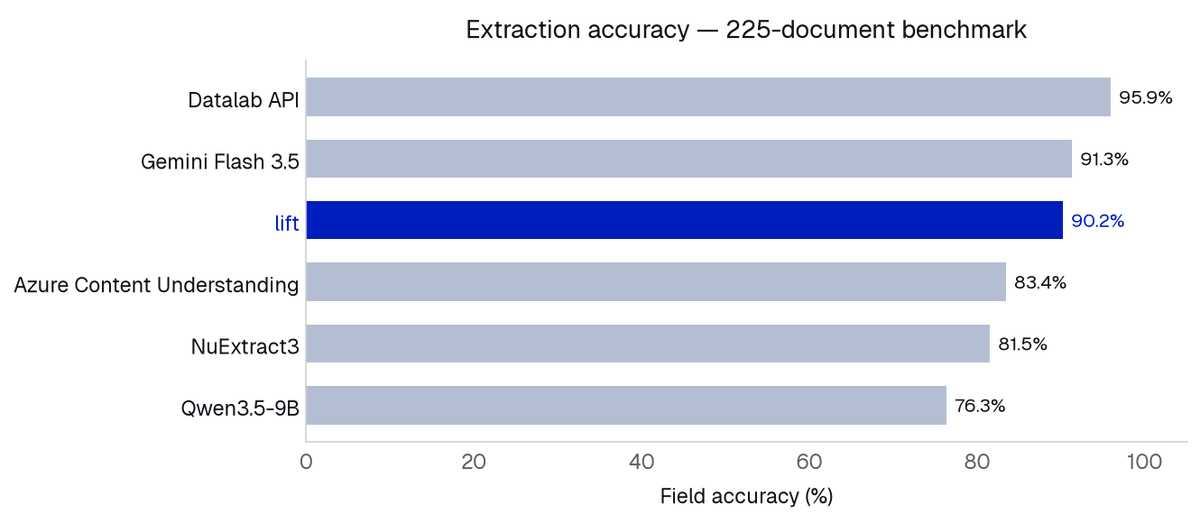
- Achieves 90.2% field accuracy, just 1.1 points behind Gemini Flash 3.5, while running ~3x faster at 9.5s median latency.
- Uses schema-constrained decoding to mathematically guarantee valid, well-typed JSON output every time, eliminating malformed responses.
- Install with
pip install lift-pdf; model weights on Hugging Face, code on GitHub (Apache 2.0 code, OpenRAIL-M weights). - Free for research and startups under $5M revenue; commercial self-hosting and a hosted API with verification and citations also available.
- Known limitation: full-document accuracy (every field correct) is 20.9%; long-document support is still being improved.
lift is a new open-weight model from Datalab that does one thing extremely well: take a PDF or image, hand it a JSON schema, and get back a perfectly structured JSON object. No prompt engineering, no retry loops, no hallucinated fields. It sits at 90.2% field accuracy on Datalab's own extraction benchmark, just 1.1 points behind Gemini Flash 3.5, while running nearly 3x faster and on a single GPU you can own.
The release comes from Vik Paruchuri, the creator of Marker (Datalab's PDF-to-markdown tool with 36k GitHub stars), and it slots into the same document intelligence stack. The model is available now on Hugging Face, with code on GitHub under Apache 2.0.
The problem it actually solves
Extracting structured data from real-world documents is one of the most common enterprise automation tasks, and it has historically been painful. General-purpose LLMs like GPT-4o or Gemini can do it, but they're expensive per-call, occasionally return malformed JSON, and aren't optimized for the specific failure modes of document extraction: values that span page breaks, fields that should be null but get hallucinated, near-miss distractors where similar-looking numbers appear in multiple places.
Dedicated extraction models like NuExtract3 are faster and cheaper, but they trade away accuracy. lift is trying to occupy the gap: frontier-level accuracy at open-weight speed and cost.
How it works under the hood
lift is a 9B vision model that returns a JSON object matching your schema, with schema-constrained decoding guaranteeing valid output. Schema-constrained decoding is the key mechanism here. Rather than hoping the model outputs valid JSON, constrained decoding intervenes in the decoding process by masking out invalid tokens based on given constraints and prefix tokens, guiding the model to sample only from valid tokens so the final output perfectly conforms to a predefined structure. The result: you will never get a malformed JSON response, a field of the wrong type, or a key that wasn't in your schema.