
Lightricks Trains a Water VFX Adapter on 572 Clips in 4.5 Hours
Lightricks releases an IC-LoRA that adds photorealistic water to any dry video clip in 4.5 hours of H100 training on just 572 paired examples
Takeaways
- New release: Lightricks open-sourced LTX-2.3-22b-IC-LoRA-Water-Simulation, an adapter that adds photorealistic water to any dry video clip.
- How it works: IC-LoRA conditions generation on a "dry" reference video and a text prompt with the
ADD WATERtrigger to re-render the shot with water added. - Tiny dataset, fast training: Trained on only ~572 paired dry/wet video examples in 3,000 steps on 8× H100s in ~4.5 hours using the open-source LTX-2 Community Trainer.
- Key constraint: Preserves subject identity, clothing, pose, and camera framing — only water-related elements change between reference and output.
- Limitations: Whole-frame effect only (no masking), generalizes poorly to non-water liquids, and high LoRA strength (≥1.5) risks face warping.
- Bigger signal: Part of a growing Creative Lab IC-LoRA collection pointing toward production pipelines built from hyper-specialized, task-specific adapters.
Water has always been one of the hardest things to fake in VFX. Physics simulations are expensive, compositing is painstaking, and general-purpose video models rarely get the fluid dynamics right. Lightricks just released a proof-of-concept that reframes the whole problem: instead of simulating water from scratch, you train a tiny, hyper-specialized adapter that adds it to footage you already have.
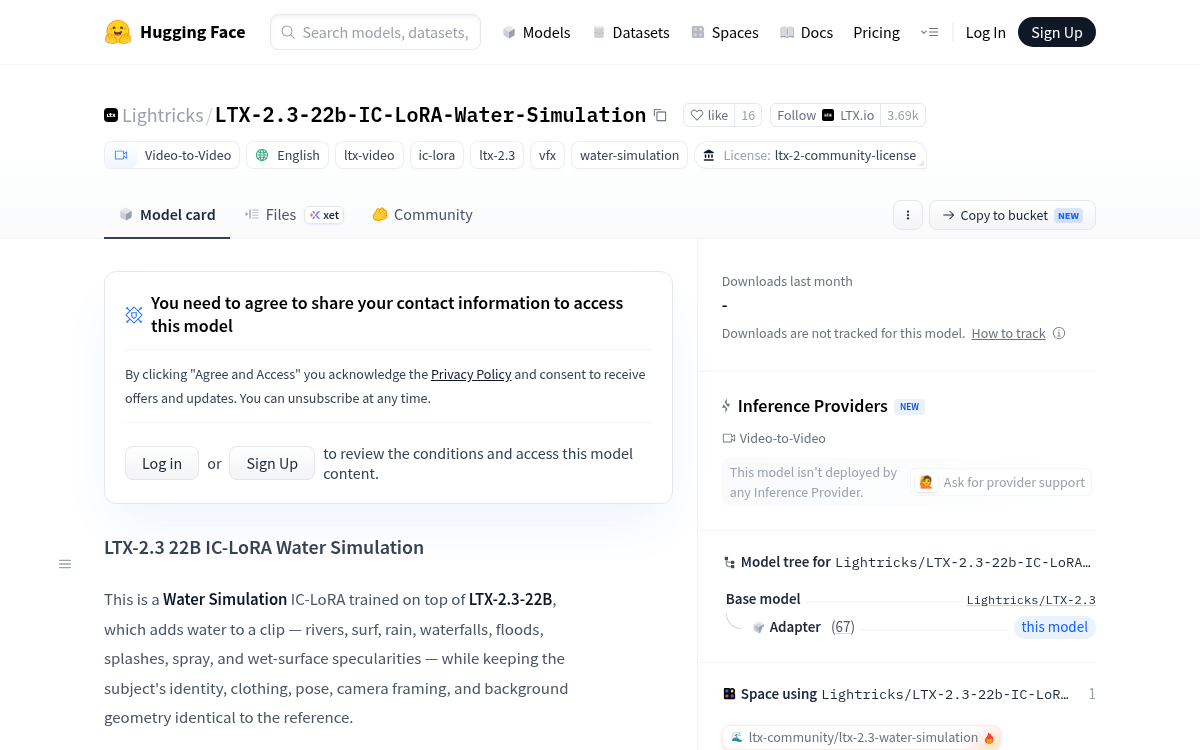
The model is LTX-2.3-22b-IC-LoRA-Water-Simulation, and it is part of a growing Creative Lab collection of IC-LoRAs built on top of the LTX-2.3 foundation model. The water adapter is free to download from Hugging Face under the LTX-2 community license.
What IC-LoRA actually means
IC-LoRA (In-Context LoRA) is a variant of the standard LoRA fine-tuning technique, but instead of just injecting a style or subject into the model's weights, it also conditions generation on a reference video at inference time. IC-LoRA enables conditioning video generation on reference video frames at inference time, allowing fine-grained video-to-video control on top of a text-to-video base model. Think of it as giving the model a "before" clip as a structural anchor, then asking it to produce the "after."
For the water adapter specifically, the control type is reference video conditioning: a "dry" reference clip drives a re-render of the same shot with water added. The dry reference video is VAE-encoded as the control signal and the model predicts the result with water added. No masking, no depth maps, no optical flow , just the original clip and a prompt.
What it can do
The model adds water to a clip , rivers, surf, rain, waterfalls, floods, splashes, spray, and wet-surface specularities , while keeping the subject's identity, clothing, pose, camera framing, and background geometry identical to the reference. That last part is the hard constraint. The water is supposed to interact with the scene (flowing around legs, surging over surfaces, foaming, reflecting) without drifting the shot.