
Meta's DINOv3 Beats Specialized Vision Models With One Frozen 7B Backbone
Meta AI shipped DINOv3, a 7B-parameter self-supervised vision backbone trained on 1.7B images with a commercial license and Gram anchoring for dense features.
Takeaways
- Meta AI released DINOv3, a 7B-parameter self-supervised vision backbone, under a commercial license.
- Trained on 1.7B images; a single frozen model beats specialists on detection, segmentation, and tracking.
- New Gram anchoring loss stops dense per-patch features from degrading during long training runs.
- Twelve checkpoints ship: ViT-S through ViT-7B plus ConvNeXt, all available on Hugging Face.
- Dedicated SAT-493M satellite variants target geospatial workloads from Maxar RGB imagery.
- Token layout changed from DINOv2: 1 CLS + 4 register + 196 patch tokens at 224x224.
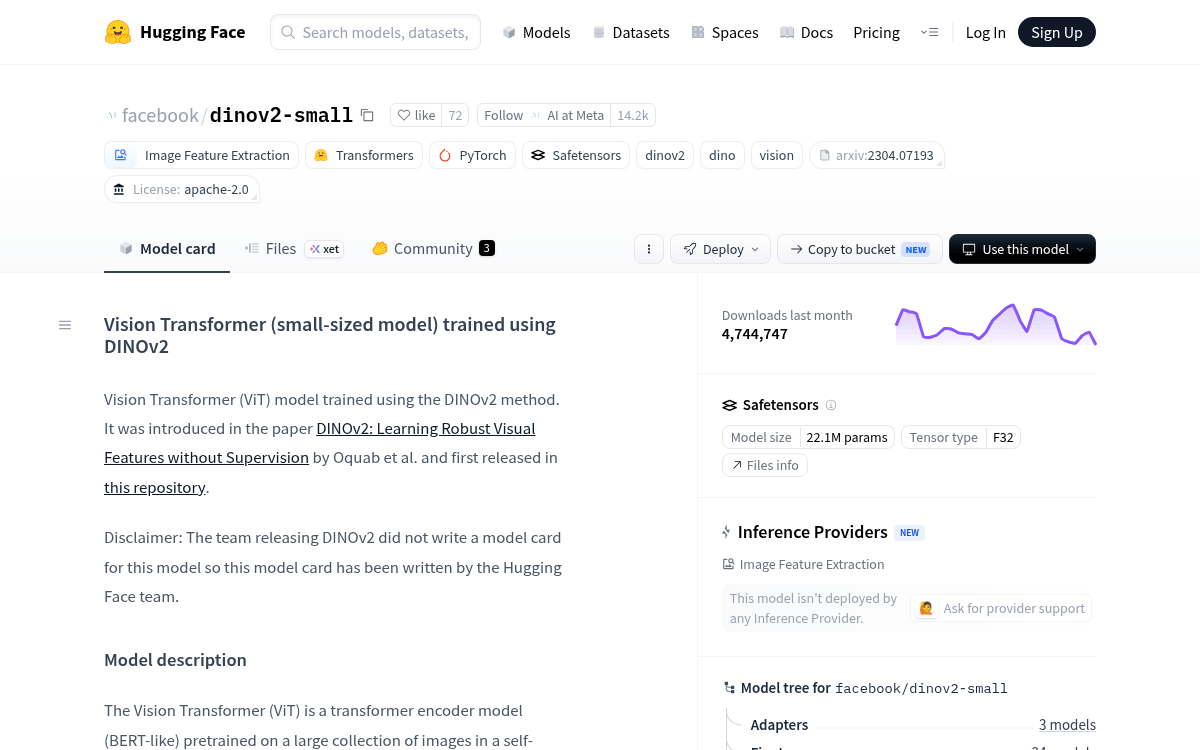
Meta's DINO family has quietly become one of the default vision backbones on Hugging Face, with the older DINOv2-small alone still pulling roughly 4.75M monthly downloads years after release. That entrenched adoption is the backdrop for Meta AI's next move: DINOv3, a self-supervised vision foundation model that scales the recipe to 7 billion parameters and 1.7 billion images, shipped under a commercial license with the full stack of code, backbones, adapters, and downstream heads.
The headline claim from DINOv3 is that for the first time, a single frozen vision backbone outperforms domain-specialized solutions across object detection, semantic segmentation, and video tracking, with no fine-tuning required. If that holds up, it changes how a lot of vision pipelines should be built.
What Meta actually shipped
DINOv3 is a family of backbones rather than a single checkpoint, covering Vision Transformer and ConvNeXt architectures trained with the method described in the paper. Twelve models are provided: ten pretrained on web data (the LVD-1689M dataset), plus dedicated satellite variants trained on Maxar imagery.
The ViT sizes span a wide range so you can pick a point on the compute curve:
- ViT-S (21M parameters): patch size 16, embedding dimension 384, 4 register tokens, 6 heads, MLP FFN, RoPE
- ViT-B (86M parameters): patch size 16, embedding dimension 768, 4 register tokens, 12 heads, MLP FFN, RoPE
- ViT-L (300M parameters): patch size 16, embedding dimension 1024, 4 register tokens, 16 heads, MLP FFN, RoPE
- ViT-H+ (840M parameters): patch size 16, embedding dimension 1280, 4 register tokens, 20 heads, SwiGLU FFN, RoPE
- ViT-7B (6716M parameters): patch size 16, embedding dimension 4096, 4 register tokens, 32 heads, SwiGLU FFN, RoPE
The smaller checkpoints are distilled from the ViT-7B teacher, so the 21M-parameter ViT-S inherits knowledge from the flagship rather than being trained from scratch on the same objective. A satellite-specific line uses the same distillation recipe on 493 million 512x512 crops sampled randomly from Maxar RGB ortho-rectified imagery at 0.6 meter resolution, aimed at geospatial workloads.