
Meta's NLLB-200 Translates 200 Languages With 44% Better Accuracy
Meta open-sources NLLB-200, a machine translation model that handles direct translation between 200 languages, including dozens of low-resource ones.
Takeaways
- Meta released NLLB-200, an open-source model translating between 200 languages including many low-resource ones.
- Reported 44% average BLEU improvement over prior systems, over 70% for some African and Indian languages.
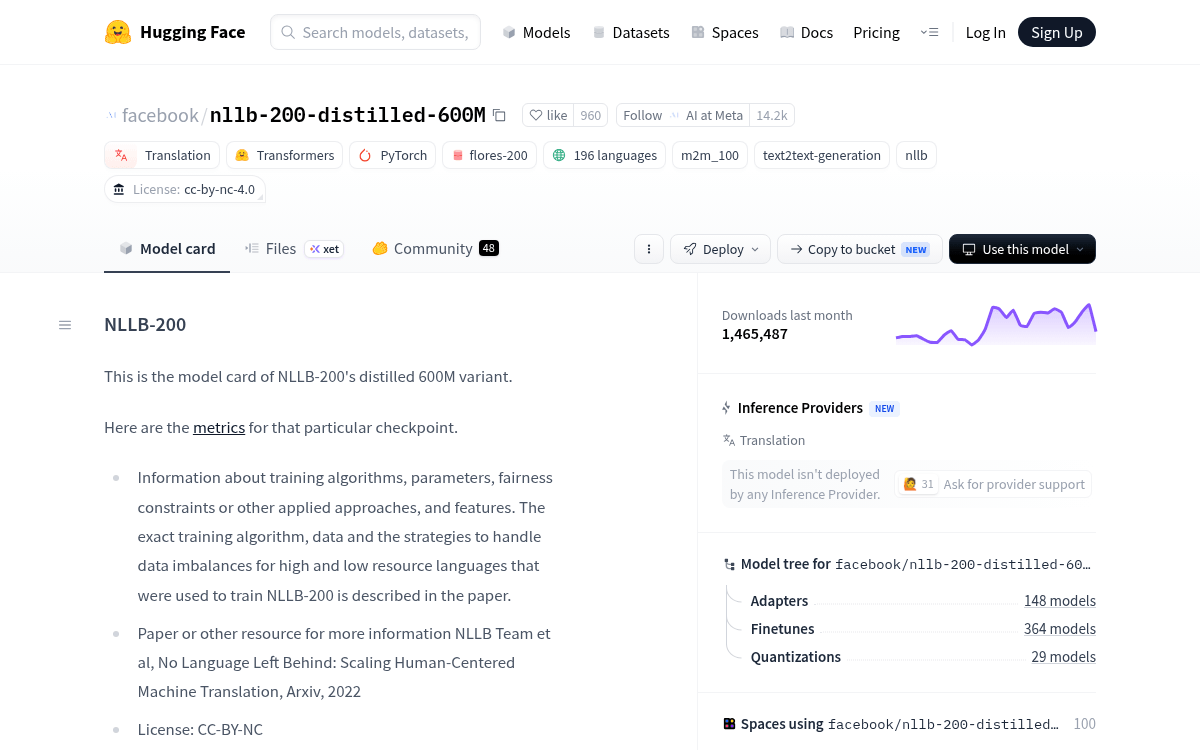
- Distilled 600M variant runs on a single GPU via Hugging Face Transformers, license is CC-BY-NC-4.0.
- Ships with FLORES-200 benchmark covering 40,000 translation directions, plus training and data mining code.
- Wikipedia Content Translation tool now uses NLLB to help editors translate into underrepresented languages.
- Research-only scope: single sentences, general domain, 512-token cap, not for certified or medical translation.
Meta AI has released NLLB-200, an open-source machine translation model that handles direct translation between 200 languages. The distilled 600M variant is published on Hugging Face under a research license, and the surrounding project, called No Language Left Behind, includes model weights, a matching evaluation benchmark, and the training pipeline. The focus is on languages that most commercial systems either translate poorly or ignore entirely.
Machine translation quality has long tracked how much parallel data exists on the web. English, Mandarin, Spanish, and Arabic get most of the attention, while hundreds of African, Indian, and Southeast Asian languages sit in a long tail with little training material. NLLB is Meta's attempt to close that gap with a single model that can go directly from one low-resource language to another without routing through English.
What's in the release
The headline artifact is the model itself, but the release bundles several pieces that make it usable and reproducible:
- NLLB-200 model checkpoints, including a distilled 600M parameter version aimed at lower-compute deployments.
- FLORES-200, an evaluation dataset covering 40,000 translation directions.
- Training code and data reconstruction scripts, so the pipeline can be extended to new languages.
- A grant program offering up to $200,000 for researchers and nonprofits applying NLLB-200 to sustainability, food security, gender-based violence, and education.
The license is CC-BY-NC-4.0, which allows research and non-commercial use but rules out commercial products without a separate arrangement.