
Meta's Omnilingual ASR Transcribes 1,600 Languages With Apache 2.0 License
Meta FAIR open-sources a speech recognition suite covering 1,600+ languages, including a 7B-parameter wav2vec 2.0 encoder anyone can fine-tune.
Takeaways
- Meta FAIR released Omnilingual ASR, transcribing 1,600+ languages including 500 never covered by ASR before.
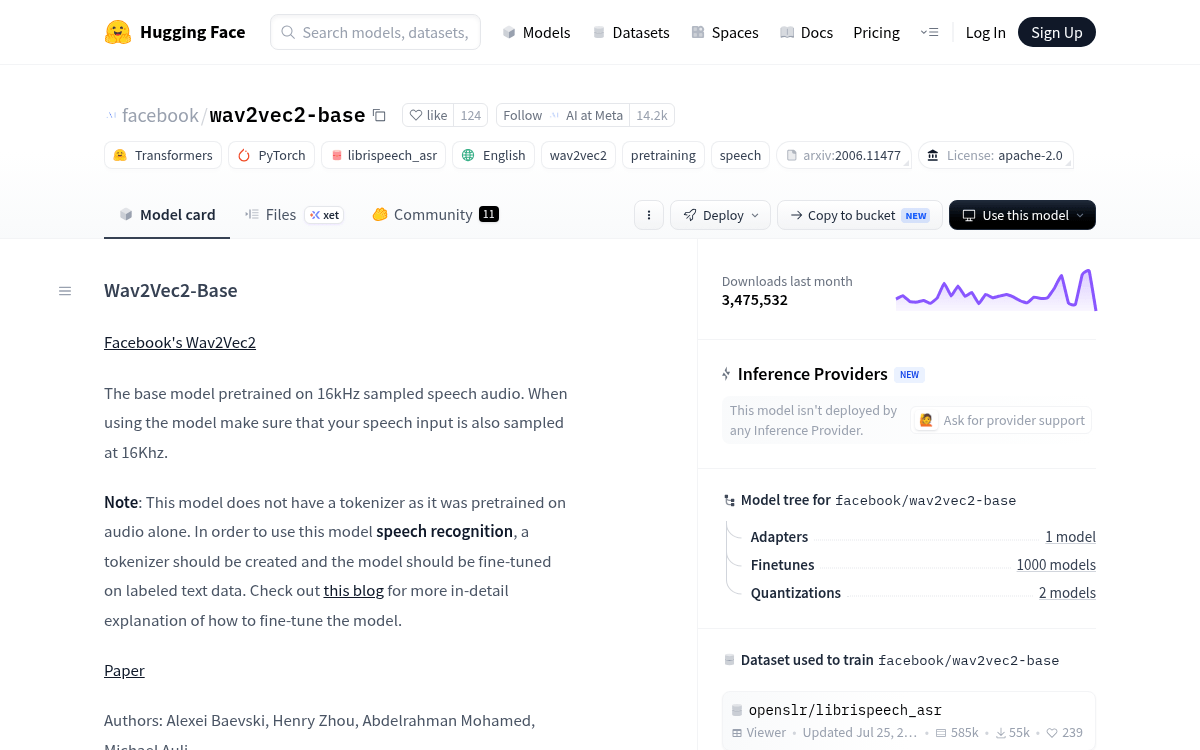
- Includes an open-sourced wav2vec 2.0 encoder scaled to 7B parameters, up from 95M in the original.
- 7B-LLM-ASR variant hits character error rate under 10 on 78% of supported languages.
- Bring-your-own-language: add unsupported languages with a few audio-text pairs at inference time.
- Ships under Apache 2.0, no Llama-style acceptable-use or MAU restrictions.
- Sizes span 300M to 7B; inference capped at 40-second clips for now.
Meta's Fundamental AI Research team has released Omnilingual ASR, a family of open-source speech recognition models that transcribe more than 1,600 languages, alongside a scaled-up wav2vec 2.0 speech encoder that jumps from the original 95M-parameter base checkpoint to a 7B-parameter multilingual foundation model. The release lands under a plain Apache 2.0 license, which matters for anyone who has been avoiding Meta's earlier speech models because of licensing friction.
The headline number is coverage. Omnilingual ASR handles more than 1,600 languages, including 500 low-resource ones never before transcribed by AI. That is roughly an order of magnitude beyond what commercial ASR APIs typically ship with, and it comes paired with a corpus of transcribed speech in 350 underserved languages that Meta collected through partnerships with local organizations.
What actually shipped
The Omnilingual ASR suite includes several model families trained on more than 4.3 million hours of audio: wav2vec 2.0 encoders for self-supervised speech representation learning (300M to 7B parameters), CTC-based models for efficient supervised transcription, LLM-ASR models that pair the speech encoder with a Transformer-based text decoder for top-tier accuracy, and an LLM-ZeroShot variant that adapts to unseen languages at inference time.
The whole stack sits on top of one architectural idea. Meta scaled its previous wav2vec 2.0 speech encoder to 7B parameters for the first time, producing rich multilingual semantic representations from raw, untranscribed speech data, then built two decoder variants to map those into character tokens: one uses a traditional connectionist temporal classification (CTC) objective, the other leverages a transformer decoder commonly used in LLMs. The transformer-decoder variant is the one Meta calls LLM-ASR, and it is where most of the accuracy gains come from.