
Mistral AI's Mistral-7B-Instruct-v0.2 Still Pulls 1.1M Downloads With Fresh Deployment Recipes
A 7B open-weight instruct model with a 32k context window, no sliding attention, and Apache 2.0 licensing that spawned thousands of derivatives.
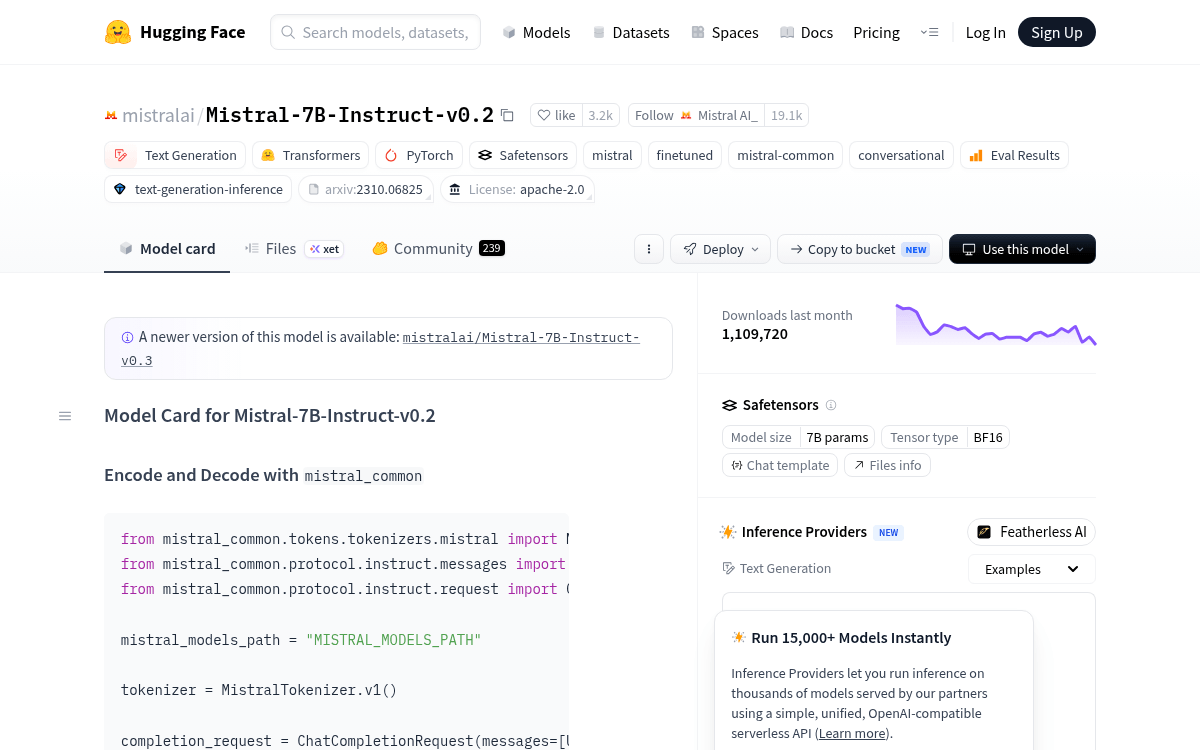
Takeaways
- Mistral-7B-Instruct-v0.2 passed 1.1M monthly downloads with a refreshed deployment card.
- 7.3B parameters, Apache 2.0, 32k context window, no sliding-window attention.
- RoPE theta of 1e6 became the template later adopted by Llama 3 and Qwen.
- One-line serve via vLLM, SGLang, and Docker Model Runner with OpenAI-compatible endpoints.
- Scores 30.84 on MMLU-Pro; ships with no built-in moderation or guardrails.
- Base for 1,200+ adapters, 1,100+ fine-tunes, 351 merges, 108 quantizations.
Mistral AI's Mistral-7B-Instruct-v0.2 remains one of the most heavily downloaded open-weight chat models on Hugging Face, clearing 1.1 million monthly downloads and 3.2k likes. The compact instruction-tuned checkpoint keeps showing up as the fine-tuning base for a sprawling ecosystem, and the model card was recently refreshed with new deployment recipes for vLLM, SGLang, and Docker Model Runner. Here is what the model actually is, what it does well, and where it fits today.
What is under the hood
Mistral 7B Instruct v0.2 is a fine-tuned instruction-following model built on Mistral AI's 7.3 billion parameter architecture, released under Apache 2.0. The architectural changes that define the v0.2 line, relative to the original v0.1, are short but consequential:
- A 32k context window (up from 8k in v0.1)
- A RoPE theta value of 1e6
- No sliding-window attention
- A transformer backbone with Grouped-Query Attention (GQA) for inference efficiency
The RoPE change is the sleeper detail. v0.2 pushed the RoPE base frequency from 10,000 to 1,000,000, a technique that dramatically improved long-context performance and was later adopted by Llama 3, Qwen, and other model families as the standard way to extend context in RoPE-based architectures. Rotary position embeddings encode token positions as rotations in embedding space, and raising the base frequency stretches how far apart those rotations can meaningfully distinguish positions, which is why long inputs stopped collapsing.