
Mistral AI's Mistral-7B v0.3 Brings Native Tool Calling to Open-Source Agents
Mistral's popular 7B instruct model gains native function calling, a 32,768-token vocabulary, and the v3 tokenizer under Apache 2.0.
Takeaways
- Mistral-7B-Instruct-v0.3 adds native function calling via dedicated
TOOL_CALLS,AVAILABLE_TOOLS, andTOOL_RESULTStokens. - Vocabulary extended to 32,768 tokens with the new v3 tokenizer for better efficiency.
- 32K context window preserved, using sliding window attention plus RoPE for long inputs.
- Apache 2.0 license and 3.2M+ downloads on Hugging Face.
- Tool-call schema is OpenAI-compatible; tool call IDs must be exactly 9 alphanumeric characters.
- No built-in moderation; requires an external safety layer for production use.
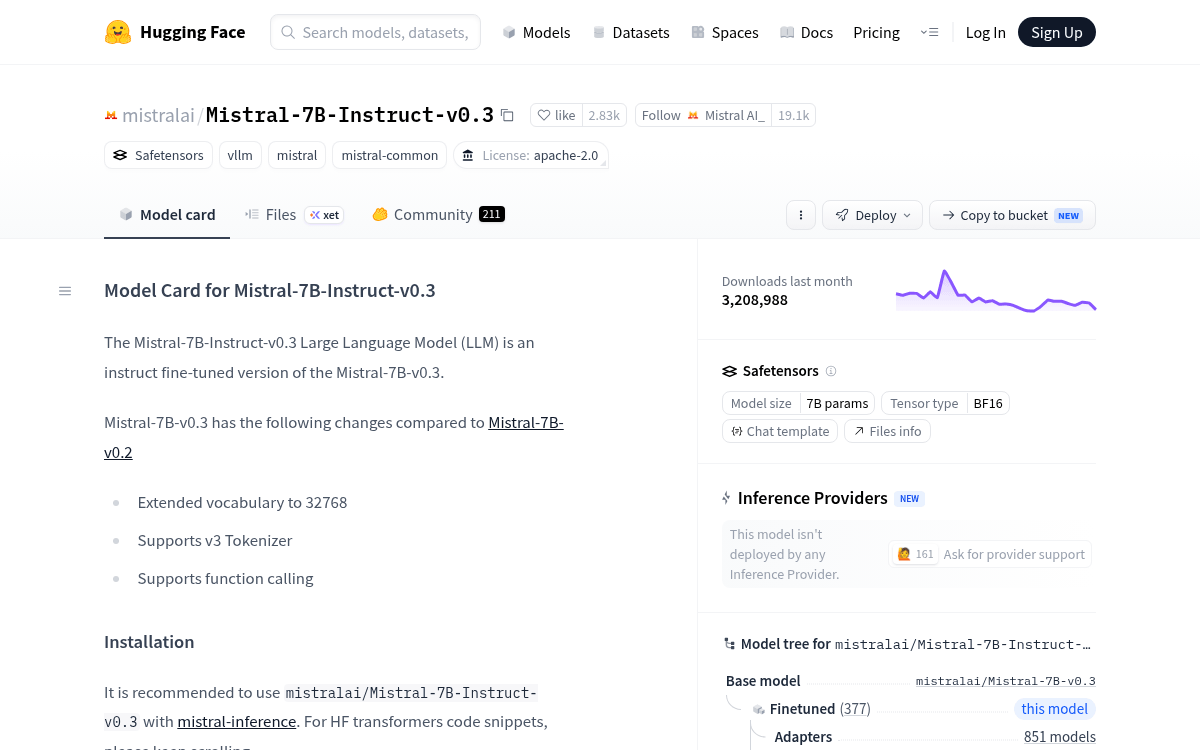
Mistral AI's small workhorse got a meaningful upgrade. Mistral-7B-Instruct-v0.3 is an instruction fine-tuned version of Mistral-7B-v0.3 that closes one of the biggest capability gaps between open-weight 7B models and proprietary APIs: native tool use. It has quietly become one of the most downloaded checkpoints on Hugging Face, with over 3.2 million downloads and 2.8k likes on the repo.
The release stays true to the original Mistral 7B recipe (Apache 2.0 license, dense transformer, sliding window attention) while making three targeted changes that matter for anyone building agents or RAG pipelines on open weights.
What actually changed in v0.3
Compared with v0.2, the update is deliberately narrow. Three concrete changes ship in this checkpoint:
- Extended vocabulary (32,768 tokens): better coverage of code, symbols, and multilingual text, which typically means fewer tokens per prompt and faster generation.
- v3 Tokenizer: a new tokenization scheme that ships with
mistral-commonfor improved efficiency and accuracy. - Function calling: a first-class tool-use protocol implemented through new special tokens.
The context window stays at 32,768 tokens. Sliding window attention is still in play, with each attention layer attending to the 4,096 nearest tokens, but information propagates across layers so the effective receptive field is much larger than 4K.