
mMiniLMv2 Hits 1.7M Monthly Downloads Reranking Across 14 Languages
A compact multilingual reranker trained on machine-translated MS MARCO is quietly powering RAG pipelines with over 1.7 million monthly downloads.
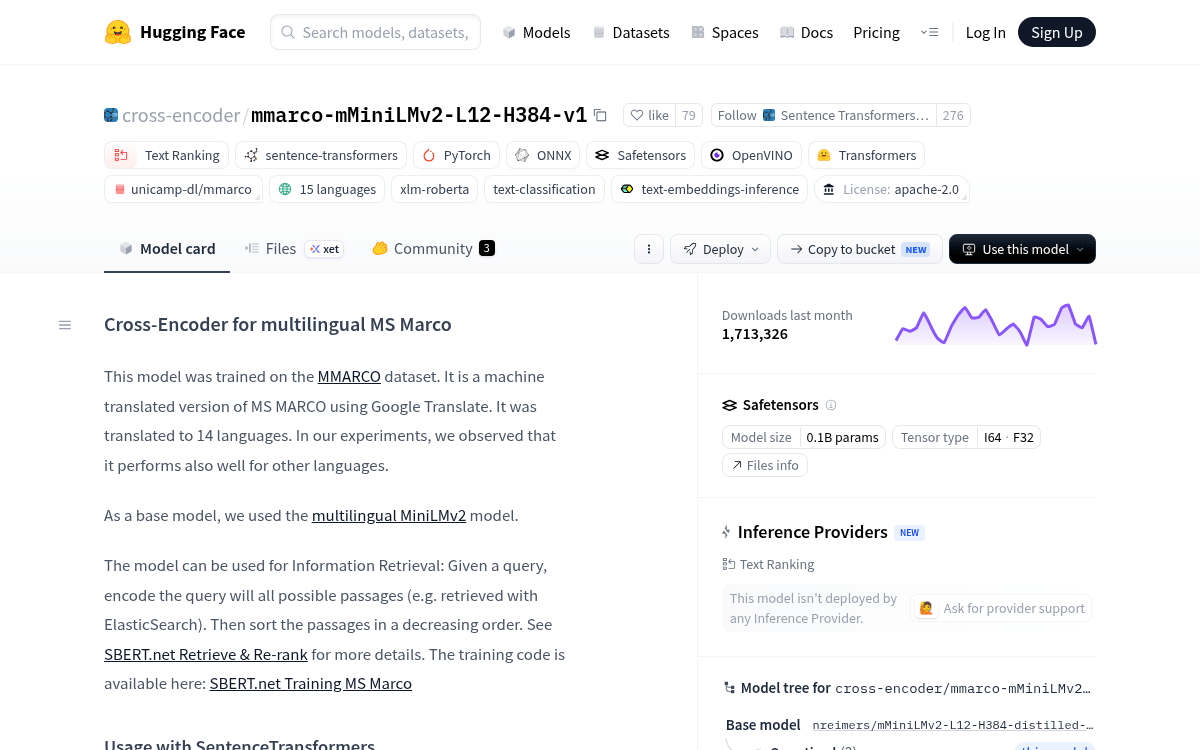
Takeaways
- Multilingual cross-encoder reranker on Hugging Face hits 1.7M monthly downloads.
- Covers 14 languages via mMARCO, machine-translated MS MARCO passage ranking data.
- Base model is mMiniLMv2-L12-H384 distilled from XLM-RoBERTa Large.
- Only 100M parameters, competitive with rerankers 5.4x its size.
- Ships with PyTorch, ONNX, Safetensors, and OpenVINO weights under Apache 2.0.
- Designed for retrieve-and-rerank pipelines, not first-stage retrieval or long documents.
A small multilingual cross-encoder has become one of the most downloaded reranking models on Hugging Face, and it is worth understanding why it keeps showing up inside retrieval-augmented generation stacks. The cross-encoder/mmarco-mMiniLMv2-L12-H384-v1 model handles query-passage relevance scoring across 14 languages with a footprint of roughly 100M parameters, and it now pulls in more than 1.7 million downloads a month while sitting under an Apache 2.0 license.
What it actually does
A cross-encoder reranker takes a query and a candidate passage together as input and returns a single relevance score. That differs from a bi-encoder, which embeds queries and passages separately for vector search. Cross-encoders run slower because they cannot precompute passage vectors, but they judge far more accurately whether a specific passage answers a specific query.
The intended pipeline follows the standard retrieve-and-rerank pattern: pull a few hundred candidates from a first-stage retriever such as BM25, Elasticsearch, or a dense embedding index, then score each candidate against the query with this model and sort. You get the recall of cheap retrieval with the precision of a transformer that reads both texts jointly.